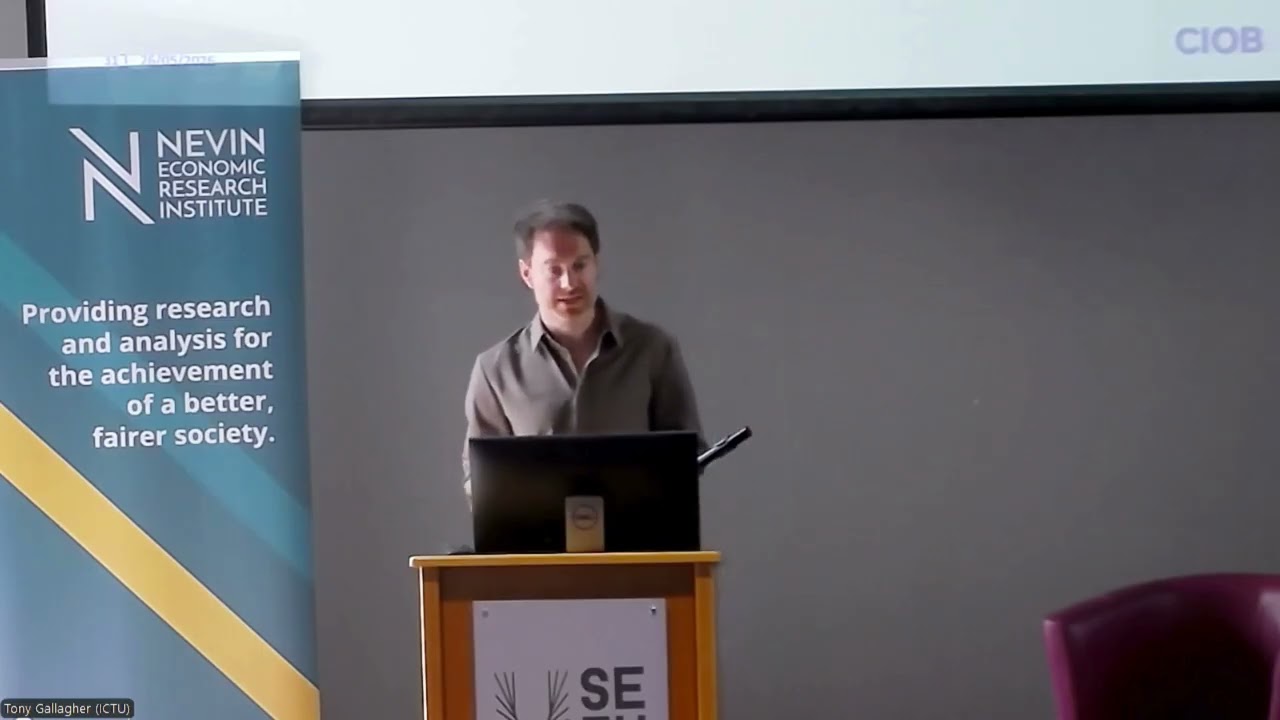
14th Annual NERI Labour Market Conference - Session 1C - Resilience - Mr.Joseph Kilroy
Keywords
Summary
146 words
Critical Evaluation
Value of the Information & Strength of the Argument
The presentation offers valuable insights into the potential of building adaptability to address intertwined issues of vacancy and housing shortage. The argument is well-structured, moving from context to evidence, examples, and policy recommendations. The speaker supports claims with specific data (e.g., vacancy rates, carbon savings) and references to existing frameworks and international examples. However, the argumentation is somewhat one-sided, focusing on benefits without deeply addressing potential challenges or counterarguments.
Scientific Rigor, Source Quality, Title Accuracy
The presentation demonstrates scientific rigor by referencing a published paper, specific data sources (GeoDirectory, Central Bank), and established frameworks (EU LEVEL(s)). The title accurately reflects the content. The speaker is a professional from the Chartered Institute of Building, adding credibility. However, the talk is a conference presentation and does not provide full methodological details or peer review.
141 words
Title / Content Match
The title accurately describes the content: a session on resilience at the NERI Labour Market Conference, featuring Joseph Kilroy's presentation on building adaptability.
Quality & Reliability
7/10
The presentation is based on a published paper by the Chartered Institute of Building (CIOB) and references specific data sources (GeoDirectory, Central Bank) and frameworks (EU LEVEL(s)). The speaker is a professional in the construction sector. However, the talk is a conference presentation and does not provide full methodological details or peer review.
Key Moments
Markers derived by PSI from the transcript: the creator did not define chapters.
- Introduction and context: Ireland's built environment, high commercial vacancy, and housing undersupply.
- Historical examples of building adaptability: Parthenon, Amsterdam canals, Manhattan.
- Present bias in construction: form rigidly relates to function, leading to obsolete buildings.
- Data on office vacancy in Dublin and other Irish cities; impact of remote work and tech sector contraction.
- Proposal: introduce adaptability metrics into planning permission, using EU LEVEL(s) framework.
- International examples: London, Paris, Amsterdam; visuals of converted buildings.
- Why Ireland is suitable: demographics, infrastructure, governance tools.
- Policy recommendations: mandate adaptability assessments, require conversion scenarios, promote MMC, use public land.
Cited Sources
- NERI Labour Market Conference Presentations — Link to the presentation slides and related materials for the conference session.
Concurring Sources
- GeoDirectory — Source of commercial vacancy data cited in the presentation.
- Central Bank of Ireland — Source of data on office vacancy trends in Dublin.
Contribution & Novelties
The presentation offers a concrete policy proposal to integrate building adaptability metrics into planning processes, specifically tailored to Ireland’s context. It synthesizes existing research and examples into actionable recommendations, emphasizing the dual benefit of addressing vacancy and housing supply. The novelty lies in the specific application to Ireland’s current crisis and the suggestion to use the EU LEVEL(s) framework as a tool.
Pour aller plus loin :
- EU LEVEL(s) framework — Official EU framework for measuring building sustainability, including adaptability.
- Urban doom loop concept — Wikipedia article explaining the phenomenon of urban decline due to vacancy and reduced tax revenue.
- Modern Methods of Construction (MMC) — Wikipedia article on MMC, which includes modular construction and its benefits for adaptability.
119 words
Radar Profile
The radar profile shows high scores in quality of information and reliability, reflecting the use of specific data and a published paper. The quantity of information is moderate, and the technical level is moderate, indicating a presentation accessible to a professional audience but not overly technical. The overall profile suggests a well-grounded expert opinion.