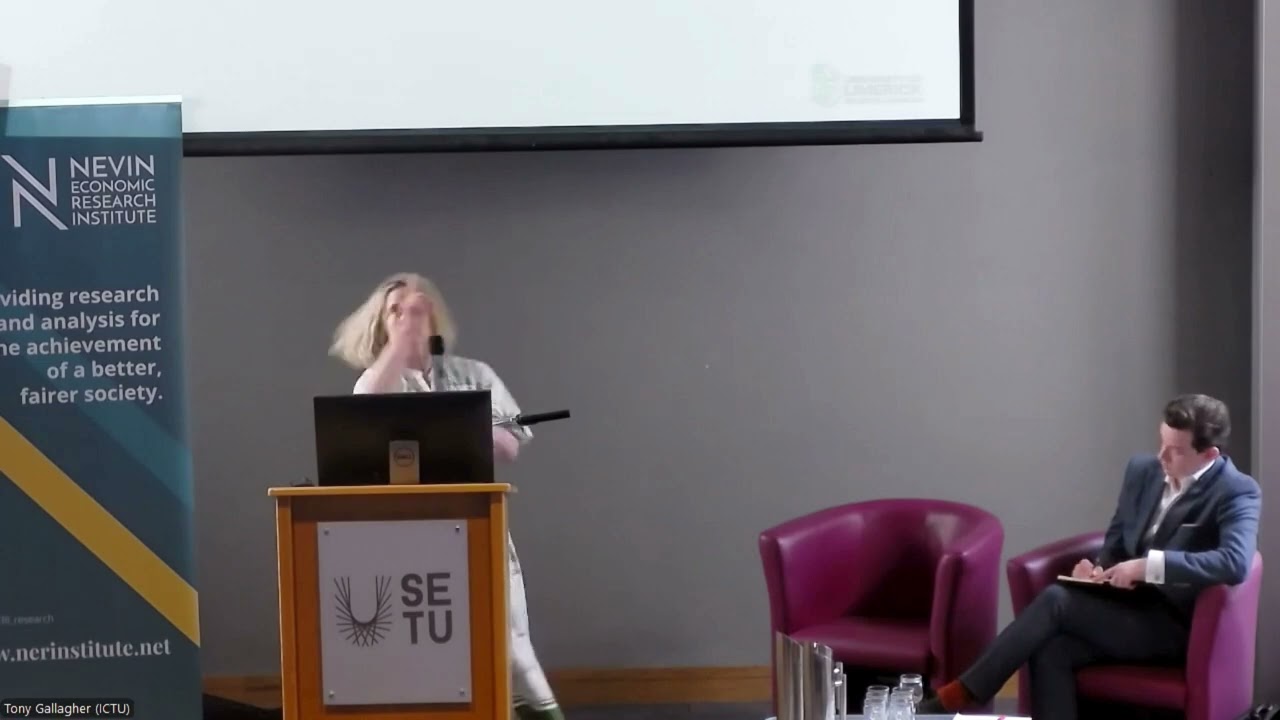
14th Annual NERI Labour Market Conference - Session 4A - Workers Rights’ - Dr. Michelle O'Sullivan
Keywords
Summary
110 words
Critical Evaluation
Value of the Information & Strength of the Argument
The presentation provides valuable insights into the current state of anti-unionism in Ireland, updating previous research with recent data. The argumentation is solid, based on a mixed-methods approach (survey and interviews) and references to established literature. The typology of employer approaches adds nuance to the binary view of union recognition. The speaker effectively argues that despite some changes, union recognition remains difficult and that employers use a variety of tactics, including subtle ones like ‘slick HR’. The discussion of the EU directive and its potential impact is timely and relevant.
Scientific Rigor, Source Quality, Title Accuracy
The research is presented with methodological rigor, including a survey distributed through the Irish Congress of Trade Unions and interviews with 32 union officials from 11 unions. The study builds on prior work by D’Arcy and Turner and uses a framework from Roy and Gregor Gall. The title accurately reflects the content, focusing on workers’ rights and anti-union tactics. The presentation is part of a conference, so sources are cited verbally and in the accompanying slides, which are available via the provided link. The adequacy between title and content is high.
196 words
Title / Content Match
The title accurately reflects the content, which is a session on workers' rights focusing on anti-union tactics in Ireland.
Quality & Reliability
8/10
Presentation of original research based on a survey and interviews with union officials, with clear methodology and references to prior studies. The speaker is an academic from the University of Limerick, and the work is funded by a reputable foundation. However, the video is a conference presentation, so details are limited and not peer-reviewed in this format.
Key Moments
Markers derived by PSI from the transcript: the creator did not define chapters.
- Introduction and background on union representation and EU directive
- Survey methodology and findings on union recognition difficulty
- Most prolific union busting tactics: stonewalling and access prevention
- Qualitative comments on worker fear and apathy
- Introduction of typology: silent assassins, double-breasters, double standard, hostile unionized
- Detailed explanation of 'slick HR' and marginalization in unionized firms
- Union officials' policy preferences and hopes for EU directive
- Conclusion on lack of institutional support and democratic consequences
Cited Sources
- Presentations from the 14th Annual NERI Labour Market Conference — Link to the presentation slides and other conference materials.
Concurring Sources
- D'Arcy and Turner (2003) study on anti-unionism in Ireland — Referenced as the baseline study from 20 years ago, showing similar findings.
Contribution & Novelties
This presentation contributes original empirical evidence on anti-union tactics in Ireland, updating a 20-year-old study and providing a nuanced typology of employer approaches. It highlights the persistence of union recognition difficulties and the subtle ways employers marginalize unions even in recognized firms. The research also connects to broader EU policy discussions on collective bargaining and minimum wages.
Pour aller plus loin :
- EU Directive on Adequate Minimum Wages — Official text of the directive, relevant to the discussion on collective bargaining.
- International Labour Organization on Collective Bargaining — Overview of collective bargaining rights and standards.
- Friedrich Ebert Foundation — Funder of the survey, with resources on labor and social policy.
110 words
Radar Profile
The radar profile shows high scores across all dimensions, indicating a well-rounded presentation with substantial information, strong quality, and high technical level. The fiabilite is also high, reflecting the academic rigor of the research.