NERI Seminar: The Pink-Collar Trap: Occupational Segregation and Gendered Vulnerability to AI
Keywords
Summary
226 words
Critical Evaluation
Value of the Information & Strength of the Argument
The value of the information is high, as it addresses a timely and important issue: the gendered impact of AI on labor markets. The research combines empirical facts with a structural model, providing a rigorous framework to analyze counterfactual scenarios. The argumentation is solid: the speaker clearly defines concepts, uses data to motivate the model, and explains the mechanisms behind the results. The finding of a compositional masking effect is particularly insightful, highlighting the danger of analyzing aggregate gender gaps. The model’s limitations are acknowledged, such as the simplified demand side, but the overall argument is compelling and well-structured.
Scientific Rigor, Source Quality, Title Accuracy
The presentation demonstrates scientific rigor through the use of established measures (AIOE from Felten et al., complementarity from Pizzinelli and Cazzaniga), and references key literature (Autor, Levy, Murnane; Goldin; Acemoglu et al.). The data source (PNAD) is appropriate for the research question. The title accurately reflects the content, focusing on occupational segregation and gendered vulnerability to AI. The speaker is a PhD student, and the research is presented as work in progress, which is appropriate for a seminar. The sources cited are relevant and credible, though the research is not yet peer-reviewed.
206 words
Title / Content Match
The title accurately reflects the content, focusing on occupational segregation and gendered vulnerability to AI.
Quality & Reliability
8/10
The seminar presents original research with a clear methodology, using Brazilian household survey data and a structural model. The speaker is a PhD candidate, and the presentation includes detailed model calibration and robustness considerations. However, the research is preliminary and not yet peer-reviewed, and the model's demand side is still being enhanced.
Key Moments
Markers derived by PSI from the transcript: the creator did not define chapters.
- Introduction by chairperson, Dr. Tom McDonnell, and speaker introduction.
- Motivation: quote from Autor, Levy, Murnane (2003) on non-routine cognitive tasks and the impact of generative AI.
- Definition of AI exposure and complementarity, with examples (office clerk vs. teacher).
- Literature review: AI and jobs, previous automation and women's labor market outcomes.
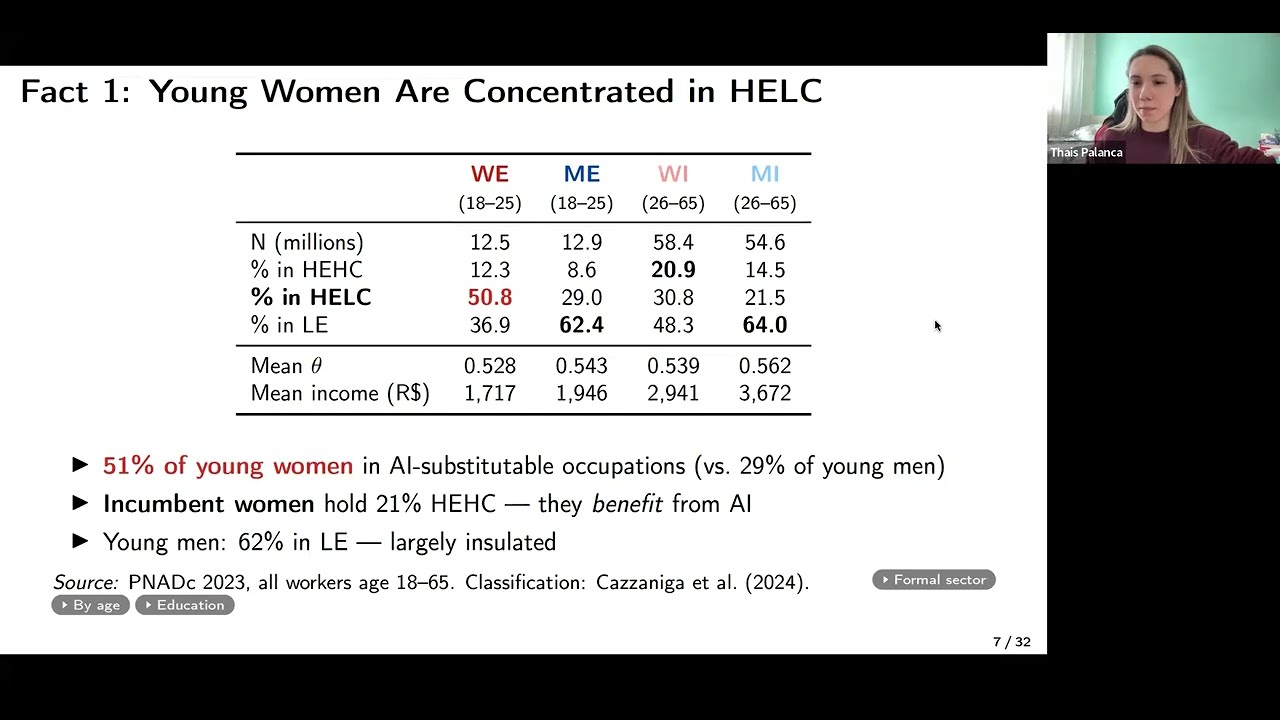
- Research question and main findings: concentration of young women in AI-substitutable occupations.
- Data description: PNAD survey, facts on occupational concentration and stickiness.
- Structural model: Roy-style discrete choice with switching costs and educational barriers.
- AI shock and wage formation, calibration, and simulation results.
- Results: gap widening for entrants, masking effect for incumbents, and policy implications.
- Q&A session begins.
Cited Sources
- The Pink-Collar Trap: Occupational Segregation and Gendered Vulnerability to AI (working paper) — The paper presented in the seminar.
- Autor, Levy, Murnane (2003) - The Skill Content of Recent Technological Change: An Empirical Exploration — Referenced for the concept of routine-biased technical change.
- Felten, Raj, Seamans (2021) - Occupational, Industry, and Geographic Exposure to Artificial Intelligence — Source for AI occupational exposure measure.
- Pizzinelli and Cazzaniga (IMF) - Complementarity measure — Source for complementarity dimension.
- Acemoglu, Autor, Hazell, Restrepo (2022) - AI and Jobs: Evidence from Online Vacancies — Referenced for evidence on AI and jobs.
- Goldin (1984) - The Historical Role of Women in the Labor Force — Referenced for the historical entry of women into pink-collar occupations.
Concurring Sources
- Acemoglu, Autor, Hazell, Restrepo (2022) - AI and Jobs — Supports the finding of limited aggregate effects but compositional changes.
- Felten et al. (2021) - AI exposure measures — Provides the exposure measure used in the study.
Dissenting Sources
- Studies showing AI has no effect on gender gaps — The speaker notes that aggregate studies may miss the compositional masking effect, which could explain why some studies find no gender impact.
Contribution & Novelties
The seminar presents original research that combines empirical facts with a structural model to analyze the gendered impact of AI on labor markets. The key novelty is the identification of a compositional masking effect, where aggregate gender gaps hide the divergent experiences of young and incumbent women. The model incorporates switching costs and educational barriers, providing a realistic framework for policy analysis. The finding that retraining 35% of non-degree women eliminates the gap widening offers a concrete policy lever.
Pour aller plus loin :
- AI and Jobs: Evidence from Online Vacancies — Relevant for understanding AI’s impact on hiring and employment.
- The Skill Content of Recent Technological Change: An Empirical Exploration — Foundational paper on routine-biased technical change.
- Occupational, Industry, and Geographic Exposure to Artificial Intelligence — Source for AI exposure measures.
- Goldin’s work on women’s labor force participation — Historical context for women’s entry into pink-collar occupations.
148 words
Radar Profile
The radar profile shows high scores in information quantity, quality, and reliability, with a slightly lower technical level. This indicates a well-researched and credible presentation, though the technical complexity may be moderate for a general audience.
💬 No comments were provided for analysis.