Energy flow networks for jet quenching studies
Keywords
Summary
187 words
Critical Evaluation
Value of the Information & Strength of the Argument
The presentation provides valuable insights into the application of machine learning to jet quenching studies. The speaker systematically compares different approaches, from linear models to advanced neural networks, and quantifies their performance using AUC. He clearly explains the importance of including realistic background effects and medium response in simulations, which is often overlooked. The argumentation is solid, with results presented in a logical progression and supported by quantitative comparisons. The speaker also acknowledges limitations and open questions, which adds to the credibility of the work.
Scientific Rigor, Source Quality, Title Accuracy
The speaker references several papers, including the original energy flow polynomials paper (2018) and the moment energy flow networks paper. He also mentions a recent paper on the effects of medium response and underlying event. However, specific citations are not provided in the video description, and the speaker does not give full references during the talk. The title accurately reflects the content, and the presentation is scientifically rigorous, with a clear methodology and quantitative results. The speaker demonstrates a good understanding of both the physics and the machine learning aspects.
190 words
Title / Content Match
The title accurately reflects the content, which focuses on the application of energy flow networks to jet quenching studies.
Quality & Reliability
8/10
The presentation is based on original research, with a clear methodology, quantitative results, and references to published work. The speaker demonstrates a good understanding of the physics and the machine learning techniques. However, the work is presented as ongoing research with some results not yet published, and the speaker acknowledges uncertainties and open questions.
Key Moments
Markers derived by PSI from the transcript: the creator did not define chapters.
- Introduction and outline of the presentation.
- Introduction to heavy-ion collisions and quark-gluon plasma.
- Discussion of jets as probes of QGP and the challenge of discriminating vacuum-like vs quenched jets.
- Importance of including underlying event and medium response in simulations.
- Introduction to energy flow polynomials (EFPs) and their properties.
- Baseline results with linear models and EFPs.
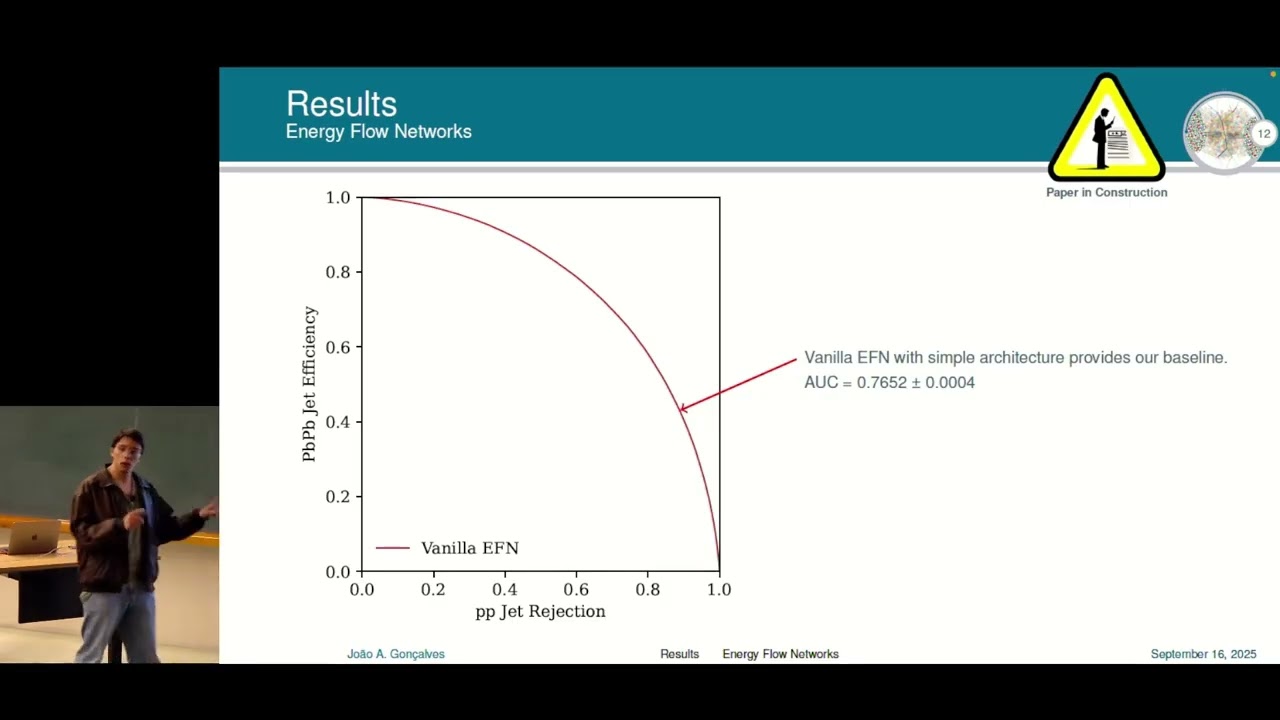
- Improvement with deep neural networks and energy flow networks.
- Adding global jet observables and particle distances to EFNs.
- Introduction to moment energy flow networks (MEFNs) and their potential.
- Results with MEFNs: latent space dimension and moments.
- Interpretation of latent space and future work.
- Conclusions and Q&A session.
Cited Sources
- Energy flow polynomials: A complete linear basis for jet substructure — Referenced as the origin of energy flow polynomials (EFPs) and their properties.
- Energy flow networks: Deep sets for particle jets — Referenced as the original paper introducing energy flow networks (EFNs).
- Moment energy flow networks — Referenced as the recent extension of EFNs using higher moments.
Concurring Sources
- Energy flow polynomials: A complete linear basis for jet substructure — Provides the theoretical basis for the observables used in the study.
- Energy flow networks: Deep sets for particle jets — Introduces the architecture that is the focus of the presentation.
Dissenting Sources
- None — No discordant sources were mentioned in the presentation.
Contribution & Novelties
The presentation contributes to the field by systematically evaluating the performance of energy flow networks (EFNs) and their extensions for jet quenching discrimination, with a particular focus on including realistic background effects. The speaker shows that adding global jet observables and particle distances to EFNs can improve discrimination power. He also explores moment energy flow networks (MEFNs), which use higher moments of the latent space distribution, and demonstrates that they can achieve comparable performance to larger EFNs with fewer latent dimensions, potentially improving interpretability. The work highlights the importance of considering underlying event contamination and medium response in simulations to obtain physically meaningful results.
Pour aller plus loin :
- Jet quenching in heavy-ion collisions — Overview of jet quenching phenomenon.
- Quark–gluon plasma — Background on the medium studied.
- Deep Sets — Theoretical foundation for permutation-invariant networks used in EFNs.
139 words
Radar Profile
The radar profile shows high scores in all dimensions, indicating a technically advanced and reliable presentation. The strongest aspects are the technical level and information quality, while the overall reliability is also high, reflecting the speaker's expertise and the use of established methods.
💬 No comments were provided for analysis.