Parton distribution from NTK analysis - Amedeo CHIEFA
Keywords
Summary
238 words
Critical Evaluation
Value of the Information & Strength of the Argument
The talk provides valuable insights into the learning dynamics of neural networks in the context of PDF extraction. The argumentation is solid, with a clear derivation of the NTK-based analytic solution and supporting numerical experiments. The speaker carefully explains the assumptions and limitations, such as the lazy regime. The work is original and contributes to the understanding of bias and uncertainty in neural network-based PDF fits.
Scientific Rigor, Source Quality, Title Accuracy
The scientific rigor is high, with a clear methodology and validation via closure tests. The speaker mentions collaboration with Luigi Del Debbio and Richard Kenway, but no specific references are given in the talk. The title accurately reflects the content. The talk is a conference presentation, so the work may not be peer-reviewed yet, but the approach is well-founded.
140 words
Title / Content Match
The title accurately reflects the content, which focuses on the use of NTK analysis for parton distributions.
Quality & Reliability
7/10
The talk presents original research on the application of Neural Tangent Kernel (NTK) analysis to parton distribution functions (PDFs). The methodology is clearly explained, and the results are supported by numerical experiments. However, the talk is a conference presentation and does not provide full details of the validation, and the work is not yet peer-reviewed.
Key Moments
Markers derived by PSI from the transcript: the creator did not define chapters.
- Introduction to PDFs and factorization formula
- Inverse problem and discretization
- Bayesian vs parametric regression, NNPDF approach
- Introduction to NTK and gradient flow
- NTK spectrum and kernel structure
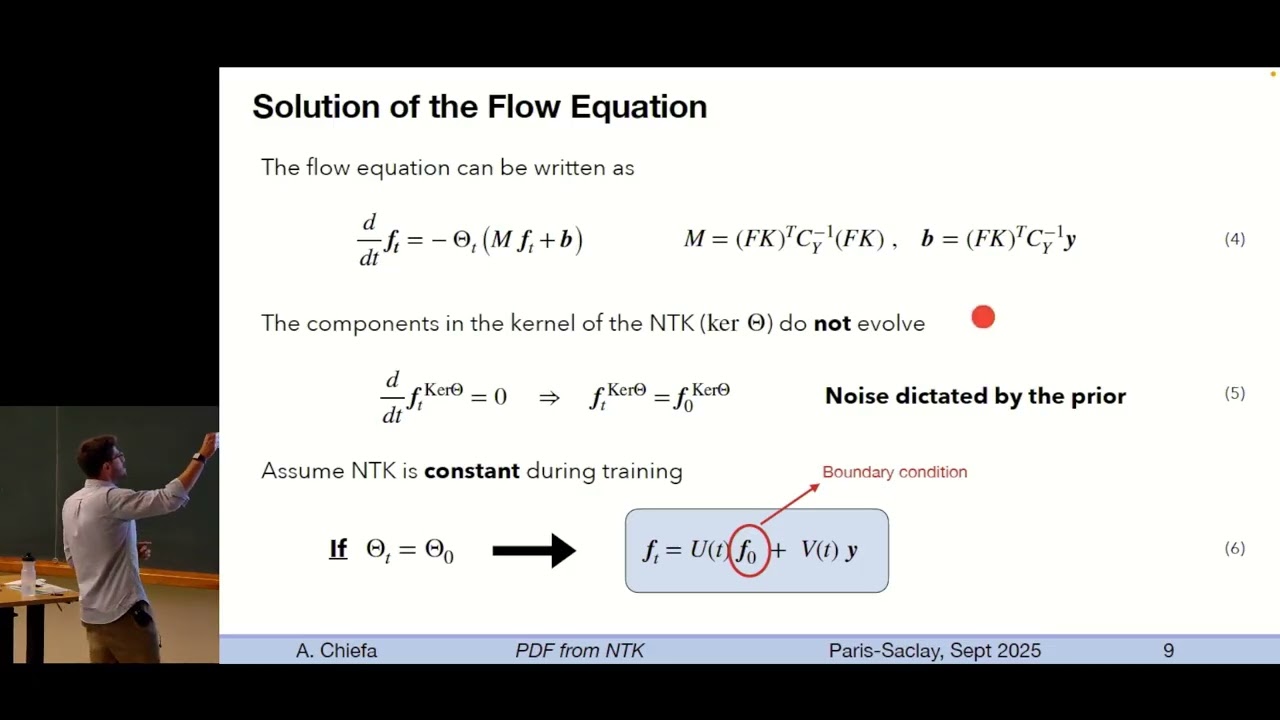
- Analytic solution in lazy regime
- Validation with closure tests and NTK evolution
- Alignment of NTK with physics and data
- Factorization of parameterization and data contributions
- Conclusions and future directions
Contribution & Novelties
The talk presents a novel application of NTK analysis to PDF determination, providing a new perspective on the learning process of neural networks in this context. The analytic solution in the lazy regime allows for a decomposition of contributions from the parameterization and the data, offering insights into bias and uncertainty. This could lead to improved monitoring and potential acceleration of training.
Pour aller plus loin :
- Neural Tangent Kernel — Overview of the NTK concept.
- Parton distribution function — Background on PDFs.
- NNPDF collaboration — Official site of the NNPDF collaboration, which uses neural networks for PDF determination.
99 words
Radar Profile
The radar profile shows high scores in technical level and information quantity, indicating a specialized and dense presentation. The quality and reliability scores are moderate, reflecting the original but not yet peer-reviewed nature of the work. The overall balance suggests a technically strong talk with room for further validation.