Uncertainty in AI driven physical simulation - Dimitrios TZIVRALIS - CEA LPTMS
Keywords
Summary
184 words
Critical Evaluation
Value of the Information & Strength of the Argument
The value of the information is high for researchers in computational physics and machine learning, as it addresses a critical issue of reliability in ML-accelerated simulations. The argumentation is solid: the presenter clearly identifies the problem (noise accumulation), provides a theoretical justification (Gaussian noise and penalty method), and supports it with numerical results. However, the talk is concise and lacks in-depth analysis of failure cases or comparisons with other uncertainty quantification methods. The presenter also honestly notes that the method is not yet computationally advantageous, which tempers the practical value.
Scientific Rigor, Source Quality, Title Accuracy
The scientific rigor is adequate: the methodology is reproducible, and the results are presented with clear figures. However, the talk does not cite specific references in the slides, and the presenter mentions ‘references’ but does not list them in the description. The title accurately reflects the content. The Q&A reveals that the penalty method has theoretical support, but the presenter does not provide formal proofs or citations. Overall, the work appears sound but would benefit from peer-reviewed publication and more detailed documentation.
187 words
Title / Content Match
The title accurately reflects the content, which focuses on uncertainty in AI-driven physical simulation.
Quality & Reliability
7/10
The presentation is a research talk at a conference, presenting original work. The methodology is clearly described, and the results are supported by numerical experiments. However, the talk is short and lacks detailed derivations or peer-reviewed references, and the presenter acknowledges limitations in runtime and precision.
Key Moments
Markers derived by PSI from the transcript: the creator did not define chapters.
- Introduction and motivation: using ML potentials in Monte Carlo simulations.
- Presentation of the XY model and the Metropolis algorithm.
- Introduction of the RCNN model and its use to approximate gradients.
- Demonstration of discrepancies in observables due to ML noise.
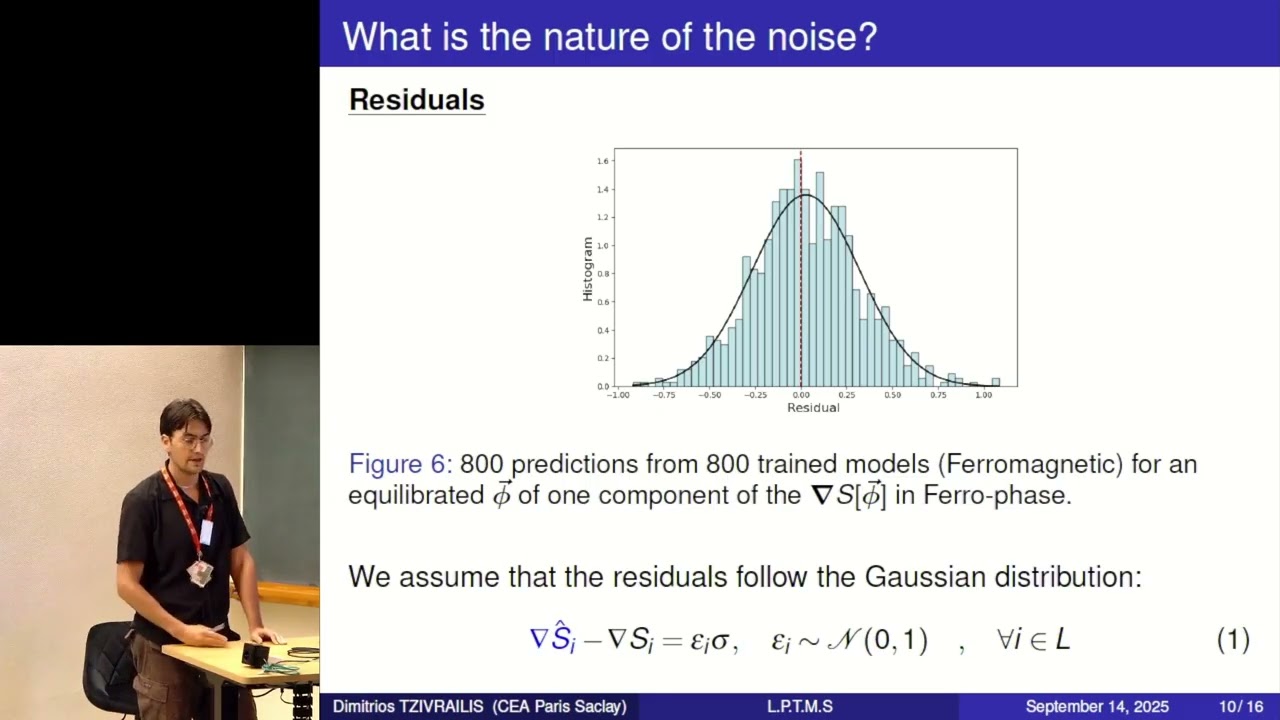
- Proposal of the penalty method based on Gaussian noise.
- Ensemble method to estimate variance and correct sampling.
- Results showing recovery of correct distributions near criticality.
- Conclusion and references.
- Q&A: discussion on noise accumulation and systematic discrepancies.
- Q&A: theoretical support and computational cost.
Contribution & Novelties
The talk presents a novel approach to handle uncertainty in ML-accelerated Monte Carlo simulations by using an ensemble of neural networks to estimate the noise variance and applying a penalty term in the acceptance probability. This is a practical solution to a known problem, but the presenter does not claim groundbreaking novelty; rather, it is an application of existing ideas (e.g., penalty methods) to a specific context. The work is original in its application to lattice field theory and provides a clear demonstration of the issues and a potential fix.
Pour aller plus loin :
- Metropolis–Hastings algorithm — Background on the sampling method used.
- Convolutional neural network — The architecture used for the ML model.
- Uncertainty quantification — General field addressing uncertainty in models.
- Lattice field theory — The context of the XY model.
- Ensemble learning — The method used to estimate variance.
143 words
Radar Profile
The radar profile shows high scores in technical level and information quality, reflecting the specialized and rigorous nature of the talk. The lower score in information quantity is due to the short duration and limited scope. The overall fiabilite is good, but the lack of cited sources and peer review prevents a perfect score.