Uncertainty quantification for deep learning in astroparticle physics - Christian GLASER
Keywords
Summary
171 words
Critical Evaluation
Value of the Information & Strength of the Argument
The talk provides valuable insights into the practical application of uncertainty quantification in a high-stakes scientific field. Glaser argues convincingly that uncertainty estimates are essential in physics and demonstrates how deep learning can be combined with normalizing flows to obtain full posterior distributions. He supports his points with concrete examples from real experiments, showing both successes and challenges. The argumentation is logical and well-structured, progressing from simple to complex methods. He also addresses potential pitfalls, such as biases in simulations and the need for calibration, which strengthens the credibility of his presentation.
Scientific Rigor, Source Quality, Title Accuracy
The talk demonstrates scientific rigor by referencing established experiments (Pierre Auger, IceCube) and published techniques (normalizing flows, nflows library). However, the description lacks explicit citations or links to specific papers, which limits the verifiability of the sources. The title accurately reflects the content, and the talk is well-aligned with the stated topic. The speaker’s expertise is evident, and he provides practical advice for implementation, which adds to the reliability of the information.
179 words
Title / Content Match
The title accurately reflects the content, which focuses on uncertainty quantification techniques for deep learning applied to astroparticle physics.
Quality & Reliability
8/10
The talk is a technical lecture by an expert in astroparticle physics, presenting established methods and recent advances in uncertainty quantification for deep learning. It references specific observatories (Pierre Auger, IceCube) and published work, but lacks formal citations or peer-reviewed references in the description.
Key Moments
Markers derived by PSI from the transcript: the creator did not define chapters.
- Introduction to astroparticle physics and cosmic rays.
- Pierre Auger Observatory example: deep learning for cosmic ray reconstruction.
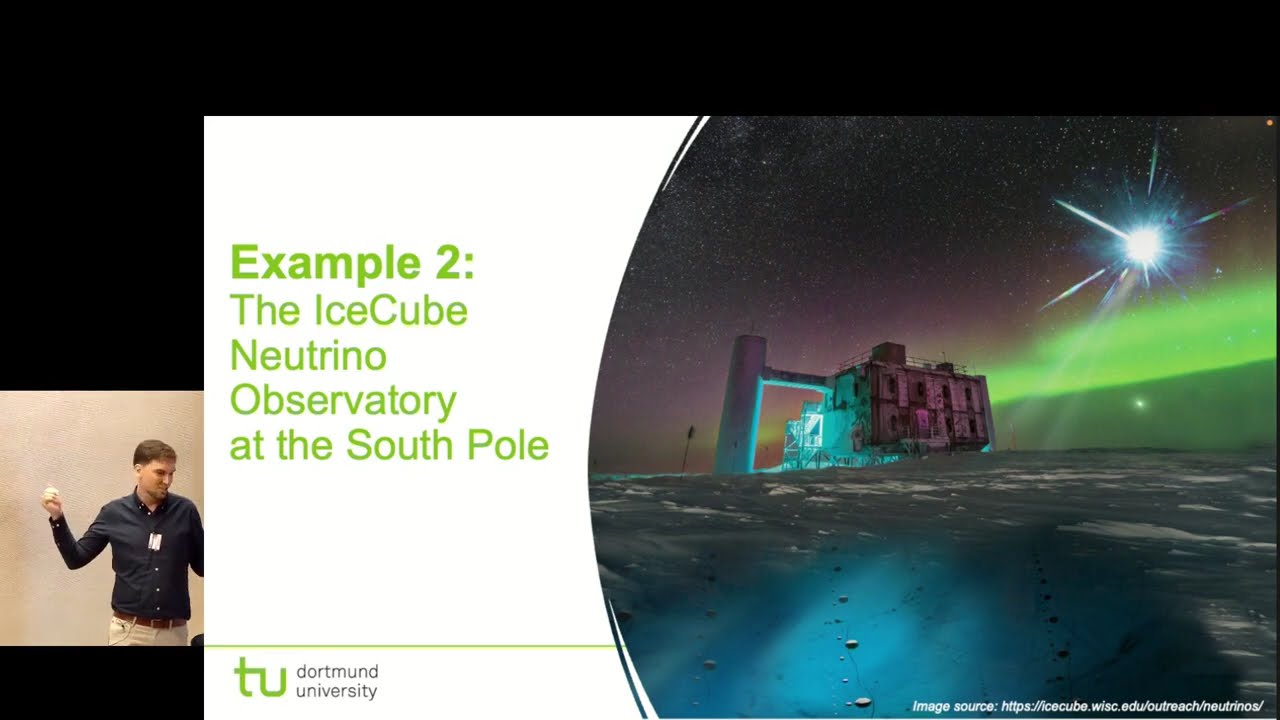
- IceCube Neutrino Observatory and the first neutrino observation of the Milky Way.
- Challenges in uncertainty quantification for neutrino direction reconstruction.
- Simple uncertainty estimation methods: average and parameterized uncertainties.
- Predicting uncertainty parameters with neural networks and Gaussian loss.
- Introduction to normalizing flows for full posterior estimation.
- Implementation details and the nflows library.
- Application to IceCube: improving angular resolution and uncertainty estimation.
- Conclusion and future prospects for neutrino source discovery.
Cited Sources
- nflows: normalizing flows in PyTorch — Mentioned as a library for implementing normalizing flows.
Concurring Sources
- nflows: normalizing flows in PyTorch — The library is mentioned as a tool for implementing normalizing flows, which aligns with the talk's content.
Contribution & Novelties
The talk provides a comprehensive overview of uncertainty quantification methods for deep learning in astroparticle physics, with a focus on normalizing flows. It highlights practical applications and challenges, offering a valuable resource for researchers in the field. The speaker’s emphasis on the importance of uncertainty estimation and the potential for new discoveries is compelling.
Pour aller plus loin :
- Normalizing Flows for Probabilistic Modeling and Inference — A comprehensive review of normalizing flows.
- Conditional Normalizing Flows — Paper on conditional normalizing flows.
- IceCube Neutrino Observatory — Official website with information on the observatory.
- Pierre Auger Observatory — Official website with information on the observatory.
104 words
Radar Profile
The radar profile shows high scores across all dimensions, indicating a well-rounded and informative talk. The strong performance in technical depth and reliability suggests it is suitable for an expert audience, while the balanced scores in information quantity and quality reflect a comprehensive coverage of the topic.