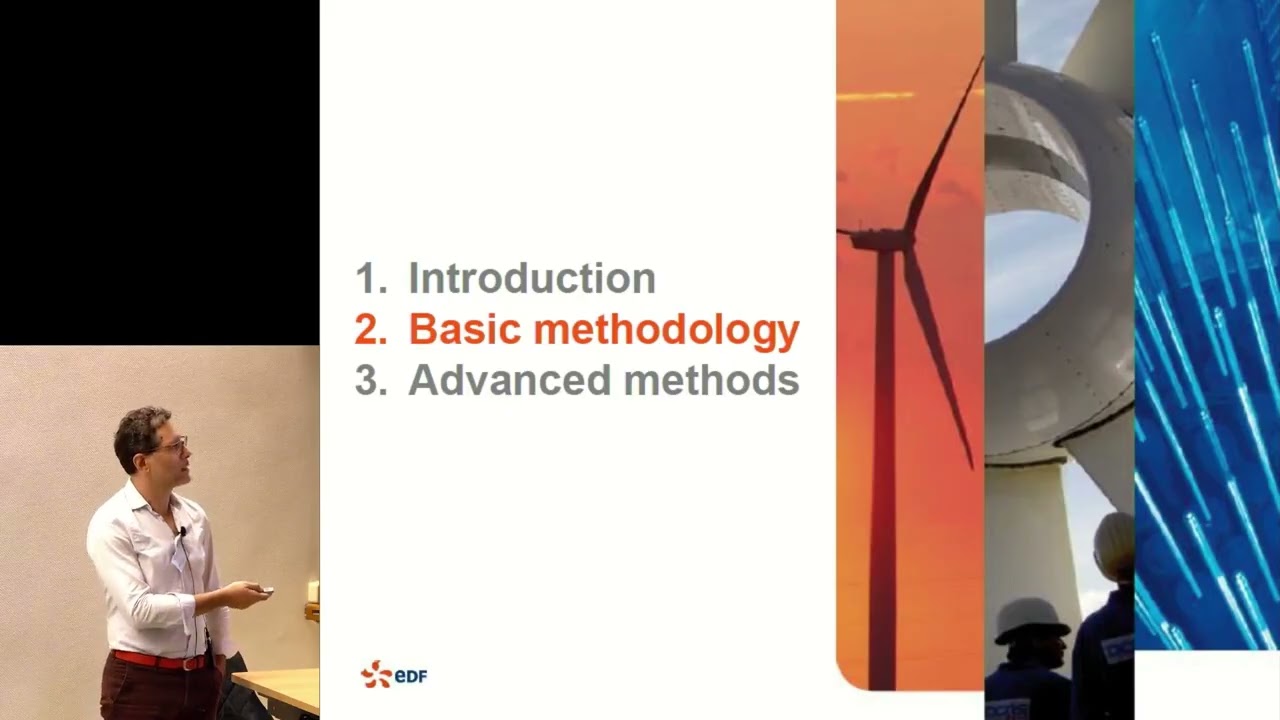
Quantifying uncertainties in computer models An overview - Merlin KELLER - EDF R&D
Keywords
Summary
152 words
Critical Evaluation
Value of the Information & Strength of the Argument
The talk provides a high-level but comprehensive overview of UQ methodology, emphasizing practical applicability in industrial settings. The argumentation is clear and logical, building from motivation to methodology to advanced topics. The speaker effectively illustrates concepts with real-world examples from nuclear safety and hydrology, enhancing credibility. The value lies in its synthesis of established methods and its emphasis on a unified framework that can be applied across various problems. The argumentation is solid, though it does not delve into deep technical details, which is appropriate for an overview talk.
Scientific Rigor, Source Quality, Title Accuracy
The talk demonstrates scientific rigor by referencing established guidelines (e.g., NRC guides, metrology guides) and mentioning collaborative efforts with academic and industrial partners. The speaker mentions specific tools (OpenTURNS, Persalys, Uranie) and publications, though no direct URLs are provided in the description. The title accurately reflects the content, which is a broad overview of UQ. The talk is well-structured and credible, though it lacks explicit citations to specific papers, which is common for such overview presentations.
180 words
Title / Content Match
The title accurately reflects the content: a comprehensive overview of uncertainty quantification in computer models.
Quality & Reliability
8/10
Talk by an expert from EDF R&D, presenting established UQ methodology and referencing institutional guidelines and tools. No formal peer review, but high practical authority.
Key Moments
Markers derived by PSI from the transcript: the creator did not define chapters.
- Introduction and motivation for UQ in numerical simulations
- Challenges in UQ for nuclear safety and asset management
- Overview of the unified UQ methodology and its steps
- Step 1: Defining the quantity of interest (QoI)
- Step 2: Probabilistic modeling of uncertain inputs, including copulas and extreme value theory
- Step 3: Uncertainty propagation methods (Taylor, Monte Carlo, rare event simulation)
- Step 4: Sensitivity analysis - screening and global sensitivity measures
- Advanced methods: meta-models, robust optimization, and open questions
- Conclusion and summary of key takeaways
Cited Sources
Concurring Sources
- OpenTURNS — The talk mentions OpenTURNS as a tool for UQ; the official documentation confirms its capabilities.
Contribution & Novelties
The talk provides a clear and structured overview of UQ methodology, synthesizing established techniques into a practical framework for industrial applications. It emphasizes the importance of each step and highlights common pitfalls, such as the need for careful probabilistic modeling and the distinction between central and tail quantities. The presentation is valuable for engineers and researchers new to UQ, offering a roadmap for implementation.
Pour aller plus loin :
- Uncertainty quantification - Wikipedia — Provides a general overview of UQ concepts and methods.
- Sobol indices - Wikipedia — Details on variance-based sensitivity analysis, a key topic in the talk.
- Copula (probability theory) - Wikipedia — Explains copulas, which are used for modeling dependence in the talk.
116 words
Radar Profile
The radar profile shows high scores in information quantity, quality, and reliability, with a slightly lower technical depth, reflecting the overview nature of the talk. The balance suggests a solid, accessible introduction to UQ.
💬 No comments were provided for analysis.