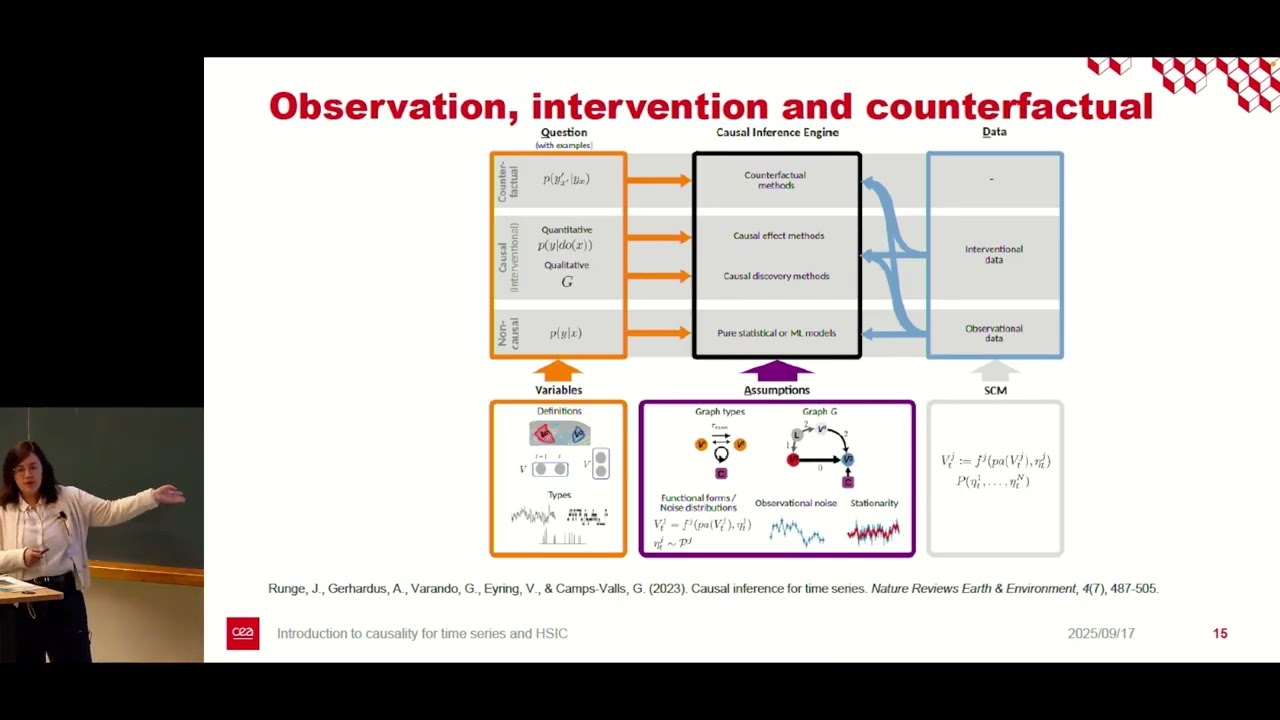
Introduction to causality for time series and HSIC
Keywords
Summary
139 words
Critical Evaluation
Value of the Information & Strength of the Argument
The talk provides a valuable overview of causal discovery for time series, clearly explaining key concepts and their relevance. The argumentation is solid, using examples (uranium vs. PhDs, yellow jersey) to illustrate correlation vs. causation and intervention vs. observation. The speaker effectively motivates the need for causality beyond prediction, and the discussion of HSIC and its adaptation to time series is informative. However, the talk is introductory and does not delve deeply into technical details or proofs, which may limit its value for advanced audiences. The quizzes engage the audience and reinforce understanding.
Scientific Rigor, Source Quality, Title Accuracy
The talk demonstrates scientific rigor by referencing foundational works (Pearl, Granger, Gretton) and recent papers, though specific citations are not provided in the description. The content is consistent with established literature on causal discovery and kernel methods. The title accurately reflects the content, which is a concise introduction to causality for time series with a focus on HSIC. The presentation is well-structured and the speaker acknowledges limitations, such as the need for assumptions like causal sufficiency. No public comments were provided for analysis.
191 words
Title / Content Match
The title accurately reflects the content: the talk introduces causality concepts for time series and focuses on the HSIC independence test.
Quality & Reliability
7/10
The talk provides a solid introduction to causal discovery for time series, covering key concepts (SCM, d-separation, PC/PCMCI) and kernel-based independence tests (HSIC). It references foundational works (Pearl, Granger, Gretton) and recent developments, but lacks detailed citations and in-depth technical derivations. The presentation is clear and well-structured, with illustrative examples and quizzes, but the scientific depth is limited to an overview.
Key Moments
Markers derived by PSI from the transcript: the creator did not define chapters.
- Introduction and overview of causality definitions
- Difference between correlation and causation with examples
- Motivation for causality in AI and time series
- Structural causal models and do-calculus
- Causal graphs for time series and assumptions
- d-separation and Markov condition
- Constraint-based algorithms: PC and PCMCI
- Kernel methods and HSIC for independence testing
- Challenges in time series: autocorrelation and computational complexity
- Recent work on conditional independence and conclusion
Cited Sources
- Causality: Models, Reasoning, and Inference — Pearl's book on causal inference, referenced for do-calculus and structural causal models.
- Investigating Causal Relations by Econometric Models and Cross-spectral Methods — Granger's seminal paper on Granger causality, mentioned in the talk.
- Measuring Statistical Dependence with Hilbert-Schmidt Norms — Gretton et al.'s paper introducing HSIC, discussed in the talk.
Concurring Sources
- Causality: Models, Reasoning, and Inference — Pearl's framework aligns with the talk's presentation of do-calculus and SCMs.
- Investigating Causal Relations by Econometric Models and Cross-spectral Methods — Granger causality is discussed as a prediction-based approach, consistent with the talk.
- Measuring Statistical Dependence with Hilbert-Schmidt Norms — HSIC is presented as a kernel-based independence test, matching the talk's focus.
Contribution & Novelties
The talk provides a clear and accessible introduction to causal discovery for time series, bridging classical concepts with modern kernel-based methods. It emphasizes the importance of distinguishing correlation from causation and highlights specific challenges in time series, such as autocorrelation and computational complexity. The discussion of HSIC and its adaptation to time series, including the use of random features for approximation, offers practical insights. The talk also touches on recent developments in conditional independence testing using functional data and signature kernels.
Pour aller plus loin :
- Causal Discovery — Overview of methods and challenges.
- Hilbert-Schmidt Independence Criterion — Detailed explanation of HSIC.
- Granger causality — Foundational concept in time series causality.
- Structural Causal Model — Background on SCMs.
- Kernel methods — General introduction to kernel-based techniques.
126 words
Radar Profile
The radar profile shows a balanced performance across all dimensions, with slightly higher scores in information quantity and quality, and lower in technical depth. This indicates a well-rounded introductory talk that is informative and reliable, but not highly technical.