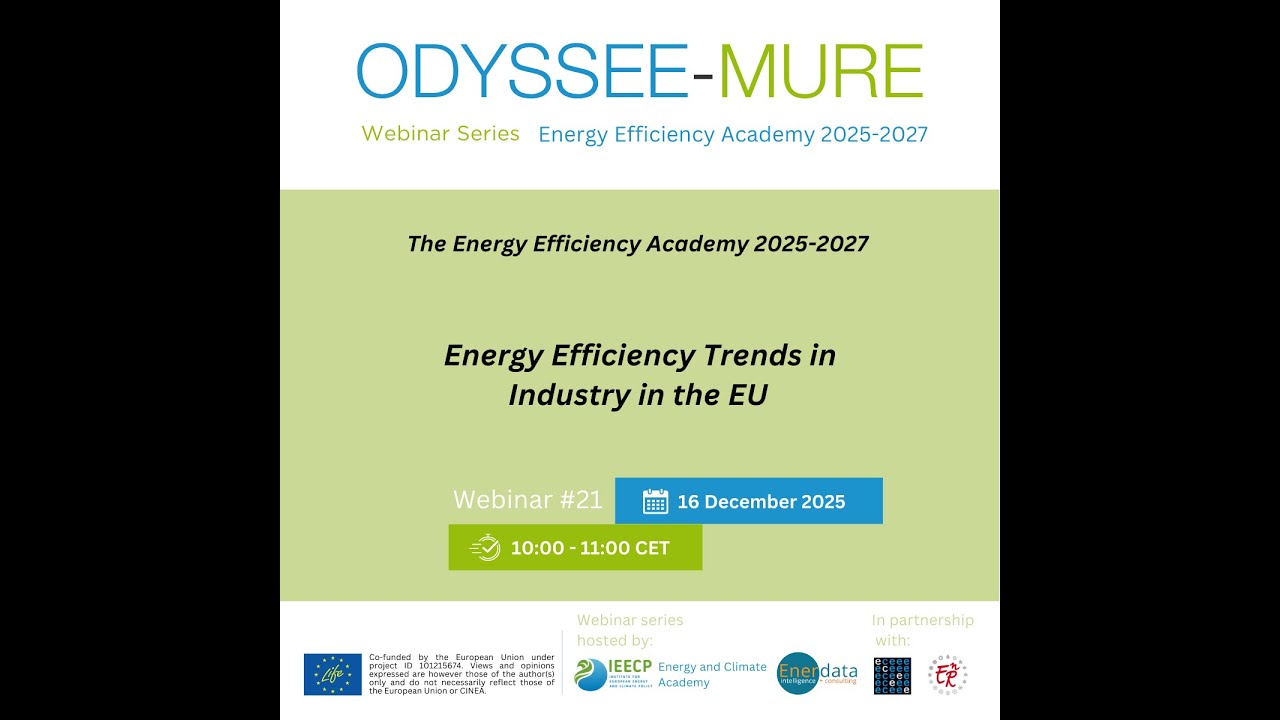
Energy Efficiency Trends in Industry in the EU | ODYSSEE-MURE Energy Efficiency Academy
Keywords
Summary
178 words
Critical Evaluation
Value of the Information & Strength of the Argument
The webinar provides valuable insights into energy efficiency trends in EU industry, backed by comprehensive data from the ODYSSEE database. The presenters clearly explain the methodology, including the ODEX index and decomposition analysis, and support their arguments with charts and examples. They also address limitations and ongoing improvements, enhancing the credibility of the analysis. The argumentation is solid, though some parts are technical and may require prior knowledge.
Scientific Rigor, Source Quality, Title Accuracy
The webinar is scientifically rigorous, relying on data from the ODYSSEE-MURE project, which is co-funded by the EU and involves a network of national partners. The presenters are experts in energy efficiency indicators. The title accurately reflects the content. The description provides a link to the ODYSSEE-MURE website for further information. No comments were provided for analysis.
140 words
Title / Content Match
The title accurately reflects the content: a webinar on energy efficiency trends in EU industry, presented by the ODYSSEE-MURE academy.
Quality & Reliability
8/10
The webinar is based on data from the ODYSSEE-MURE project, a well-established EU-funded initiative with a network of national partners. The methodology (ODEX index) is clearly explained and the presenters are experts in the field. However, the video is a recording of a live webinar with limited production values, and some data are preliminary estimates.
Key Moments
Markers derived by PSI from the transcript: the creator did not define chapters.
- Introduction and practical information about the webinar
- Overview of the ODYSSEE-MURE project and data sources
- Share of industry in total final consumption and trends
- Energy price evolution and its impact on consumption
- Introduction to ODEX index and energy efficiency measurement
- Energy efficiency progress by branch and overall EU trends
- Decomposition analysis of drivers of energy consumption change
- Discussion on structural changes and limitations, Q&A
Cited Sources
- ODYSSEE-MURE — Project website providing data and indicators on energy efficiency
Concurring Sources
- ODYSSEE-MURE — The project's own data and indicators align with the webinar's content.
Contribution & Novelties
The webinar provides an up-to-date analysis of energy efficiency trends in EU industry, using the ODEX index and decomposition analysis. It highlights the acceleration of efficiency gains post-2019 and discusses the role of energy prices and structural changes. The presenters also acknowledge limitations and ongoing methodological improvements, offering a nuanced view.
Pour aller plus loin :
- ODYSSEE-MURE — Official project website with detailed data and publications.
- Energy Efficiency Directive (EU) 2023/1791 — Relevant EU policy context.
- Eurostat energy data — Source of underlying energy statistics.
- International Energy Agency - Energy Efficiency — Global perspective on energy efficiency trends.
98 words
Radar Profile
The radar profile shows high scores in quantity and quality of information, with a slightly lower technical level, indicating a well-balanced presentation suitable for an informed audience. The overall reliability is strong, reflecting the use of established data sources.