Mechanistic and Neuroanatomic Bases of Disparity Between Arm Capacity and Use Post Stroke
Keywords
Summary
163 words
Critical Evaluation
Value of the Information & Strength of the Argument
The presentation provides valuable insights into a clinically relevant problem: the gap between arm capacity and actual use post-stroke. The speaker presents a clear theoretical framework and supports it with preliminary data. The argumentation is logical, building from established models (ICF) to propose a novel cognitive-motor interface model. The use of multiple assessment methods (AUT, actigraphy, VR) strengthens the approach. However, the results are preliminary, with small sample sizes and low prediction power in some analyses, limiting the strength of conclusions. The speaker acknowledges these limitations and outlines next steps, which is scientifically sound.
Scientific Rigor, Source Quality, Title Accuracy
The presentation demonstrates scientific rigor through detailed methodology, clear inclusion/exclusion criteria, and use of validated assessments. The speaker cites relevant literature (e.g., work by Dr. Laurel Buxbaum) and references a clinical trial showing capacity improvements not translating to daily use. The title accurately reflects the content. The description mentions support from the Shrier family but no other sources. No external sources are provided in the description, so the evaluation relies on the content itself. The speaker’s credentials and institutional affiliation add credibility.
191 words
Title / Content Match
The title accurately reflects the content, which focuses on the mechanistic and neuroanatomic bases of the disparity between arm capacity and use after stroke.
Quality & Reliability
8/10
Presentation of ongoing research with preliminary data, clear methodology, and transparent limitations. The speaker is a postdoctoral researcher with relevant credentials. The study is funded and follows established protocols, but results are preliminary and not yet peer-reviewed.
Key Moments
Markers derived by PSI from the transcript: the creator did not define chapters.
- Introduction of Dr. Gangwani and her background.
- Overview of the presentation objectives and the concept of use capacity disparity.
- Presentation of the ICF model and the gap between capacity and real-life arm use.
- Example of two participants with similar impairment but different arm use.
- Introduction of the theoretical model of use capacity disparity at the cognitive-motor interface.
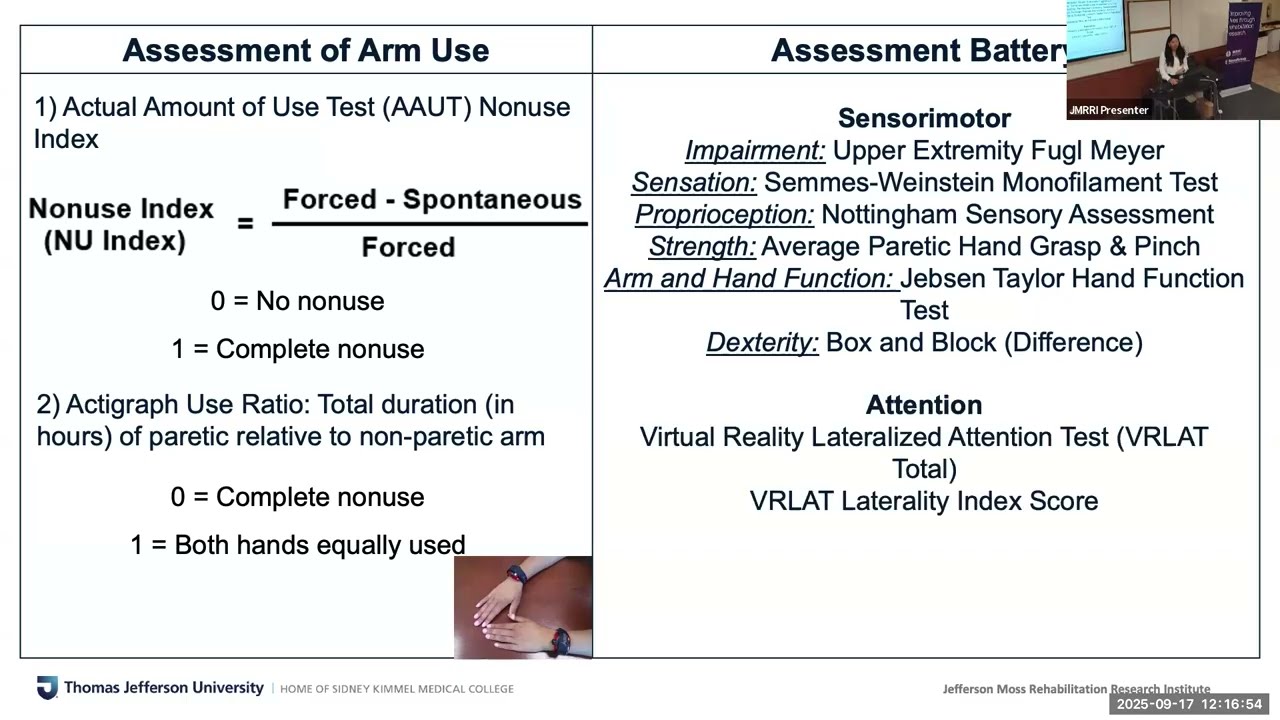
- Description of the Actual Amount of Use (AUT) test and non-use index.
- Preliminary study by Dr. Buxbaum identifying predictors of arm non-use.
- Overview of the current study aims and methods.
- Preliminary results from aim 1: predictors of AUT non-use index and actigraph use ratio.
- Introduction of the VR task for assessing arm use and efficiency.
- Validation of the VR task: concurrent and discriminant validity.
- Results on arm use under cognitive and motor demands, and inter-individual variability.
- Next steps and conclusion.
Contribution & Novelties
This presentation offers a novel perspective on post-stroke arm non-use by integrating cognitive and motivational factors into the traditional sensorimotor framework. The development of a naturalistic VR task to assess arm use and efficiency under varying demands is an innovative contribution. The preliminary findings suggest that attention and apathy are significant predictors of arm non-use, which could inform future rehabilitation strategies.
Pour aller plus loin :
- International Classification of Functioning, Disability and Health (ICF) — Framework for understanding disability and functioning.
- Virtual reality in stroke rehabilitation — Review of VR applications in stroke rehabilitation.
- Learned non-use phenomenon — Concept related to reduced use of affected limb after stroke.
108 words
Radar Profile
The radar profile shows high scores in information quantity, quality, and reliability, with a slightly lower technical level. This indicates a well-structured presentation with substantial content, appropriate for a scientific seminar, but not overly technical for a broader audience.