Shrier Family Topics In Rehabilitation Science Seminar: Dr. Anna Volkmer, April 2026
Keywords
Summary
220 words
Critical Evaluation
Value of the Information & Strength of the Argument
The presentation provides valuable insights into the development of a novel intervention for PPA, addressing a gap in clinical practice. The argumentation is solid, grounded in systematic review, co-design methodology, and pilot trial data. The speaker acknowledges limitations and the need for further research, enhancing credibility. The use of conversation analysis and behavior change theory is well-justified, and the emphasis on co-production with patients is a strength.
Scientific Rigor, Source Quality, Title Accuracy
The scientific rigor is high, with references to systematic reviews, pilot trials, and international consensus methods. The speaker cites specific studies and frameworks, though detailed citations are not provided in the video. The title accurately reflects the seminar’s content, focusing on the development and trialing of interventions. The presentation is well-structured and evidence-based, though it primarily represents the speaker’s expert opinion and preliminary findings.
146 words
Title / Content Match
The title accurately reflects the seminar format and the speaker's focus on developing and trialing interventions for PPA.
Quality & Reliability
8/10
Presentation by a clinical academic with 25 years of experience, based on systematic review, co-design with patients, and pilot trial data. The speaker is transparent about limitations and ongoing work.
Key Moments
Markers derived by PSI from the transcript: the creator did not define chapters.
- Introduction of Dr. Anna Volkmer by Sharon.
- Volkmer's background and motivation for research.
- Definition of dementia and primary progressive aphasia (PPA).
- Explanation of the three variants of PPA and their pathologies.
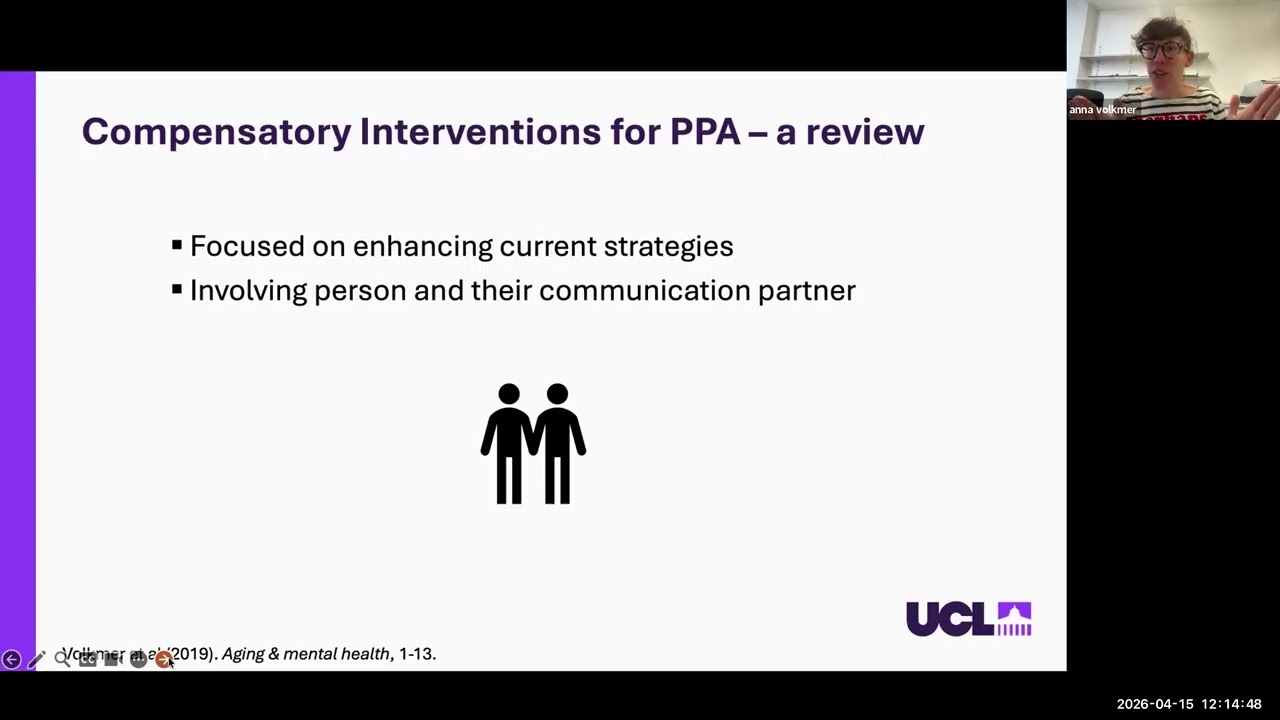
- Systematic review of compensatory interventions and survey of speech therapists.
- Development of the Better Conversations with PPA intervention.
- Pilot trial results and challenges.
- International core outcome set study and future directions.
Cited Sources
- UCL Better Conversations with PPA — Mentioned as hosting the intervention materials for trained speech therapists.
Concurring Sources
- Gorno-Tempini et al. (2011) Classification of primary progressive aphasia — Referenced as the international criteria for PPA variants.
Contribution & Novelties
The presentation contributes to the field by detailing a co-designed, conversation-focused intervention for PPA, addressing a gap in existing therapies. It emphasizes the importance of involving patients and families in intervention development and using video feedback to promote behavior change. The pilot trial provides preliminary evidence of feasibility and effectiveness.
Pour aller plus loin :
- Primary progressive aphasia - Wikipedia — Overview of PPA and its variants.
- Conversation analysis - Wikipedia — Theoretical basis for the intervention.
- Behavior change theory - Wikipedia — Framework used in the intervention.
88 words
Radar Profile
The radar profile shows high scores across all dimensions, indicating a well-rounded and reliable presentation. The strongest areas are information quality and reliability, reflecting the speaker's expertise and evidence-based approach. The weakest is technical level, which is moderate, making it accessible to a broad audience.