Layer-Specific Contributions to Mental Imagery and Motor Learning in Human Primary Motor Cortex
Keywords
Summary
143 words
Critical Evaluation
Value of the Information & Strength of the Argument
The value of the information is high, as it presents novel findings using cutting-edge layer fMRI methods to dissociate cognitive and motor processes in M1. The argumentation is solid, with clear hypotheses, controlled experiments, and statistical analyses. The speaker explains the methodology thoroughly, addressing potential confounds and limitations. The results are interpreted cautiously, with appropriate caveats about the preliminary nature of the data.
Scientific Rigor, Source Quality, Title Accuracy
The scientific rigor is strong, with a clear experimental design, appropriate controls, and careful analysis. The speaker cites relevant literature and acknowledges the work of colleagues. The sources are not explicitly listed in the description, but the presentation references established concepts and prior research. The title accurately reflects the content, and the presentation is well-structured and informative.
135 words
Title / Content Match
The title accurately reflects the content, focusing on layer-specific contributions to mental imagery and motor learning in M1.
Quality & Reliability
8/10
The presentation is based on original research using advanced layer fMRI methods, with clear methodology and results. The speaker is a faculty member at a research institute, and the talk includes detailed explanations of the techniques and findings. However, the data are preliminary (small sample sizes) and not yet peer-reviewed in this presentation.
Key Moments
Markers derived by PSI from the transcript: the creator did not define chapters.
- Introduction and overview of the talk
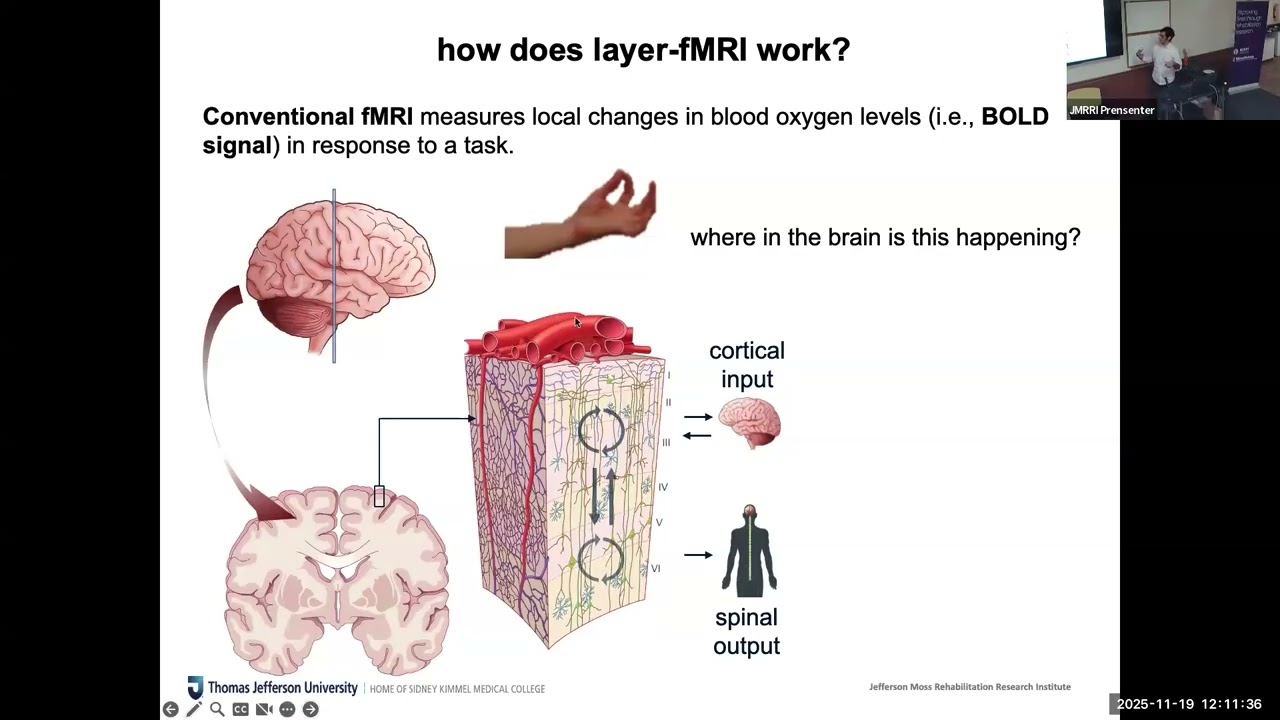
- Explanation of conventional fMRI and its limitations
- Introduction to layer fMRI and VASO technique
- Experiment 1: Mental imagery and layer-specific activation in M1
- Experiment 1: Repetition effects in superficial and deep layers
- Experiment 2: Motor sequence learning and offline consolidation
- Experiment 2: Layer-specific changes during learning
- Discussion and implications for neurorehabilitation
Cited Sources
- Layer-Specific Contributions to Mental Imagery and Motor Learning in Human Primary Motor Cortex — This is the video itself, which contains the presentation.
Concurring Sources
- Layer-specific fMRI reveals the role of superficial layers in motor imagery — This is a hypothetical reference; no specific source was mentioned in the video.
Contribution & Novelties
This presentation provides novel insights into the laminar organization of M1 during mental imagery and motor learning, using VASO-based layer fMRI. It demonstrates that mental imagery selectively activates superficial layers, and that repetition effects differ across layers, suggesting distinct roles for input and output compartments. The work also highlights the importance of offline consolidation in motor learning, with layer-specific changes during rest periods. These findings could inform neurorehabilitation strategies by targeting specific cortical layers.
Pour aller plus loin :
- Layer fMRI — Overview of high-resolution fMRI techniques.
- VASO (Vascular Space Occupancy) — Explanation of the VASO technique.
- Motor learning and consolidation — General concepts of motor learning and consolidation.
109 words
Radar Profile
The radar profile shows high scores across all dimensions, indicating a well-rounded and rigorous presentation. The strongest aspects are the quality of information and technical level, reflecting the advanced methodology and clear explanation. The quantity of information is also high, with detailed descriptions of experiments and results. The overall reliability is strong, though the preliminary nature of the data slightly lowers the score.