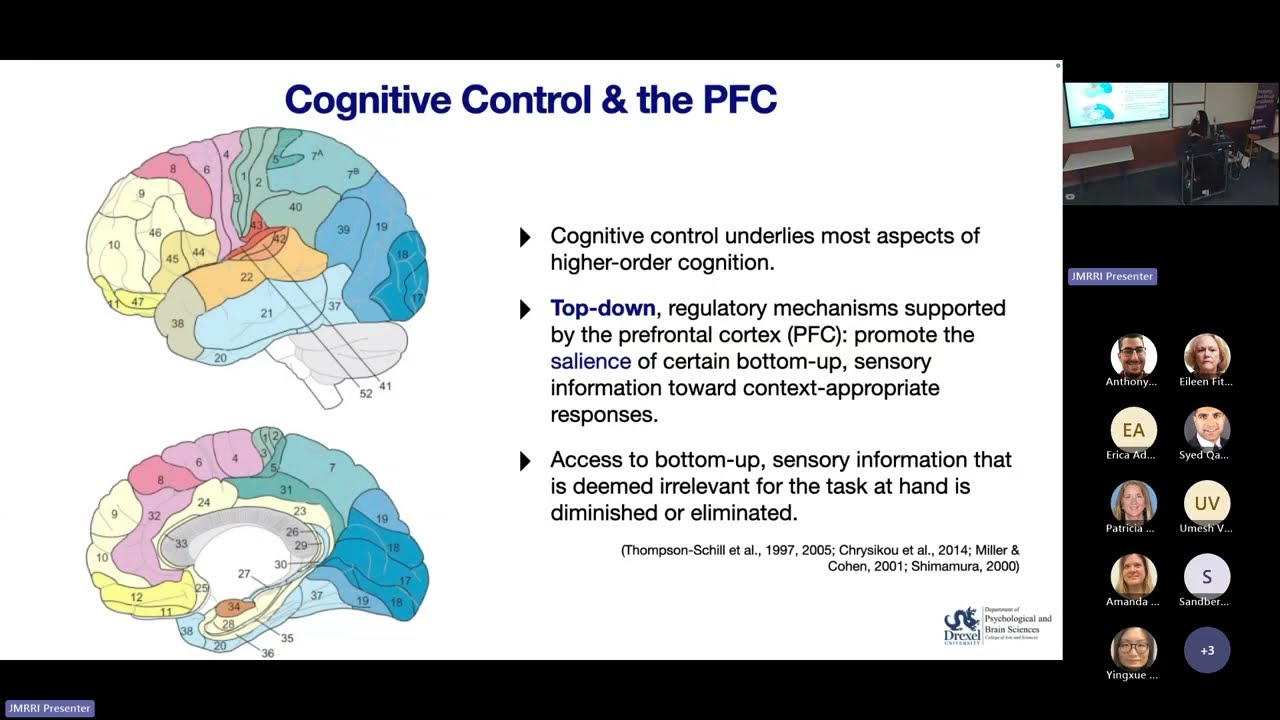
Shrier Family Topics In Rehabilitation Science Seminar: Dr. Evangelia Chrysikou, June 2026
Keywords
Summary
157 words
Critical Evaluation
Value of the Information & Strength of the Argument
The presentation provides valuable insights into the cognitive neuroscience of creativity and flexible object use. Dr. Chrysikou effectively argues that traditional models of semantic memory and cognitive control may not fully account for open-ended problem-solving. She supports her claims with data from her own lab and references to other studies, such as the work of Yoed Kenett and colleagues. The argumentation is coherent and well-structured, though some conclusions are presented as preliminary and require further validation.
Scientific Rigor, Source Quality, Title Accuracy
The talk demonstrates scientific rigor by grounding the research in established theories and citing relevant literature. Dr. Chrysikou references influential models, such as the distributed representation approach and the hub-and-spoke model, and discusses recent findings from network neuroscience. The title accurately reflects the content, which is a seminar presentation on her research. The sources cited are appropriate and credible, though the talk is not a formal publication and some claims are based on ongoing work.
166 words
Title / Content Match
The title accurately reflects the content, which is a seminar presentation by Dr. Chrysikou on her research on concepts and cognitive regulation.
Quality & Reliability
8/10
The presentation is given by a recognized expert in cognitive neuroscience, with a strong academic background and multiple publications. The talk is based on original research and established theories, but it is a seminar presentation rather than a peer-reviewed article, and some claims are presented as preliminary.
Key Moments
Markers derived by PSI from the transcript: the creator did not define chapters.
- Introduction and examples of flexible object use in everyday life
- Discussion of semantic memory models and ad hoc conceptualization
- Presentation of the matched filter hypothesis for cognitive control
- fMRI study on neural correlates of idea generation
- Network neuroscience study on generation and evaluation of ideas
- Conclusions and implications for rehabilitation
Cited Sources
- No specific sources cited in the video description — The description only mentions the support from Nancy and Marc Shrier.
Concurring Sources
- No concordant sources provided — No external sources were listed in the video description.
Dissenting Sources
- No discordant sources provided — No conflicting sources were mentioned.
Contribution & Novelties
The talk offers a novel perspective on the neural mechanisms of flexible object use, emphasizing the role of cognitive control and semantic memory in open-ended problem-solving. It integrates findings from fMRI and network neuroscience to propose that creativity involves a dynamic interplay between default mode and executive control networks. The matched filter hypothesis provides a framework for understanding when cognitive control is beneficial or detrimental.
Pour aller plus loin :
- Default mode network — Key network involved in spontaneous thought and creativity.
- Executive functions — Cognitive processes underlying goal-directed behavior.
- Semantic memory — Memory for general knowledge and concepts.
99 words
Radar Profile
The radar profile shows high scores across all dimensions, indicating a well-rounded and reliable presentation. The talk is rich in information, technically detailed, and based on credible research, with a strong overall quality.