Visiting Scholar Lecture: Dr. Rutvik H. Desai, June 2026
Keywords
Summary
212 words
Critical Evaluation
Value of the Information & Strength of the Argument
The lecture provides valuable insights into the ongoing debate about the ATL’s role. Desai presents a compelling argument against the hub-and-spoke model by systematically showing that ATL damage or stimulation affects verbal but not non-verbal semantic tasks. The use of multiple methodologies (lesion mapping, tDCS, fMRI) strengthens the argument. He acknowledges limitations, such as the executive demands of the pyramids and palm trees task, and develops a new task to address this. The argumentation is logical and well-supported by data, though it represents a single research group’s perspective. The proposed alternative model is testable and offers a novel interpretation of existing findings.
Scientific Rigor, Source Quality, Title Accuracy
The talk is scientifically rigorous, with clear descriptions of methods and results. Desai references multiple studies, including his own and others, and discusses conflicting evidence, such as dissociations between semantic deficits and surface alexia. The title accurately reflects the content, focusing on the lexical vs. semantic distinction. The sources cited are primarily from peer-reviewed literature, though specific citations are not always explicitly named in the talk. The description provides no additional links, so the sources cited are based on the speaker’s references. The talk does not include a public Q&A, so no comment trends are available.
213 words
Title / Content Match
The title accurately reflects the content, which focuses on the role of the anterior temporal lobe in lexical versus semantic processing.
Quality & Reliability
8/10
Presentation by a leading researcher in cognitive neuroscience, based on multiple peer-reviewed studies including lesion-symptom mapping, tDCS, and fMRI. The talk is well-structured, transparent about methods and limitations, and provides a balanced view of competing models. However, it is a single expert's perspective and not a systematic review.
Key Moments
Markers derived by PSI from the transcript: the creator did not define chapters.
- Introduction of Dr. Rutvik Desai by the host.
- Desai begins talk on semantic memory and its importance.
- Overview of models of semantic memory, including hub-and-spoke.
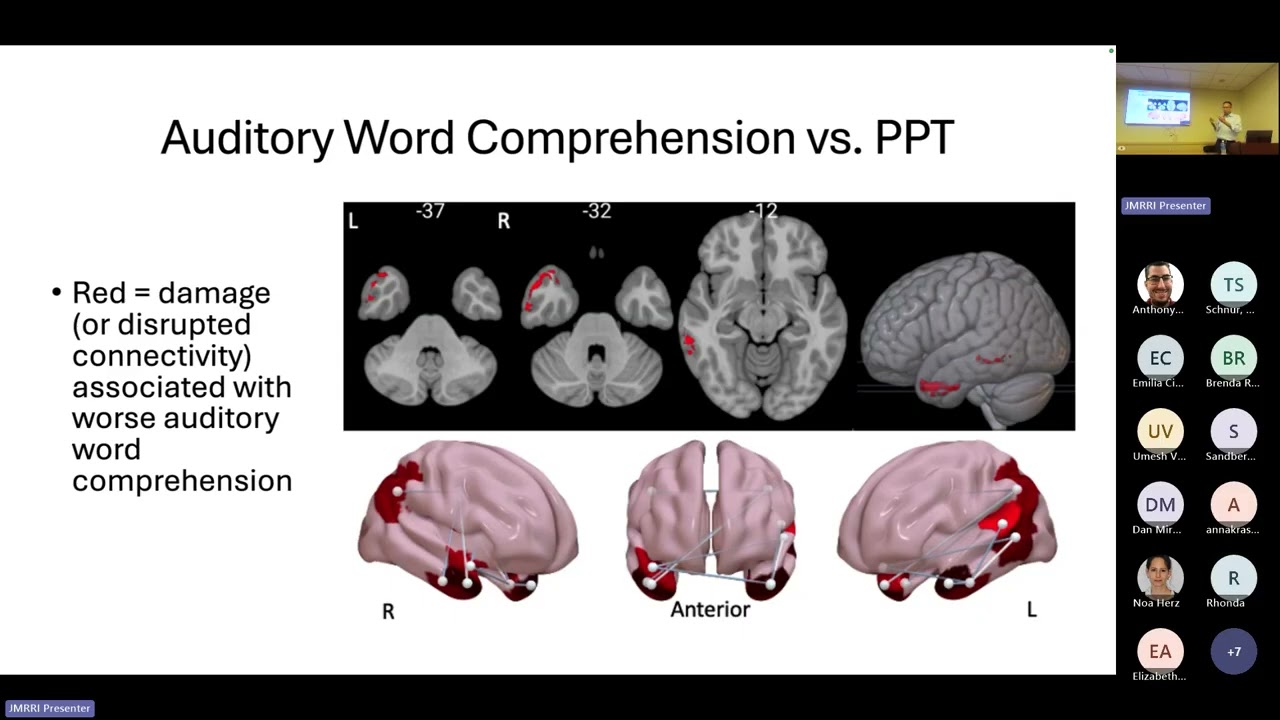
- Description of lesion-symptom mapping study with 79 stroke survivors.
- Results: left ATL damage affects verbal tasks but not non-verbal semantic task.
- Introduction of tDCS studies and new picture plausibility task.
- tDCS results: ATL stimulation affects verbal but not non-verbal semantic task.
- tDCS study on lexical decision and word-picture matching showing opposite effects across modalities.
- Word naming study: ATL stimulation produces surface alexia-like effects.
- Proposal of revised model: ATL as mapping between word forms and semantics, not semantic hub.
- Discussion of implications for classic models of word production and conclusion.
Cited Sources
- Hub and spoke model (Rogers et al., 2004) — Referenced as the most prominent model of ATL function.
- Dual route model (e.g., Gainotti, 2014) — Mentioned as an alternative view distinguishing left and right ATL.
- Unique entities (e.g., Tranel, 2006) — Discussed in relation to ATL damage and deficits.
- Lesion-symptom mapping study (Desai et al., 2022) — Described in detail as the first study presented.
- tDCS studies (Desai et al., 2023, 2024) — Described as the second and third studies.
- fMRI study (Desai et al., 2025) — Mentioned as the fourth study.
Concurring Sources
- Rogers et al. (2004) - Hub and spoke model — The model that Desai challenges, but it is the starting point for his argument.
- Patterson et al. (2007) - Where do you know what you know? — A key paper supporting the hub-and-spoke model, which Desai's findings contradict.
- Lambon Ralph et al. (2017) - The neural and computational bases of semantic cognition — A recent review supporting the hub-and-spoke model, providing a contrast to Desai's view.
Dissenting Sources
- Patterson et al. (2007) - Where do you know what you know? — This paper argues that the ATL is a semantic hub, which Desai's findings directly challenge.
- Lambon Ralph et al. (2017) - The neural and computational bases of semantic cognition — A comprehensive review that supports the hub-and-spoke model, contradicting Desai's proposal.
Contribution & Novelties
The lecture offers a novel perspective on the ATL, challenging the widely held hub-and-spoke model. Desai synthesizes evidence from multiple studies to argue that the ATL is not a semantic hub but rather a region involved in mapping between word forms and semantics. This is a significant contribution to the field, as it reconciles conflicting findings and proposes a testable alternative. The development of a new non-verbal semantic task (picture plausibility) is also a methodological innovation.
Pour aller plus loin :
- Semantic memory — Provides background on the concept of semantic memory.
- Anterior temporal lobe — Overview of the brain region and its proposed functions.
- Transcranial direct-current stimulation — Explanation of the tDCS technique used in the studies.
- Surface dyslexia — Related to the reading deficits discussed.
- Levelt’s model of speech production — Classic model referenced in the talk.
139 words
Radar Profile
The radar profile shows high scores across all dimensions, indicating a well-rounded and reliable presentation. The strongest aspects are the quality of information and technical level, reflecting the depth of the research presented. The slightly lower score for quantity of information is due to the focused scope of the talk, which is appropriate for a lecture.