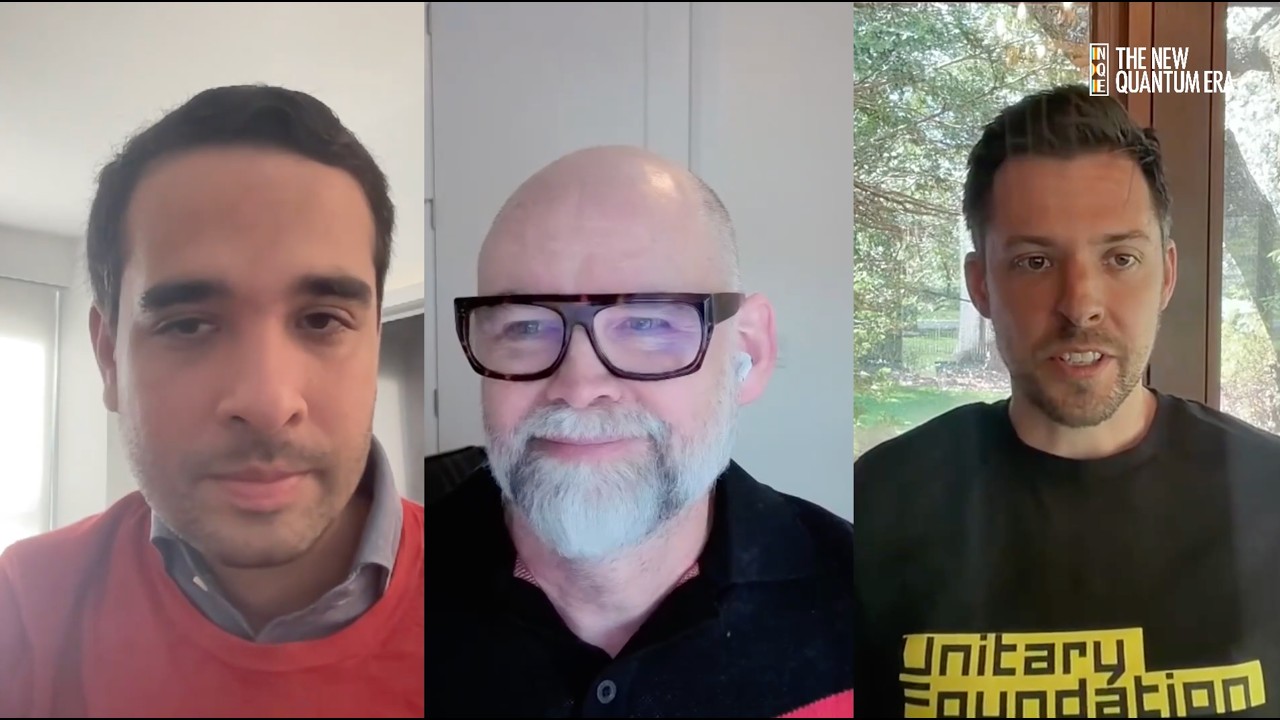
Quantum Open Source with Will Zeng and Ziyaad Bhorat
Keywords
Summary
169 words
Critical Evaluation
Value of the Information & Strength of the Argument
The discussion provides valuable insights into the funding ecosystem for quantum open source software, highlighting a real gap that is often overlooked. The argumentation is solid, grounded in the speakers’ direct experience and specific examples like microgrants and Unitary Hack. They effectively contrast the risks of a closed, secretive development path with the benefits of an open, community-driven approach. The analogy to classical computing’s history (von Neumann vs. ENIAC) is compelling. However, the argument is largely qualitative and advocacy-oriented, with limited quantitative evidence or independent verification of claims. The speakers are credible, but the discussion is more persuasive than analytical.
Scientific Rigor, Source Quality, Title Accuracy
The speakers reference their co-authored white paper, ‘The Open Foundation Quantum Technology Needs,’ and mention specific projects (Mitiq, Metriq, PyMatching, PyZX) and recent technical developments (Google’s Shor’s algorithm improvement, Oratomic). The sources are relevant and credible, though not all are formally cited with URLs. The title accurately reflects the content. The discussion is rigorous in its use of examples and references, but it is primarily an opinion piece rather than a systematic review. The speakers are transparent about their roles and motivations, which adds to the credibility.
202 words
Title / Content Match
The title accurately reflects the content: a discussion about quantum open source with the two named guests.
Quality & Reliability
8/10
The discussion features two experts with strong credentials (Will Zeng, co-founder of Unitary Foundation and partner at Quantonation; Ziyaad Bhorat, VP at Mozilla Foundation). They reference a co-authored white paper and specific technical developments (Google's Shor's algorithm improvement, Oratomic's qubit claims). The conversation is well-structured and grounded in real initiatives, though it is primarily opinion and advocacy rather than presenting new empirical data.
Key Moments
Markers derived by PSI from the transcript: the creator did not define chapters.
- Introduction of guests and topic: open source quantum software funding gap.
- Ziyaad explains Mozilla's motivation to engage in quantum open source.
- Will discusses the funding gap and the need for public goods in quantum.
- Discussion on community building and on-ramps for quantum careers.
- Will shares the story of Rigetti's open source software and early contributors.
- Ziyaad emphasizes community over workforce planning.
- Discussion on Shor's algorithm and recent hardware improvements.
- Will argues for an open future for quantum computing.
- Ziyaad calls for an affirmative vision and warns against secret development.
- Discussion on the quantum Linux analogy and its limitations.
Cited Sources
- The Open Foundation Quantum Technology Needs — White paper co-authored by Zeng, Castanon, and Bhorat (March 2026) that anchors the conversation.
- Unitary Foundation — Non-profit building and sustaining open source quantum software.
- Mozilla Foundation — Non-profit championing open source and supporting Unitary Foundation's quantum work.
- Mitiq — Open source toolkit for quantum error mitigation.
- Metriq — Community-driven quantum benchmarking platform.
- Metriq Gym — Open source benchmarking suite for quantum computers.
- Unitary Compiler Collection (UCC) — Quantum circuit compilation tools.
- QuTiP — Quantum Toolbox in Python, stewarded by Unitary Foundation.
- PyMatching — Open source decoder for quantum error correction, originally funded by a UF microgrant.
- PyZX — ZX-calculus library for quantum circuit optimization, originating from UF support.
- Unitary Hack — Annual bug bounty hackathon connecting open source quantum projects with contributors.
- CSIS Commission on U.S. Quantum Leadership — Warning on quantum decryption surprise referenced in the white paper.
Concurring Sources
- Google's Shor's algorithm improvement — Referenced in the video as a 20x efficiency gain, indicating faster timelines for breaking encryption.
- Oratomic launch — Claim of 10,000 reconfigurable atomic qubits, potentially sufficient for cryptographically relevant computation.
Contribution & Novelties
The video provides a unique perspective on the intersection of quantum computing and philanthropy, highlighting a funding gap that is often overlooked. It offers concrete examples of how small investments (microgrants) can have outsized impact, and it frames the open source quantum software challenge in terms of community building and on-ramps rather than just technical development. The discussion also brings timely updates on recent hardware advancements and their implications for security timelines.
Pour aller plus loin :
- Shor’s algorithm — The factoring algorithm central to the discussion on quantum threat.
- Quantum error correction — Key to understanding the resource estimates mentioned.
- Open-source software — The broader context of the funding gap.
- Mozilla Foundation — The philanthropic organization involved.
- Unitary Foundation — The non-profit leading open source quantum efforts.
128 words
Radar Profile
The radar profile shows high scores in quality of information and reliability, reflecting the expertise of the speakers and the grounded discussion. The quantity of information is moderate, as the conversation is focused but not exhaustive. The technical level is moderate, accessible to a general audience while still providing depth. Overall, the profile indicates a credible and informative discussion.
💬 No comments were provided for analysis.