UW Madison Genetic Colloquium - Eliana Torres Zelada
Keywords
Summary
219 words
Critical Evaluation
Value of the Information & Strength of the Argument
The talk provides valuable insights into the mechanisms of pioneer factor function, specifically how a single protein can have tissue-specific roles. The argumentation is solid, based on a logical progression from observations to mechanistic experiments. The use of quantitative assays (e.g., counting neuroblasts) and molecular techniques (ChIP-seq, reporter constructs) strengthens the conclusions. The presenter carefully interprets results and acknowledges limitations, such as the use of overexpression systems.
Scientific Rigor, Source Quality, Title Accuracy
The scientific rigor is high, with standard techniques and controls. The presenter references previous work (e.g., from Chris Ruslow’s lab) and collaborative studies. The title accurately reflects the content, as it is a research seminar. No external sources are cited in the description, but the talk itself references published work.
132 words
Title / Content Match
The title accurately reflects the content: a research seminar by Eliana Torres Zelada at UW-Madison.
Quality & Reliability
8/10
Presentation of original research with detailed experimental data, including ChIP-seq, ATAC-seq, and reporter assays. Methods are standard and results are clearly presented, but the talk is a colloquium and not peer-reviewed.
Key Moments
Markers derived by PSI from the transcript: the creator did not define chapters.
- Introduction to the Harrison lab's interest in cell fate specification and the role of transcription factors.
- Explanation of the pioneer factor model and the maternal-to-zygotic transition.
- Introduction of Zelda as a pioneer factor in Drosophila and its role in zygotic genome activation.
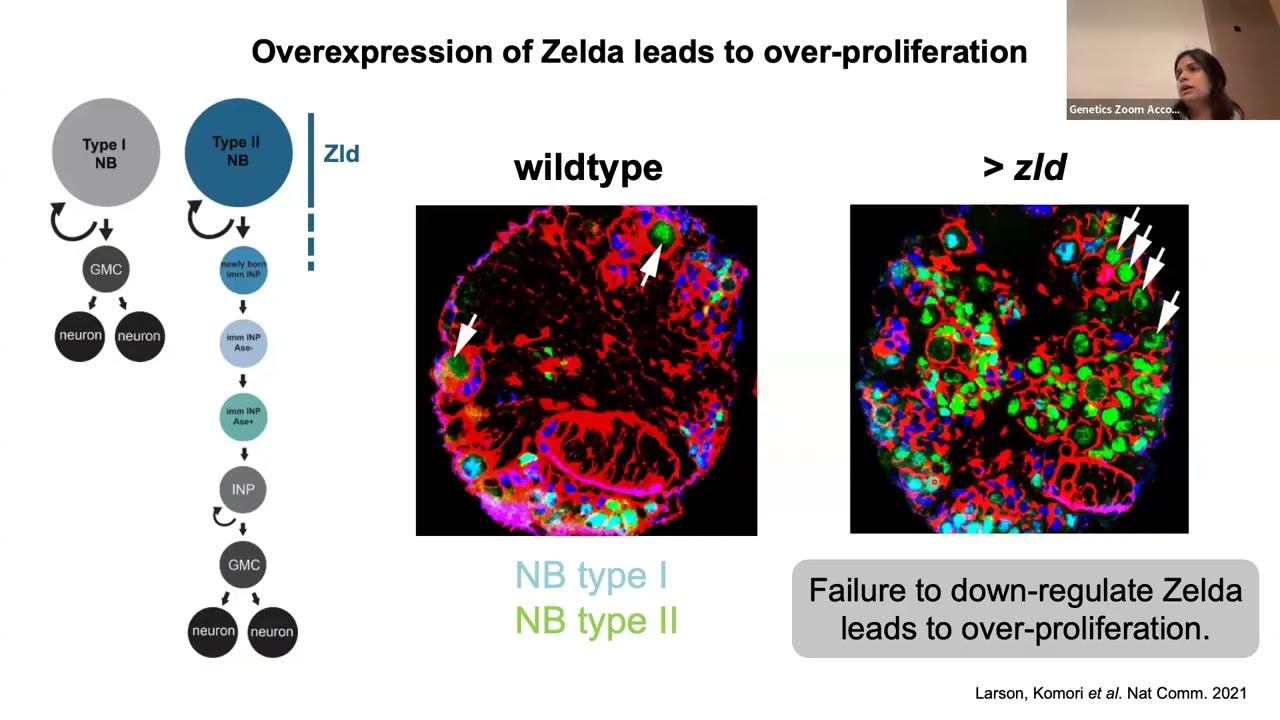
- Presentation of data showing Zelda expression in larval neural stem cells and its role in promoting stem cell fate.
- Description of ChIP-seq experiments comparing Zelda binding in embryos and neuroblasts, revealing tissue-specific occupancy.
- Identification of a neural-specific enhancer in the tailless gene regulated by Zelda.
- Discussion of intrinsic and extrinsic features that shape pioneer factor binding.
- Functional analysis of zinc finger domains, showing opposing roles for zinc finger 2 in embryo and neuroblasts.
- Use of reporter assays and cell lines to dissect the role of zinc finger 2 in binding and pioneering activity.
- Summary of findings and implications for understanding pioneer factor function.
Contribution & Novelties
The talk presents novel findings on the tissue-specific function of the pioneer factor Zelda, specifically identifying zinc finger 2 as a key determinant of binding to non-canonical sites and pioneering activity in neural stem cells. This adds to the understanding of how pioneer factors achieve specificity beyond DNA sequence.
Pour aller plus loin :
- Pioneer transcription factors: establishing competence for gene expression — Relevant review on pioneer factors.
- Zelda: A pioneer factor in Drosophila — Original paper identifying Zelda.
- Chromatin accessibility and transcription factor binding — Review on chromatin and TF binding.
92 words
Radar Profile
The radar profile shows high scores in quantity of information and technical level, reflecting the detailed experimental data and advanced techniques. Quality and reliability are also high, but slightly lower due to the nature of a colloquium talk. The overall balance indicates a rigorous scientific presentation.