UW-Madison Genetics Colloquium - Raj Khangura | January 21st, 2026
Keywords
Summary
185 words
Critical Evaluation
Value of the Information & Strength of the Argument
The talk provides valuable insights into the genetic basis of complex traits, particularly the role of natural variation in modulating mutant phenotypes. The argumentation is solid, based on experimental data from genome-wide association studies, expression analysis, and targeted mutagenesis. The speaker clearly explains the logic behind each experiment and the interpretation of results. The use of a dominant mutant as a reporter to uncover cis-regulatory variation is elegant and demonstrates a powerful approach. The discussion of trade-offs in plant architecture and disease resistance is well-supported by examples from literature. The presentation is coherent and builds a strong case for the importance of studying modifier genes.
Scientific Rigor, Source Quality, Title Accuracy
The talk references several published papers, including the speaker’s own work and classical studies on maize mutants. The sources are appropriate and credible. The title accurately reflects the content, as it is a colloquium presentation. The talk does not include a formal bibliography, but the speaker mentions specific papers and concepts. The methodology appears rigorous, with appropriate controls and statistical analyses. The speaker acknowledges limitations, such as the inability to detect recessive modifiers in their screen. Overall, the scientific rigor is high, though the talk is not a peer-reviewed publication.
210 words
Title / Content Match
The title accurately reflects the content: a genetics colloquium talk by Raj Khangura at UW-Madison.
Quality & Reliability
8/10
The talk presents original research from a plant genetics lab, with clear methodology and references to published work. The speaker is a postdoc/assistant professor with relevant expertise. However, the presentation is a colloquium talk, not a peer-reviewed publication, and some claims are preliminary.
Key Moments
Markers derived by PSI from the transcript: the creator did not define chapters.
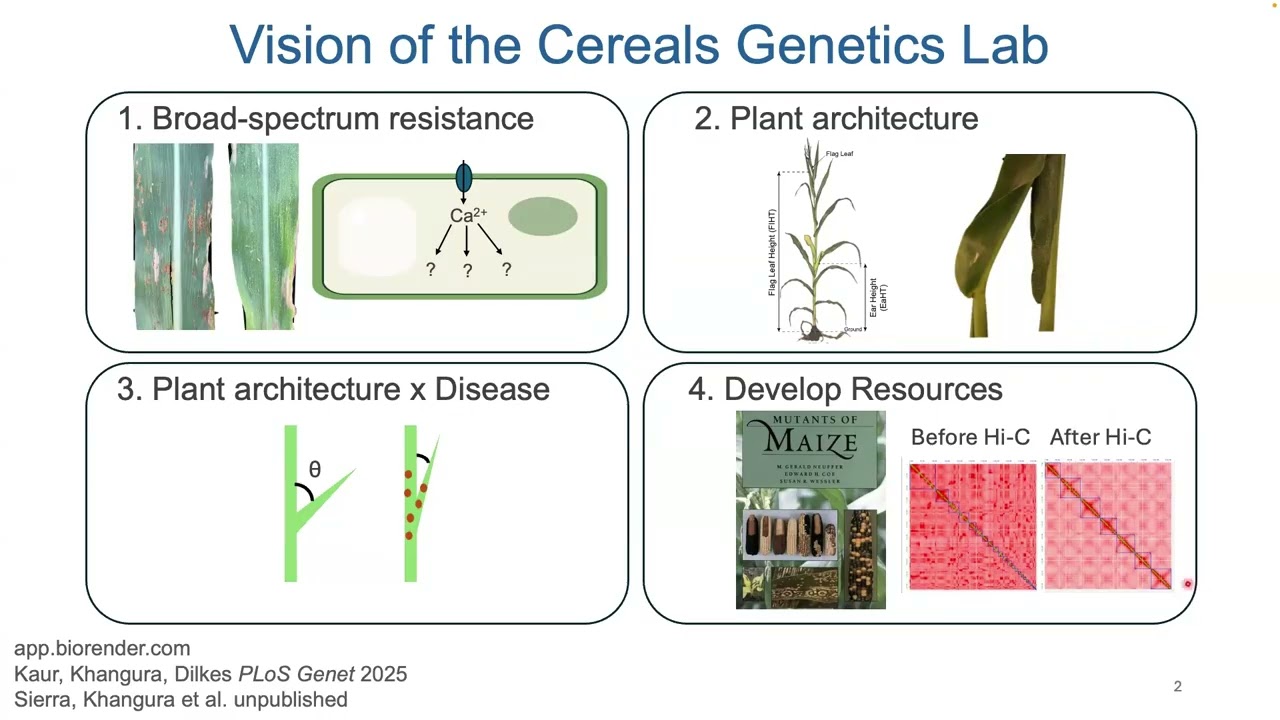
- Introduction to the lab's research themes: disease resistance and plant architecture.
- Discussion of classical examples of plant architecture genes (dwarfing genes in wheat and rice).
- Explanation of the chlorophyll biosynthetic mutant ool19 and its use as a reporter.
- Genome-wide association mapping identifies QTL at ool1 locus.
- Expression analysis shows cis-acting polymorphisms affect wild-type allele expression.
- Phenotypic effects on tillering, senescence, and plant height.
- Introduction to somatic chimeras as a tool for fine mapping.
- Application to sorghum male sterility mutant ms8.
- Identification of bHLH transcription factor via chimeric sectors.
- Ongoing work on wheat genome assemblies and future directions.
Cited Sources
- Maize mutants collection — Mentioned as a classical collection of maize mutants by Jerry Neuffer, Ed Coe, and Sue Wessler.
- Dwarfing genes in wheat (Rht) — Discussed as classical examples of plant architecture genes.
- SD1 mutants in rice — Mentioned as semidwarf mutants in gibberellic acid biosynthesis.
- Ligule1 and Ligule2 in maize — Mentioned as loci selected for leaf angle reduction.
- Teopod mutants — Discussed as examples of genetic background effects on mutant severity.
Concurring Sources
- Maize Genetics and Genomics Database — Resource for maize genetic information, supporting the discussion of maize mutants.
- Wheat genome assembly — Reference for wheat genome resources mentioned in the talk.
Contribution & Novelties
The talk presents novel findings on how natural variation at a gene (ool1) modulates the phenotype of a dominant mutant, revealing cis-regulatory mechanisms that affect chlorophyll biosynthesis and downstream traits. This provides a framework for understanding genetic background effects and has implications for breeding. The use of somatic chimeras for fine mapping is an innovative approach that can accelerate gene identification.
Pour aller plus loin :
- Genome-wide association studies in maize — Background on GWAS methodology.
- Chlorophyll biosynthesis — Overview of the pathway and its regulation.
- Maize genetics — General information on maize as a model organism.
97 words
Radar Profile
The radar profile shows high scores across all dimensions, indicating a well-rounded presentation with substantial information, high technical depth, and strong reliability. The talk is particularly strong in quantitative information and technical level, reflecting the speaker's expertise.
💬 No comments were provided for analysis.