UW-Madison Genetics Colloquium - David Garcia | April 8th, 2026
Keywords
Summary
101 words
Critical Evaluation
Value of the Information & Strength of the Argument
The talk provides valuable insights into tRNA modification biology, presenting a novel high-throughput approach that overcomes limitations of previous methods. The argumentation is solid, based on genetic perturbations and direct sequencing data. The speaker clearly explains the rationale and interprets results cautiously, acknowledging prior work and limitations.
Scientific Rigor, Source Quality, Title Accuracy
The speaker cites relevant literature (e.g., reviews by Eric Phizicky and Anita Hopper) and his own published work. The title accurately reflects the content. The talk is a seminar, not peer-reviewed, but the methodology and genetic validation lend credibility. No comments were provided for analysis.
107 words
Title / Content Match
The title accurately reflects the content: a genetics colloquium talk by David Garcia on tRNA modifications.
Quality & Reliability
8/10
The talk presents original research from the speaker's lab, with detailed methodology and genetic validation. The speaker is an established researcher (PhD, MIT; postdoc, Stanford; now faculty at University of Oregon). The content is technical and appears scientifically sound, though not peer-reviewed in this format.
Key Moments
Markers derived by PSI from the transcript: the creator did not define chapters.
- Introduction of David Garcia by Claire, highlighting his background and research focus.
- Overview of tRNA structure and the central dogma, emphasizing the role of tRNA as adapter molecules.
- Introduction to RNA modifications, focusing on tRNA as the most heavily modified RNA class.
- Explanation of the importance of modifications in the anticodon loop and body of tRNA for function.
- Description of the direct RNA sequencing method using nanopore technology and splint adapters.
- Presentation of heat maps showing reference match probabilities for all tRNA isoacceptors, highlighting pseudouridine at position 55.
- Genetic validation by deleting Pus4, showing loss of pseudouridine and its effect on m1A58, illustrating modification circuits.
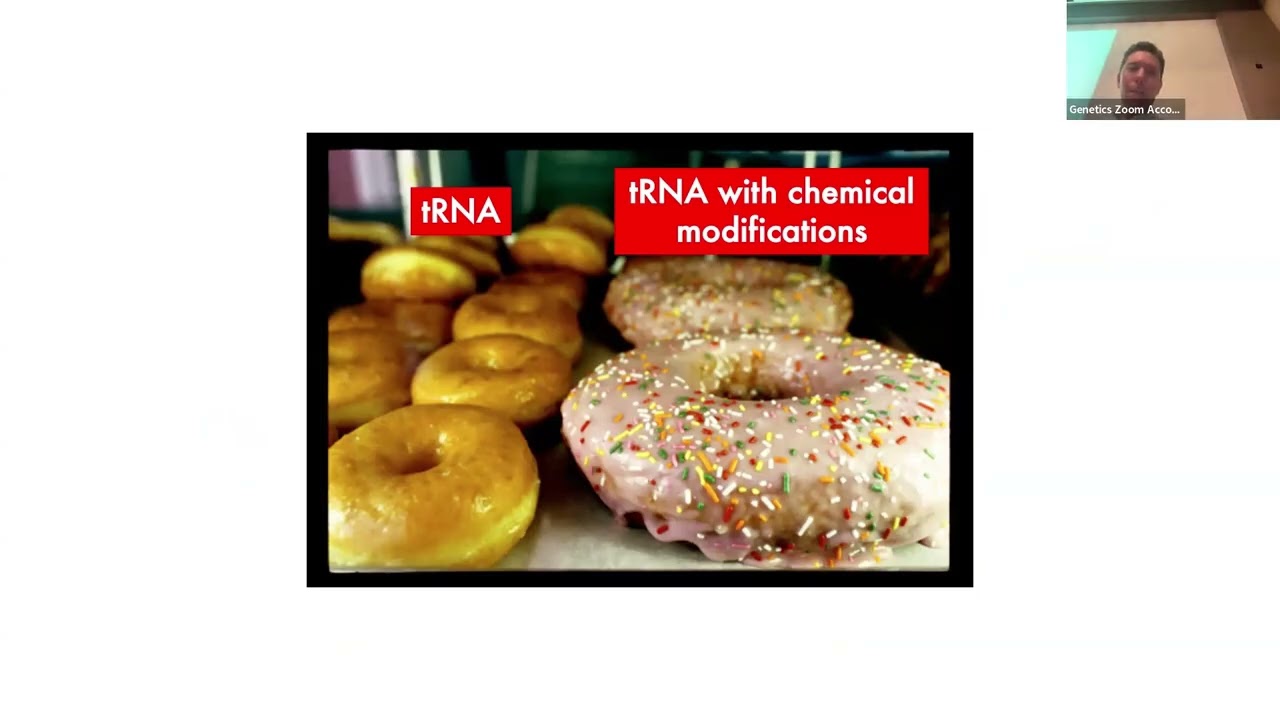
- Discussion of the factory analogy to explain modification circuits and the order of modifications.
- Introduction of ongoing work on other modifications and stress-induced changes.
- Conclusion and acknowledgments, emphasizing the collaborative nature of the work.
Cited Sources
- tRNA modifications: a review by Eric Phizicky and Anita Hopper (2010) — Referenced as a favorite review showing the diversity of tRNA modifications in yeast.
- Direct RNA sequencing of tRNAs using nanopore (Lucas et al., 2021) — The method developed by Mark Akeson's group and collaborators, used as the basis for the presented work.
Concurring Sources
- tRNA modifications and their role in translation (Phizicky & Hopper, 2010) — Supports the importance of tRNA modifications for structure and function.
- Direct RNA sequencing of tRNAs (Lucas et al., 2021) — Provides the methodological foundation for the presented work.
Contribution & Novelties
The talk presents a novel high-throughput method for profiling tRNA modifications across all isoacceptors in vivo, enabling the discovery of modification circuits at a genome-wide scale. This approach allows for the systematic study of how modifications influence each other and respond to environmental changes.
Pour aller plus loin :
- tRNA modifications and their role in translation — Overview of tRNA modifications and their functions.
- Nanopore sequencing — Background on the technology used for direct RNA sequencing.
- Pseudouridine — The most abundant RNA modification, highlighted in the talk.
87 words
Radar Profile
The radar profile shows high scores across all dimensions, indicating a technically rigorous and informative presentation. The talk excels in providing detailed information and maintaining scientific accuracy, with a strong balance between technical depth and clarity.