UW Madison Genetics Colloquium - Becca Back
Keywords
Summary
149 words
Critical Evaluation
Value of the Information & Strength of the Argument
The presentation provides valuable insights into the development of a novel microfluidics tool for studying phage-host interactions. The argumentation is solid, as she systematically validates each step: Poisson loading, phage replication in droplets, and merging efficiency. She acknowledges limitations and iteratively improves her design. The preliminary results are promising and support the feasibility of the approach.
Scientific Rigor, Source Quality, Title Accuracy
The scientific rigor is high, with clear methodology and validation. She references a method from ‘LAN atl’ published last year, but no specific citations are provided in the video. The title accurately reflects the content, as it is a colloquium presentation. No comments were provided for analysis.
118 words
Title / Content Match
The title accurately reflects the content: a genetics colloquium presentation by Becca Back.
Quality & Reliability
8/10
Presentation of original research with clear methodology, validation steps, and preliminary results. Limitations are acknowledged. The work is presented in a colloquium setting, indicating peer feedback.
Key Moments
Markers derived by PSI from the transcript: the creator did not define chapters.
- Introduction by advisor, highlighting Becca's project on phage-host interactions using droplet microfluidics.
- Becca begins her presentation, outlining the talk structure.
- Background on phage-host interactions, their abundance, and relevance.
- Discussion of existing methods and their limitations, motivating the need for new technology.
- Introduction to microfluidics and its advantages for high-throughput studies.
- Explanation of the barcoding strategy for identifying phage-host pairs.
- Validation of single-cell encapsulation using Poisson loading.
- Demonstration that phage replication occurs in droplets, comparable to bulk.
- Identification of limitations with the simple one-pot method.
- Introduction of the advanced merging device and its design considerations.
- Optimization of the merging device, including electrode and droplet size tuning.
- Preliminary results showing 70% merging efficiency.
- Conclusion and future directions.
Cited Sources
- Method from LAN atl (published last year) — Referenced as the basis for the one-pot encapsulation method.
Contribution & Novelties
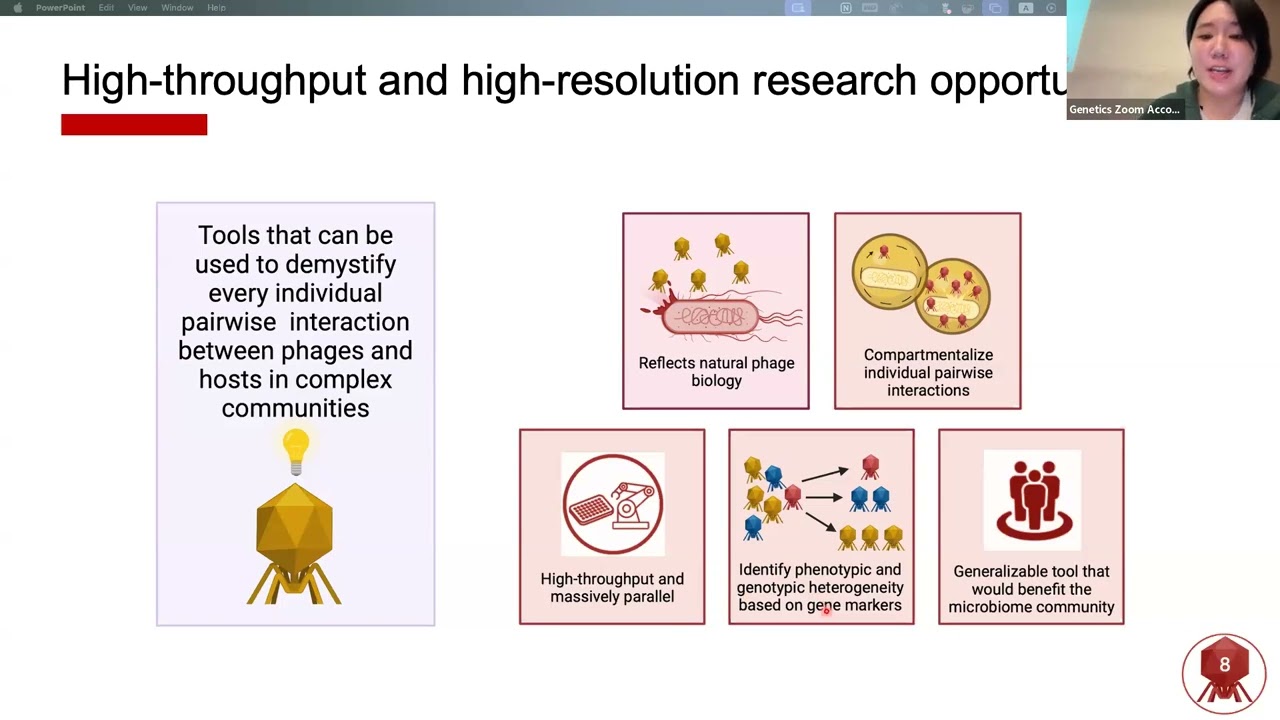
The presentation describes a novel droplet microfluidics approach to study phage-host interactions at single-cell resolution, addressing limitations of existing methods. The ‘Kirby merger’ device is an original design that allows merging of culture and PCR droplets, overcoming issues of PCR inhibition. This work contributes to the field by providing a high-throughput, high-resolution tool for characterizing phage-host interactions in complex communities.
Pour aller plus loin :
- Droplet microfluidics — Overview of the technology used.
- Phage therapy — Application of phages in medicine.
- Single-cell sequencing — Techniques for analyzing individual cells.
89 words
Radar Profile
The radar profile shows high scores across all dimensions, indicating a well-rounded presentation with strong technical depth, reliable methodology, and substantial information content. The balance suggests a rigorous scientific contribution.