UW-Madison Genetics Colloquium - Scarlet Shell | April 29th, 2026
Keywords
Summary
164 words
Critical Evaluation
Value of the Information & Strength of the Argument
The talk provides valuable insights into a relatively understudied area of bacterial gene regulation. The speaker presents a clear logical progression from the clinical problem of TB to the molecular mechanisms of mRNA degradation. The argumentation is solid, based on multiple complementary experimental approaches: reverse genetics, in vitro biochemistry, transcriptome-wide analysis, and mRNA half-life measurements. The speaker is transparent about unexpected results, which enhances credibility. The identification of RppH in mycobacteria and its transcriptome-wide impact is a significant contribution. However, the unresolved discrepancy between expected and observed effects on mRNA stability indicates that the story is incomplete, and the speaker acknowledges this. The value lies in opening new questions about the complexity of post-transcriptional regulation.
Scientific Rigor, Source Quality, Title Accuracy
The scientific rigor is high: the speaker describes controlled experiments with appropriate complements and catalytic mutants. The use of multiple assays (ligation-based, transcriptomic, half-life) strengthens the conclusions. The sources cited are primarily the speaker’s own work and key studies in the field, but specific references are not provided in the talk. The title accurately reflects the content, as it is a colloquium presentation on mycobacterial post-transcriptional regulation. No comments were provided, so no analysis of public reception is possible.
209 words
Title / Content Match
The title accurately reflects the content: a genetics colloquium presentation by Scarlet Shell on mycobacterial post-transcriptional regulation.
Quality & Reliability
8/10
The talk presents original research with detailed experimental data, including genetic screens, biochemical assays, and transcriptomic analyses. The methodology is rigorous, and the speaker transparently discusses unexpected results. However, as a colloquium talk, it lacks peer-reviewed publication details and some conclusions are preliminary.
Key Moments
Markers derived by PSI from the transcript: the creator did not define chapters.
- Introduction and motivation: TB burden and treatment challenges.
- Stress responses and antibiotic tolerance in mycobacteria.
- Global mRNA degradation regulation in response to energy stress.
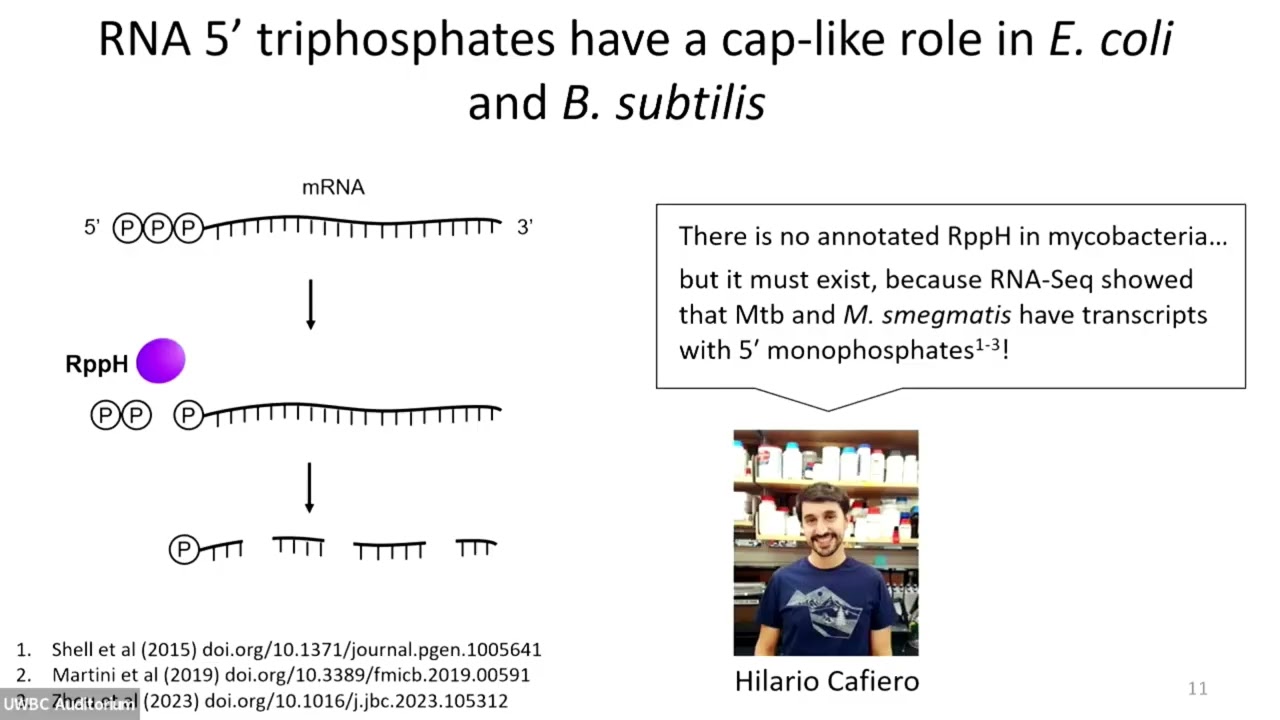
- Introduction to RppH and its role in 5' end processing.
- Reverse genetic screen to identify RppH in mycobacteria.
- Biochemical confirmation of RppH activity and complementation.
- Transcriptome-wide analysis of RppH targets and substrate preferences.
- In vitro sensitization of transcripts to RNases by RppH.
- mRNA half-life measurements in RppH knockout: unexpected results.
- Discussion of intrinsically disordered regions and future directions.
Contribution & Novelties
This talk presents novel findings on the identification and characterization of RppH in mycobacteria, a previously unannotated enzyme. The discovery that RppH acts transcriptome-wide and its substrate preferences are new contributions. The unexpected results regarding mRNA stability highlight the complexity of post-transcriptional regulation and open new avenues for research.
Pour aller plus loin :
- RNA pyrophosphohydrolase (RppH) - Wikipedia — Overview of RppH function in bacteria.
- Mycobacterium tuberculosis - Wikipedia — Background on the pathogen and its disease.
- mRNA degradation - Wikipedia — General mechanisms of mRNA decay.
- Intrinsically disordered proteins - Wikipedia — Relevance to RppH’s IDRs.
98 words
Radar Profile
The radar profile shows high scores in all dimensions, indicating a well-rounded scientific presentation with substantial information, strong methodology, and high reliability. The technical level is appropriate for a specialized audience, and the talk is both informative and rigorous.