UW-Madison Genetics Colloquium - Sadie Wignall | March 3rd, 2026
Keywords
Summary
139 words
Critical Evaluation
Value of the Information & Strength of the Argument
The talk provides valuable insights into acentrosomal spindle assembly, a fundamental process in oocyte meiosis. The use of the AID system allows for rapid protein depletion, enabling the study of post-assembly roles. The argumentation is solid, with clear experimental design and controls. The discovery of PLK1’s role in suppressing ectopic microtubule nucleation is novel and well-supported by imaging data. The presentation of unpublished data on the ring complex adds to the value, though it is preliminary.
Scientific Rigor, Source Quality, Title Accuracy
The talk is scientifically rigorous, with methods and results presented clearly. The speaker references landmark studies, such as the 2015 human oocyte study, and her own published work. The title accurately reflects the content. The talk does not include a formal citation list, but the research is consistent with the field’s literature. The adéquation between title and content is excellent.
151 words
Title / Content Match
The title accurately reflects the content: a genetics colloquium talk by Sadie Wignall on spindle assembly in oocyte meiosis.
Quality & Reliability
8/10
The talk presents original research from a reputable lab, with clear methodology and data. The speaker is a professor at Northwestern University and the content is consistent with published literature. However, as a colloquium talk, it lacks peer review and some claims are preliminary.
Key Moments
Markers derived by PSI from the transcript: the creator did not define chapters.
- Introduction by Anna, highlighting Sadie's career and teaching award.
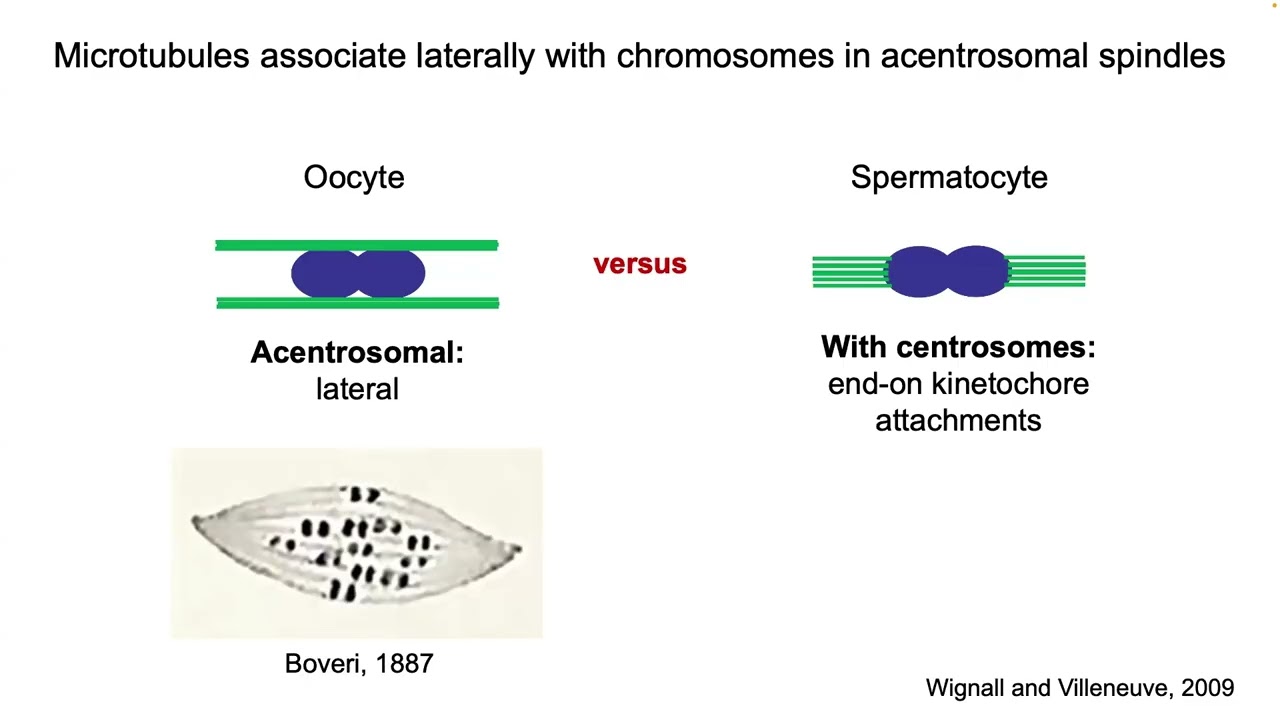
- Sadie introduces the spindle and its role in cell division, with historical drawings.
- Explanation of oocyte meiosis and the absence of centrosomes.
- Discovery of the ring complex and its components, including KLP19 and Aurora B.
- Description of spindle assembly stages in C. elegans oocytes.
- Introduction of the auxin-inducible degradation (AID) system for rapid protein depletion.
- Depletion of ZYG-9 and ZYG-8 leads to spindle instability, showing different phenotypes.
- Focus on PLK1: depletion after spindle assembly causes spindle collapse and ectopic microtubule nucleation.
- Observation of microtubule asters near sperm DNA upon PLK1 depletion.
- Unpublished work on the ring complex's role in spindle organization.
Cited Sources
- Boveri's drawings of oocyte spindles — Historical reference to early observations of oocyte spindles.
- Human oocyte spindle instability study (2015) — Landmark study showing human oocyte spindles are unstable, motivating research on spindle stability.
- Auxin-inducible degradation system adapted for C. elegans — Method used for rapid protein depletion, adapted by Abby Dernburg's lab.
Concurring Sources
- Wignall lab publications on oocyte meiosis — The speaker's own published work on spindle assembly and ring complex.
- Studies on human oocyte spindle instability — Referenced as motivation for studying spindle stability.
Contribution & Novelties
The talk presents novel findings on the role of PLK1 in oocyte spindle stability and suppression of ectopic microtubule nucleation. It also introduces unpublished work on the ring complex’s involvement in spindle organization. The use of the AID system allows for post-assembly depletion, providing new insights into spindle maintenance.
Pour aller plus loin :
- Acentrosomal spindle assembly in oocytes — Overview of spindle assembly mechanisms.
- Polo-like kinase 1 (PLK1) functions — General functions of PLK1 in cell division.
- Auxin-inducible degron system — Description of the AID system used in the talk.
91 words
Radar Profile
The radar profile shows high scores across all dimensions, indicating a well-rounded and reliable scientific talk. The strongest aspects are the quantity and quality of information, with a slightly lower but still high score on technical level and global reliability.
💬 No comments were provided for analysis.