UW Madison Genetic Colloquium Angelica Lang
Keywords
Summary
168 words
Critical Evaluation
Value of the Information & Strength of the Argument
The value of the information is high: it provides novel insights into a fundamental question in neuroscience—how neurons sense and respond to mitochondrial demand in distal regions. The argumentation is solid: the presenter systematically tests hypotheses, uses multiple complementary approaches (genetics, imaging, RNA-seq, electron microscopy), and includes appropriate controls. She also addresses alternative explanations (e.g., mitochondrial dynamics) and provides evidence to rule them out. The use of an artificial tether to mimic the transport defect strengthens the causal link. The RNA-seq data adds a global perspective. Overall, the argumentation is rigorous and convincing.
Scientific Rigor, Source Quality, Title Accuracy
The scientific rigor is high: the presenter describes careful experimental design, including biological and experimental replicates, consistent imaging settings, and normalization. She uses well-established markers (SSB, TFAM, PGC1A) and techniques (HCR, RNA-seq, EM). The sources cited are primarily the presenter’s own work and previous lab publications, as well as the artificial tether developed by a Yale lab. The title accurately reflects the content. No comments were provided, so no analysis of public reception is possible.
183 words
Title / Content Match
The title accurately reflects the content: a genetics colloquium talk by Angelica Lang.
Quality & Reliability
8/10
The presentation is based on original research with rigorous experimental methods including genetic mutants, imaging, RNA-seq, and electron microscopy. The speaker clearly explains controls and replicates. However, the data is not yet peer-reviewed (preprint on bioRxiv) and the presentation is a seminar, so some details are simplified.
Key Moments
Markers derived by PSI from the transcript: the creator did not define chapters.
- Introduction by PI Katie, background on Angelica and project.
- Angelica starts talk: importance of neurons and mitochondria.
- Introduction to zebrafish lateral line neurons and ACTR10 mutant phenotype.
- Mitochondrial transport imaging shows reduced retrograde transport in mutants.
- Cell body mitochondrial density reduced in mutants.
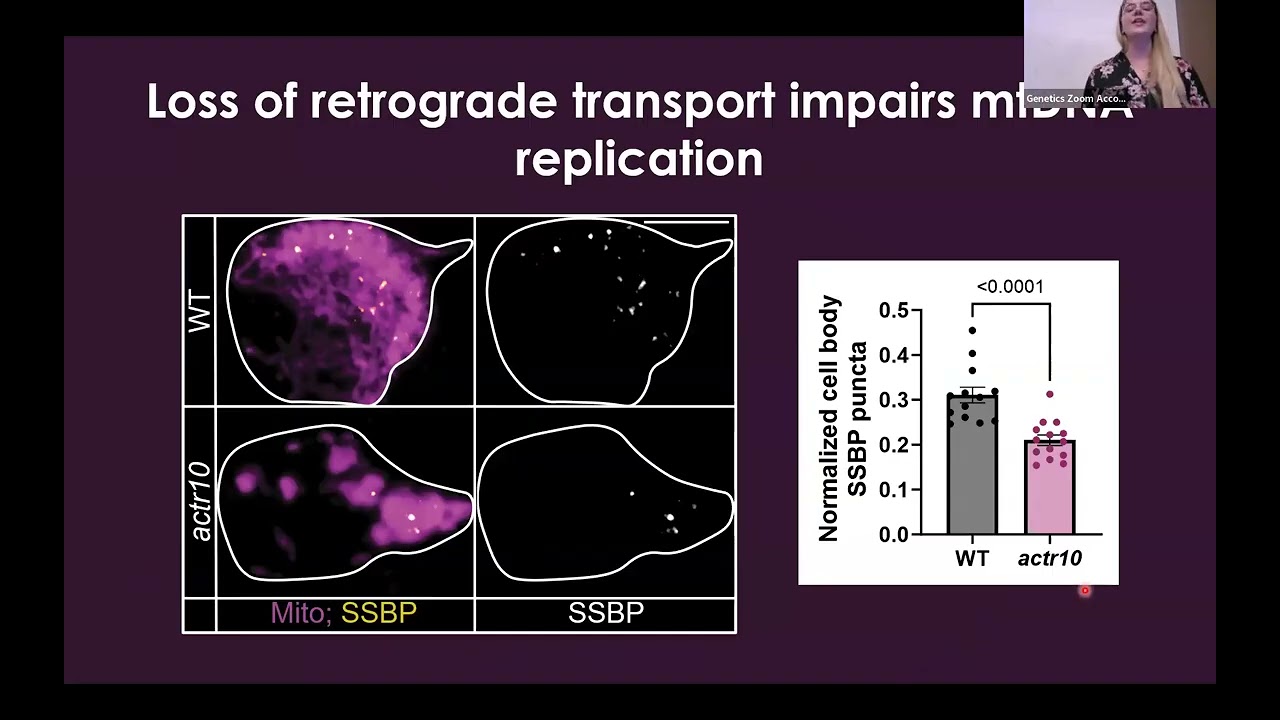
- Mitochondrial biogenesis markers (SSB, TFAM, PGC1A) reduced in mutants.
- RNA-seq on sorted neurons shows downregulation of mitochondrial genes.
- Artificial tether to force anterograde transport recapitulates biogenesis defects.
- DRP1 disruption does not affect biogenesis, supporting retrograde transport signal.
- Conclusion and questions.
Cited Sources
- bioRxiv preprint of this work — The presenter mentions the work is available on bioRxiv.
- Artificial tether developed by Yale lab — The presenter mentions using an artificial tether developed by a lab at Yale, but no specific URL is given.
Concurring Sources
- Previous work from the lab on ACTR10 — The presenter references previous lab work identifying the ACTR10 mutation.
Contribution & Novelties
This work provides novel evidence that mitochondrial retrograde transport is not only for returning mitochondria to the cell body for degradation, but also serves as a signal to regulate mitochondrial biogenesis. The use of zebrafish lateral line neurons allows in vivo imaging and genetic manipulation. The RNA-seq data on a specific neuronal population is a technical achievement. The work challenges the view that mitochondrial dynamics alone regulate biogenesis.
Pour aller plus loin :
- Mitochondrial biogenesis — Overview of the process.
- PGC1A — Master regulator of mitochondrial biogenesis.
- Axonal transport — Mechanisms of cargo movement in neurons.
- Zebrafish as a model organism — Advantages of zebrafish in research.
107 words
Radar Profile
The radar profile shows high scores in quantity and quality of information, and moderate technical level. The fiabilite is high due to rigorous methods. The profile indicates a well-rounded, reliable scientific presentation.