UW Madison Genetics Colloquium - Erin Alberts
Keywords
Summary
176 words
Critical Evaluation
Value of the Information & Strength of the Argument
The presentation provides valuable insights into the ongoing research on Raptor’s role in plant development. The argumentation is structured around three complementary approaches, which strengthens the scientific rigor. The use of CRISPR-combo is innovative and well-explained. However, the presentation is a work in progress, with no final results yet, so the value is more in the methodology and hypotheses than in conclusive findings. The discussion of discrepancies in previous literature is valuable, as it highlights the need for careful genotyping and consideration of genetic background.
Scientific Rigor, Source Quality, Title Accuracy
The presentation shows good scientific rigor in the design of experiments and attention to potential pitfalls, such as T-DNA-induced rearrangements. The sources cited are primarily from the literature mentioned in the description (not provided) and the speaker’s own work. The title accurately reflects the content. The speaker acknowledges limitations, such as the incomplete genome of Nicotiana benthamiana. However, the presentation lacks detailed citations for specific claims, and the audience questions suggest areas for further investigation.
175 words
Title / Content Match
The title accurately reflects the content: a genetics colloquium presentation by Erin Alberts.
Quality & Reliability
7/10
Presentation of ongoing research with clear methodology, but limited peer-reviewed validation and some speculative interpretations.
Key Moments
Markers derived by PSI from the transcript: the creator did not define chapters.
- Introduction to the TOR complex and Raptor
- Discrepancies in Raptor1B mutant phenotypes in literature
- Overview of three strategies to study Raptor
- CRISPR-combo system for generating knockouts
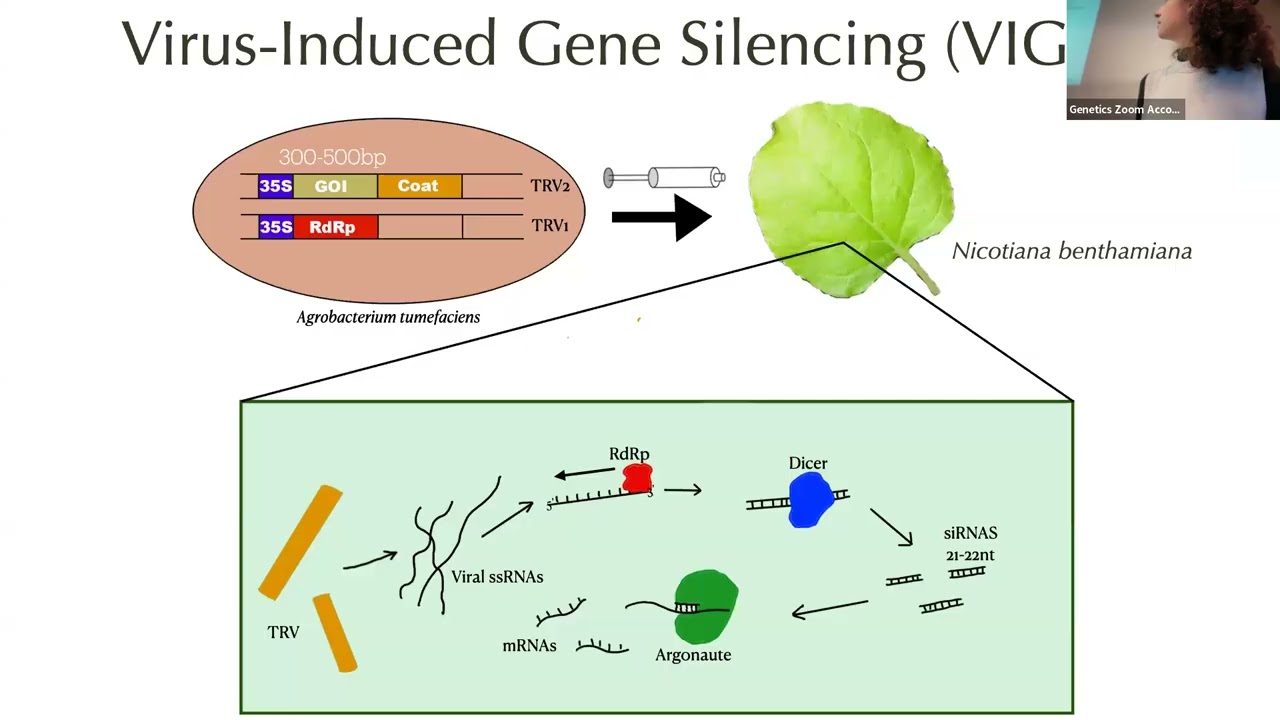
- Virus-induced gene silencing (VIGS) approach
- Genotyping of SALK/SAIL T-DNA lines
- Preliminary genotyping results and next steps
- Responsible data management practices
- Acknowledgments and funding sources
- Q&A session on modifier genes and sequence similarity
Cited Sources
- Anderson et al. 2005 (paper on Raptor1B mutants) — Cited as showing that Raptor1B mutants are tiny but alive.
- Another 2005 paper (showing embryo lethality) — Cited as showing that Raptor1B mutants are not viable.
Concurring Sources
- Anderson et al. 2005 (paper on Raptor1B mutants) — Shows viable but small plants, consistent with some findings.
Dissenting Sources
- Another 2005 paper (showing embryo lethality) — Reports embryo lethality, conflicting with other observations.
Contribution & Novelties
This presentation contributes to the understanding of Raptor’s role in plant development by proposing a comprehensive approach to resolve conflicting literature. The use of CRISPR-combo to generate complete knockouts and VIGS for transient silencing provides complementary methods. The emphasis on genotyping T-DNA lines to ensure true knockouts addresses a common issue in the field. The potential identification of modifier genes could reveal new insights into TOR signaling.
Pour aller plus loin :
- TOR signaling in plants — Overview of TOR pathway.
- CRISPR-Cas9 — Background on CRISPR technology.
- Virus-induced gene silencing — Explanation of VIGS method.
95 words
Radar Profile
The radar profile shows high scores in technical level and information quality, reflecting the detailed methodology and scientific depth. The lower score in information quantity is due to the ongoing nature of the research with preliminary results. Overall, the profile indicates a technically strong presentation with good scientific rigor.
💬 No comments were provided for analysis.