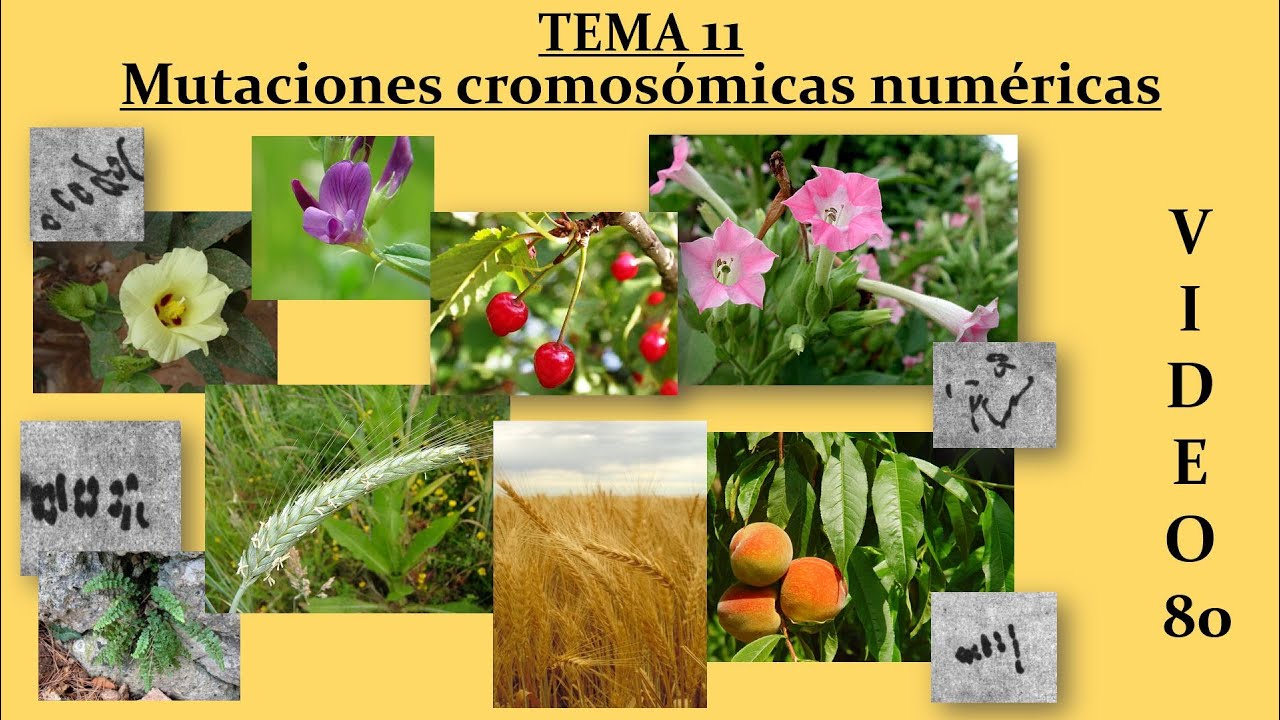
83 Tema 11 Mutaciones Cromosómicas Numéricas. Genética (Cód. 2030)
Keywords
Summary
131 words
Critical Evaluation
Value of the Information & Strength of the Argument
The video provides a thorough and systematic approach to solving genetics problems involving autotetraploids. It clearly explains the derivation of gamete ratios and uses them to predict genotypic and phenotypic ratios in crosses. The argumentation is logical and builds from basic concepts to more complex applications. The instructor emphasizes the characteristic ratios (35:1, 11:1, 5:1) that are diagnostic of tetrasomic inheritance, which is valuable for understanding polyploid genetics. The problem-solving methodology is rigorous and would be useful for students.
Scientific Rigor, Source Quality, Title Accuracy
The scientific rigor is high in terms of genetic principles, but the video does not cite external sources or references. The content is based on established knowledge in genetics, but the lack of citations limits its verifiability. The title accurately describes the content, which is focused on numerical chromosomal mutations. The video is a tutorial, so it does not present original research but rather explains concepts. The absence of sources is a minor weakness, but the pedagogical quality is good.
174 words
Title / Content Match
The title accurately reflects the content, which covers numerical chromosomal mutations (specifically autotetraploidy) in genetics.
Quality & Reliability
7/10
The video is an educational tutorial on numerical chromosomal mutations, specifically autotetraploidy, with detailed problem-solving. The content is scientifically accurate and follows established genetic principles, but it lacks citations to external sources and is presented in a classroom style without peer review.
Key Moments
Markers derived by PSI from the transcript: the creator did not define chapters.
- Introduction to the topic and problem 1: gamete proportions for autotetraploid genotypes.
- Explanation of gamete ratios for nulliplex, simplex, duplex, triplex, and quadruplex.
- Problem 2: Crosses involving duplex, simplex, and nulliplex, calculating genotypic and phenotypic ratios.
- Derivation of characteristic ratios 35:1, 11:1, and 5:1 for autotetraploid inheritance.
- Problem 3: Lotus corniculatus as an autotetraploid, determining ploidy and parental genotypes.
- Analysis of progeny ratios to identify dominant and recessive phenotypes.
- Problem 4: Alfalfa resistance to nematodes, determining mode of inheritance and genotypes.
- Conclusion and summary of key concepts.
Contribution & Novelties
The video provides a clear and detailed tutorial on solving genetics problems involving autotetraploids, which is a specialized topic. It emphasizes the characteristic phenotypic ratios (35:1, 11:1, 5:1) that are diagnostic of tetrasomic inheritance, which is a valuable educational contribution. The step-by-step problem-solving approach is original in its pedagogical clarity.
Pour aller plus loin :
- Polyploidy — Overview of polyploidy, including autopolyploidy.
- Tetrasomic inheritance — Explanation of tetrasomic inheritance patterns.
- Lotus corniculatus — Information on the species used in the video.
81 words
Radar Profile
The radar profile shows high scores in quantity of information, technical level, and reliability, indicating a dense and accurate tutorial. The quality of information is slightly lower due to lack of citations, but overall the video is a solid educational resource.