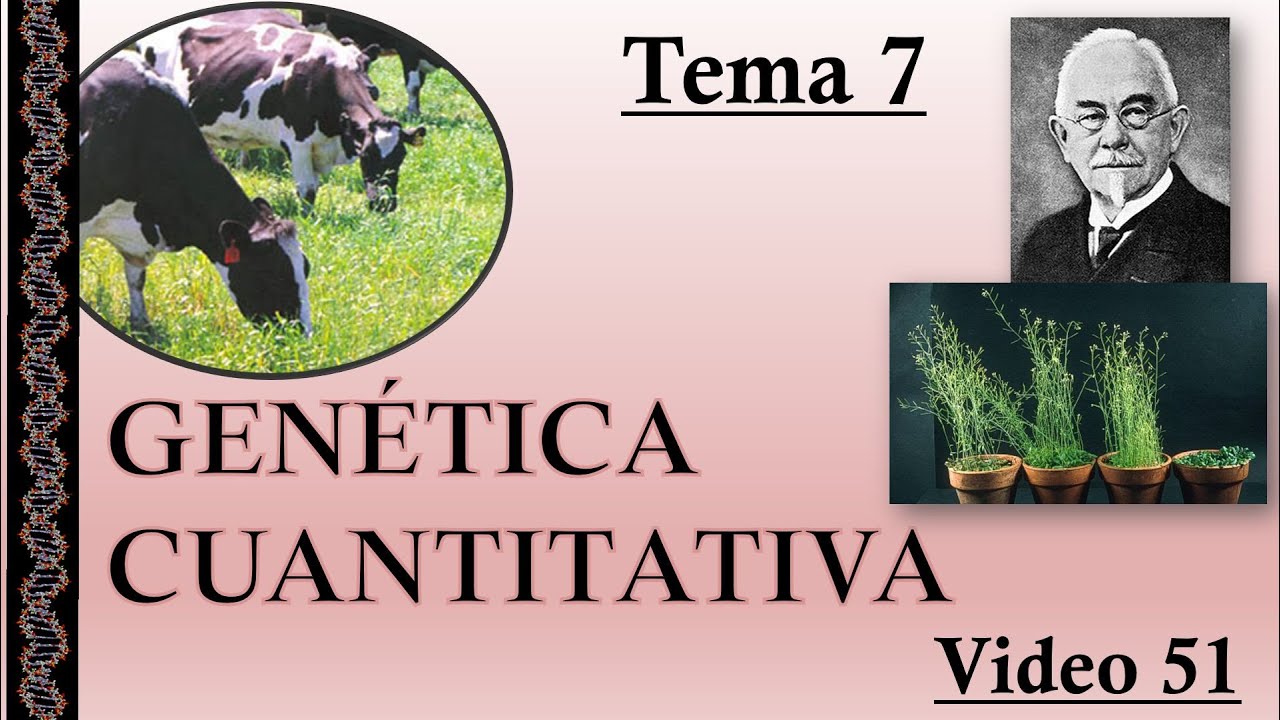
54 Tema 7. Genética Cuantitativa. Genética (Cód. 2030)
Keywords
Summary
193 words
Critical Evaluation
Value of the Information & Strength of the Argument
The video provides a solid introduction to quantitative genetics, with clear explanations and worked examples. It effectively uses the Galton board to visualize the binomial distribution of alleles, which aids in understanding the genetic basis of continuous variation. The argumentation is logical and builds step-by-step, from basic concepts to more complex calculations. However, the video lacks depth in discussing the statistical models used in quantitative genetics, such as heritability estimation or the decomposition of phenotypic variance. It also does not address modern molecular approaches like QTL mapping. The reliance on classic examples is appropriate for an introductory course, but the content is not exhaustive.
Scientific Rigor, Source Quality, Title Accuracy
The scientific rigor is acceptable for an educational video, as it presents established concepts accurately. However, it does not cite specific scientific sources, which limits its utility for advanced study. The only external link is to an interactive Galton board, which is a useful tool but not a primary source. The title accurately describes the content, and the video is well-structured for teaching purposes. The lack of citations to primary literature is a minor weakness, but the content aligns with standard genetics textbooks.
202 words
Title / Content Match
The title accurately reflects the content, which is a lecture on quantitative genetics as part of a genetics course.
Quality & Reliability
7/10
The video provides a clear and structured explanation of quantitative genetics, using classic examples and a Galton board simulation. The content is scientifically accurate, but it lacks explicit citations to primary literature, relying on established textbook knowledge. The single external link is to an interactive tool, not a scientific source.
Key Moments
Markers derived by PSI from the transcript: the creator did not define chapters.
- Introduction to modifier genes and their quantitative effects.
- Example of quantitative variation in maize ear length, showing parental, F1, and F2 distributions.
- Explanation of how to estimate the number of genes from extreme phenotype proportions in F2.
- Calculation of allele contribution using tobacco corolla length example.
- Introduction to transgressive segregation with an example in plant height.
- Discussion of phenotypic classes and the smoothing effect of environmental variance.
- Use of the Galton board to illustrate binomial distribution in polygenic inheritance.
- Demonstration of the Galton board with increasing number of rows, showing the emergence of a normal distribution.
- Conclusion and reminder to practice with the provided link.
Cited Sources
- Quincunx (Galton Board) - Math is Fun — Interactive tool used to demonstrate the binomial distribution underlying polygenic inheritance.
Concurring Sources
- Quantitative Genetics - NCBI Bookshelf — Provides a detailed explanation of quantitative genetics principles, consistent with the video's content.
Contribution & Novelties
The video provides a clear pedagogical explanation of quantitative genetics, using the Galton board as a visual aid to illustrate the binomial distribution of alleles. It effectively bridges the gap between Mendelian genetics and continuous variation, making complex concepts accessible. The step-by-step calculations for estimating gene number and allele contribution are valuable for students.
Pour aller plus loin :
- Quantitative genetics - Wikipedia — Provides a comprehensive overview of the field, including heritability and QTL mapping.
- Polygenic inheritance - Wikipedia — Explains the concept of polygenic traits and their continuous distribution.
- Galton board - Wikipedia — Details the history and mechanics of the Galton board, illustrating the central limit theorem.
110 words
Radar Profile
The radar profile shows high scores in information quantity and quality, with moderate technical level and reliability. This indicates a well-structured educational video that provides substantial information but may not delve into advanced statistical or molecular aspects.