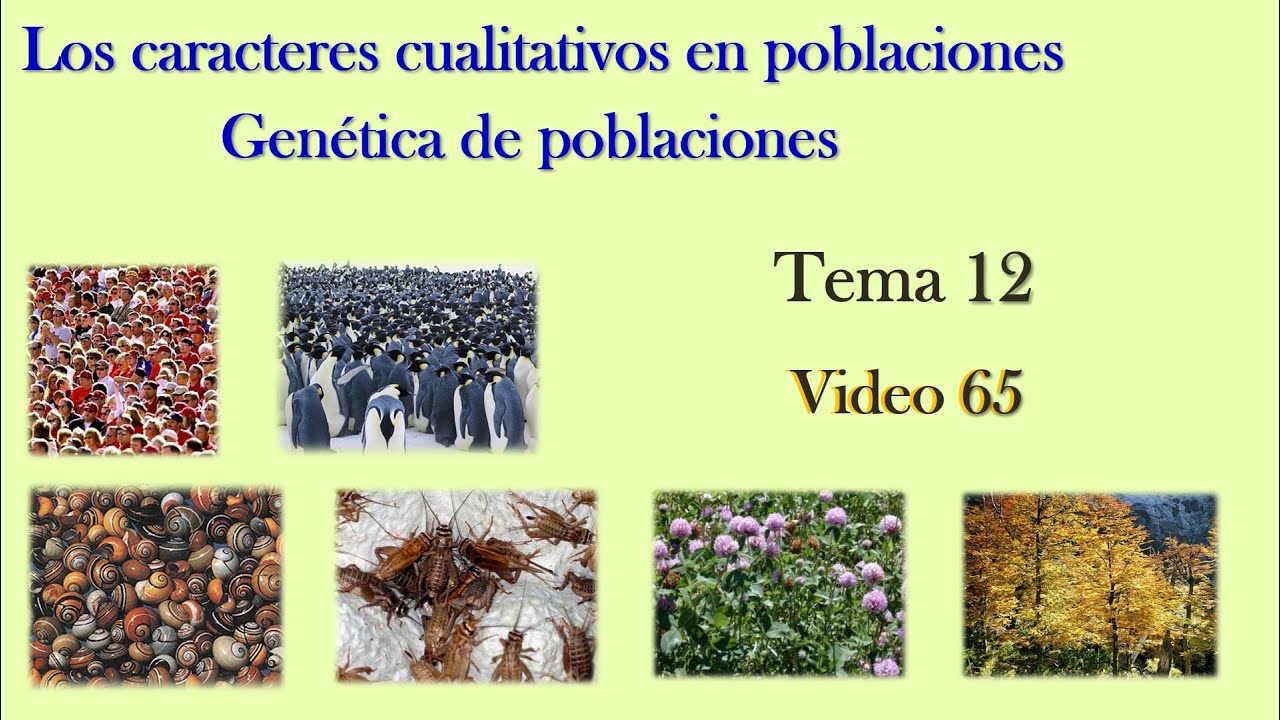
68 Tema 12 Caracteres Cualitativos en Poblaciones. Genética (Cód. 2030)
Keywords
Summary
196 words
Critical Evaluation
Value of the Information & Strength of the Argument
The video provides a solid introduction to genetic drift and inbreeding, with clear definitions and illustrative examples. The worked example of a bottleneck effect is particularly valuable, as it walks through the calculations step-by-step, reinforcing the concepts. The use of simulations and a real experiment with Drosophila adds credibility and helps visualize the stochastic nature of drift. The argumentation is logical and builds from the Hardy-Weinberg equilibrium, showing how violations of its assumptions lead to evolutionary change. However, the presentation is somewhat dry and could benefit from more engaging visuals or real-world case studies beyond the mentioned Amazon fires and oil spills. The explanation of inbreeding is concise but lacks depth on its quantitative effects, such as the inbreeding coefficient.
Scientific Rigor, Source Quality, Title Accuracy
The scientific rigor is adequate for an introductory course: the concepts are accurately presented, and the examples are standard in population genetics. However, the video does not cite specific scientific sources or studies, relying instead on general knowledge. The title accurately reflects the content, which is part of a structured course module. The description mentions ‘Procesos Dispersivos. Deriva génica’ (Dispersive Processes. Genetic Drift), which matches the video’s focus. No comments were provided for analysis.
209 words
Title / Content Match
The title accurately reflects the content, which covers qualitative traits in populations as part of a genetics course.
Quality & Reliability
7/10
The video provides a clear, structured explanation of population genetics concepts, with worked examples and simulations. However, it lacks explicit citations to scientific literature, and the production quality is basic.
Key Moments
Markers derived by PSI from the transcript: the creator did not define chapters.
- Introduction to dispersive processes and genetic drift
- Definition of genetic drift and its causes
- Explanation of bottleneck effect and founder effect
- Example of bottleneck effect with allele frequencies
- Worked example of genetic drift in a small population
- Consequences of genetic drift: loss of variation and divergence
- Simulation of drift with different population sizes
- Drosophila experiment demonstrating drift over generations
- Introduction to inbreeding and its effects
- Consequences of inbreeding: increased homozygosity and inbreeding depression
Contribution & Novelties
The video offers a clear pedagogical explanation of genetic drift and inbreeding, with a worked example that is particularly instructive. It effectively uses simulations and a classic Drosophila experiment to illustrate the concepts. The ‘Pour aller plus loin’ section suggests further exploration.
Pour aller plus loin :
- Genetic drift - Wikipedia — Comprehensive overview of genetic drift, including mathematical models and examples.
- Founder effect - Wikipedia — Detailed explanation of the founder effect and its implications.
- Inbreeding - Wikipedia — Covers the genetic consequences of inbreeding and inbreeding depression.
- Population bottleneck - Wikipedia — Discusses bottlenecks and their evolutionary impact.
100 words
Radar Profile
The radar profile shows a balanced performance with high scores in information quantity and quality, moderate technical level, and good reliability. This indicates a solid educational resource that is accessible yet informative, suitable for students learning population genetics.