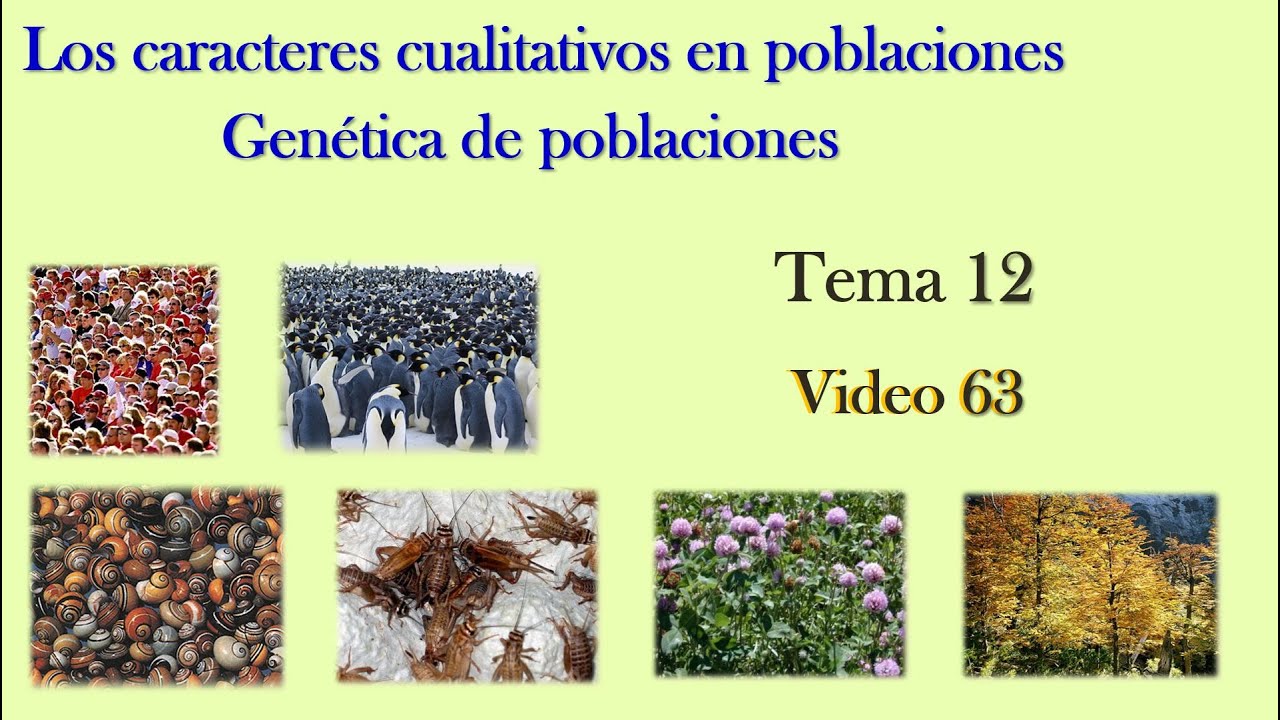
66 Tema 12 Caracteres Cualitativos en Poblaciones. Genética (Cód. 2030)
Keywords
Summary
177 words
Critical Evaluation
Value of the Information & Strength of the Argument
The video provides a comprehensive and systematic explanation of natural selection models in population genetics. It offers clear derivations and examples, making it valuable for students. The argumentation is solid, based on standard population genetics theory. The lecturer emphasizes the relative nature of fitness and the importance of dominance relationships, which are crucial for understanding selection outcomes. The step-by-step calculations are well-structured, and the use of a general framework for all selection scenarios is pedagogically effective. However, the video does not critically engage with the limitations or assumptions of these models, and it lacks references to empirical studies or real-world examples beyond a few mentions.
Scientific Rigor, Source Quality, Title Accuracy
The scientific rigor is high for an educational lecture: the content aligns with established population genetics principles. However, no specific sources are cited within the video, and the description provides only chapter timestamps, not references. The title accurately reflects the content, which is a lecture on qualitative traits in populations, focusing on selection. The video’s production is simple, but the scientific content is accurate and well-presented. The lack of citations to primary literature is a minor weakness, but the material is standard and likely based on common textbooks.
208 words
Title / Content Match
The title accurately reflects the content, which covers qualitative traits in populations within the context of genetics, specifically focusing on natural selection.
Quality & Reliability
8/10
The video is a structured academic lecture on population genetics, presenting standard models and formulas. The content is consistent with established evolutionary genetics theory, and the presentation is clear and methodical. However, it lacks explicit citations to primary literature, and the production quality is basic, which slightly reduces the score.
Key Moments
Markers derived by PSI from the transcript: the creator did not define chapters.
- Introduction to systematic processes and selection
- Definition of natural selection and its premises
- Explanation of biological fitness (w) and its relative nature
- Calculation of fitness from genotype counts
- Introduction to selection coefficient (s) and gametic selection
- Zygotic selection with complete dominance against recessive allele
- Selection against dominant allele and its consequences
- Codominance and incomplete dominance effects on selection
- Overdominance and maintenance of polymorphism
- Effectiveness of selection and time required for allele frequency changes
Contribution & Novelties
The video provides a clear and systematic tutorial on natural selection models, which is particularly useful for students. It synthesizes various selection scenarios into a unified framework, making it easier to understand. The emphasis on the relative nature of fitness and the impact of dominance relationships is valuable. For further exploration, one can consult standard population genetics textbooks or online resources.
Pour aller plus loin :
- Population genetics - Wikipedia — Overview of the field.
- Natural selection - Wikipedia — General principles.
- Fitness (biology) - Wikipedia — Definition and measurement.
- Overdominance - Wikipedia — Explanation of heterozygote advantage.
- Sickle cell disease - Wikipedia — Example of overdominance.
107 words
Radar Profile
The radar profile shows high scores in quantity and quality of information, with a moderate technical level. This indicates a content-rich lecture that is accessible to a broad audience, though it requires some background in genetics. The reliability is high, reflecting the academic nature of the presentation.