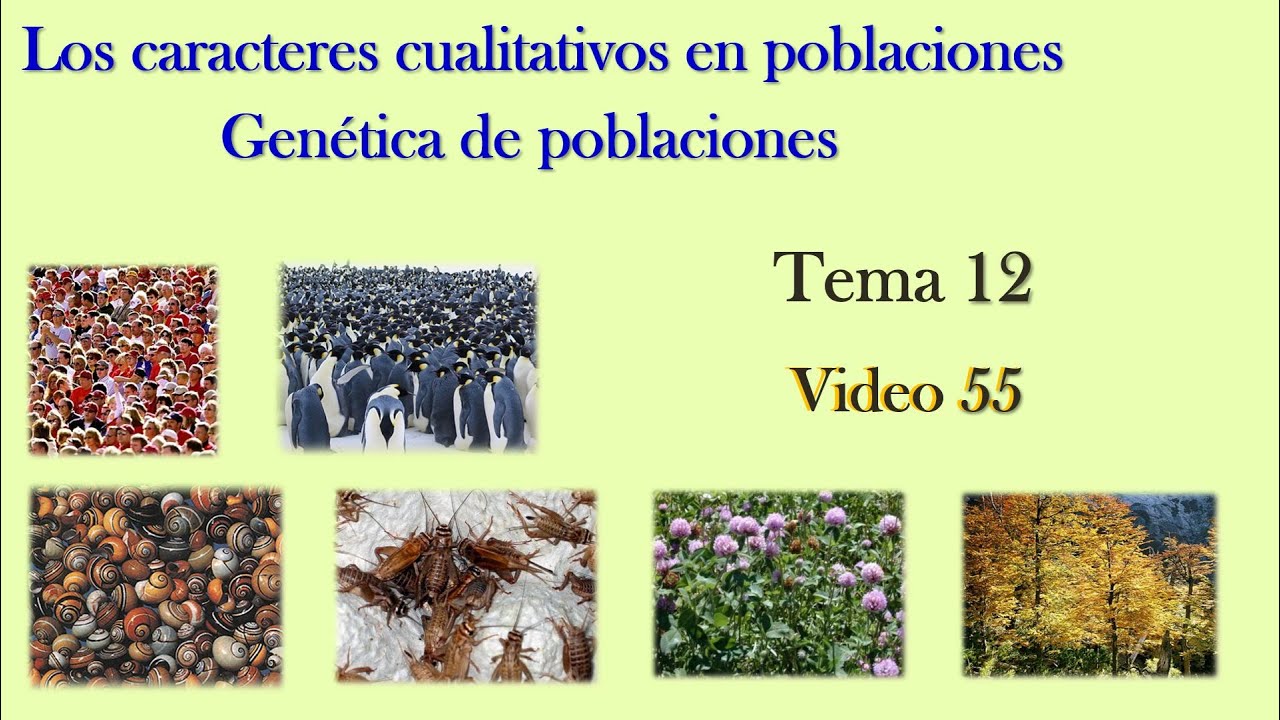
58 Tema 12 Caracteres Cualitativos en Poblaciones. Genética (Cód. 2030)
Keywords
Summary
151 words
Critical Evaluation
Value of the Information & Strength of the Argument
The video provides a clear and structured introduction to population genetics, effectively explaining key concepts such as gene pool, allele frequencies, and genotype frequencies. The argumentation is logical, building from basic definitions to more complex calculations. The instructor uses concrete examples to illustrate how to compute frequencies, which aids understanding. However, the video does not delve into the mathematical derivations of the Hardy-Weinberg equilibrium, nor does it discuss the assumptions in depth. The presentation is didactic and suitable for beginners, but it lacks critical evaluation of the models or discussion of real-world complexities.
Scientific Rigor, Source Quality, Title Accuracy
The video is scientifically accurate in its presentation of population genetics fundamentals. It references the Hardy-Weinberg law and mentions factors like mutation, migration, selection, and genetic drift, which are standard topics. However, it does not cite specific sources or provide references to the literature. The title accurately reflects the content, which is focused on qualitative traits in populations. The video is part of a university course, suggesting a certain level of academic rigor, but the lack of citations and the informal presentation style limit its scholarly value.
195 words
Title / Content Match
The title accurately reflects the content, which covers qualitative traits in populations within a genetics course.
Quality & Reliability
7/10
The video is a structured educational tutorial on population genetics, presenting fundamental concepts accurately. The content is consistent with established genetic principles, though it lacks citations to primary literature and is based on a single instructor's presentation.
Key Moments
Markers derived by PSI from the transcript: the creator did not define chapters.
Contribution & Novelties
The video provides a foundational overview of population genetics, focusing on qualitative traits. It explains the calculation of allele and genotype frequencies, which is essential for understanding genetic variation. The presentation is clear and suitable for students new to the topic.
Pour aller plus loin :
- Hardy–Weinberg principle — This principle is central to the video’s discussion of equilibrium.
- Population genetics — Provides broader context and additional concepts.
- Genetic drift — A key factor mentioned in the video that affects allele frequencies.
82 words
Radar Profile
The radar profile shows balanced scores across all dimensions, with slightly higher quality of information and reliability, indicating a solid educational resource. The lower technical level suggests it is accessible to beginners.