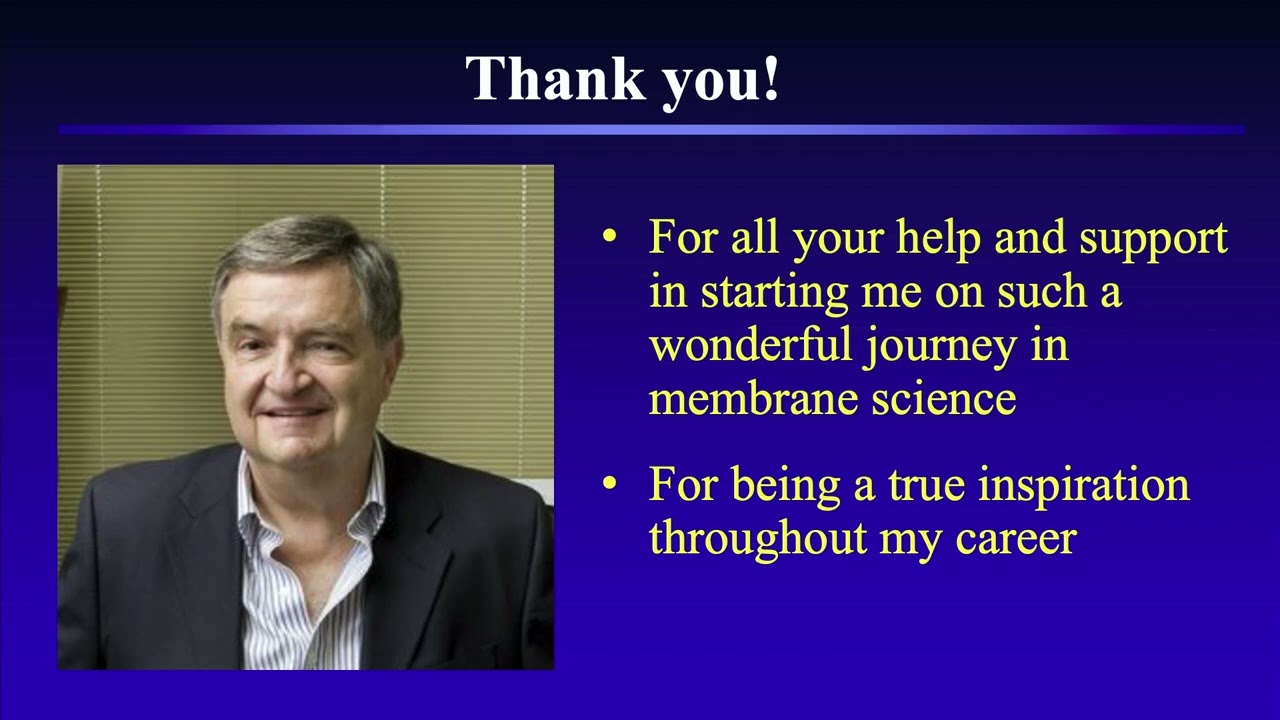
Clark Colton Symposium Membrane Processes
Keywords
Summary
194 words
Critical Evaluation
Value of the Information & Strength of the Argument
The video provides valuable firsthand accounts of Clark Colton’s impact on membrane science and his mentorship style. The speakers present specific examples of research projects, such as the development of new models for membrane filtration and the creation of immunoaffinity membranes, which illustrate the practical applications of Colton’s work. The argumentation is based on personal experience and professional achievements, which lends credibility to the claims about Colton’s influence. However, the content is largely anecdotal and lacks quantitative data or external validation, limiting its scientific rigor. The speakers’ narratives are compelling and well-structured, effectively conveying the significance of Colton’s contributions to the field.
Scientific Rigor, Source Quality, Title Accuracy
The video is a symposium recording, not a formal scientific presentation. The speakers reference specific publications and collaborations, such as the ASAIO journal papers and work with Genentech, but no direct citations or URLs are provided. The title accurately reflects the content, as it is a tribute to Clark Colton’s work in membrane processes. The scientific rigor is moderate, as the content is based on personal recollections rather than peer-reviewed data. The sources mentioned are credible but not formally cited, and the video does not include a systematic review of the literature. The adequacy between the title and content is high, as the symposium focuses on Colton’s legacy in membrane science.
228 words
Title / Content Match
The title accurately reflects the content, which is a symposium honoring Clark Colton, focusing on membrane processes and his influence.
Quality & Reliability
7/10
The video is a symposium recording featuring personal accounts and professional recollections from former students and colleagues of Clark Colton. It provides anecdotal evidence and historical context rather than peer-reviewed data. The content is credible as a tribute and reflects the speakers' direct experiences, but lacks formal citations or verifiable data beyond personal testimony.
Key Moments
Markers derived by PSI from the transcript: the creator did not define chapters.
- Introduction and first speaker's account of joining MIT and working on membrane filtration for blood cell separation.
- First speaker discusses new models for filtrate flux and hemolysis, and Clark's presentation at conferences.
- First speaker describes his career at University of Delaware, focusing on bioprocessing and collaborations with Genentech.
- First speaker shares a story about Clark preparing slides at a conference, illustrating his dedication.
- Second speaker begins, discussing her PhD on gas separation and decision to join Clark's lab.
- Second speaker talks about developing an immunoaffinity membrane for xenotransplantation and its application in dialysis.
- Second speaker reflects on Clark's mentorship and personal impact, including a cake for his 50th birthday.
- Third speaker, a patent attorney, begins, discussing his background and first project on shear stress and immune cells.
- Third speaker discusses his second project on immunoaffinity membranes and the lessons learned about resourcefulness.
- Third speaker highlights the patent productivity of the Colton family tree and concludes with personal remarks.
Cited Sources
- ASAIO Journal — Mentioned as the journal where Clark Colton and his collaborators published work on membrane filtration for blood cell separation, and where the first speaker published new models.
- Genentech collaboration — Mentioned as a collaboration for developing a membrane-based process for monoclonal antibody purification.
Concurring Sources
- ASAIO Journal — The speakers reference publications in this journal, which is a peer-reviewed source for artificial organs and membrane science.
Contribution & Novelties
The video provides a unique historical perspective on the development of membrane processes in biomedical engineering, highlighting Clark Colton’s role as a mentor and pioneer. It offers personal anecdotes that illustrate the practical challenges and successes in the field, such as the development of immunoaffinity membranes for xenotransplantation and the use of membranes for biopharmaceutical purification. The symposium also underscores the significant patent productivity of Colton’s academic lineage, which is an original contribution to understanding the impact of academic research on commercialization.
Pour aller plus loin :
- Membrane technology — Provides an overview of membrane processes and their applications.
- Immunoaffinity chromatography — Related to the immunoaffinity membranes discussed in the video.
- Xenotransplantation — Context for the work on removing xeno-reactive IgM to prevent hyperacute rejection.
125 words
Radar Profile
The radar profile shows moderate scores across all dimensions, with slightly higher scores in quality of information and reliability, reflecting the video's strength as a personal testimony but its limitations in technical depth and formal sourcing.