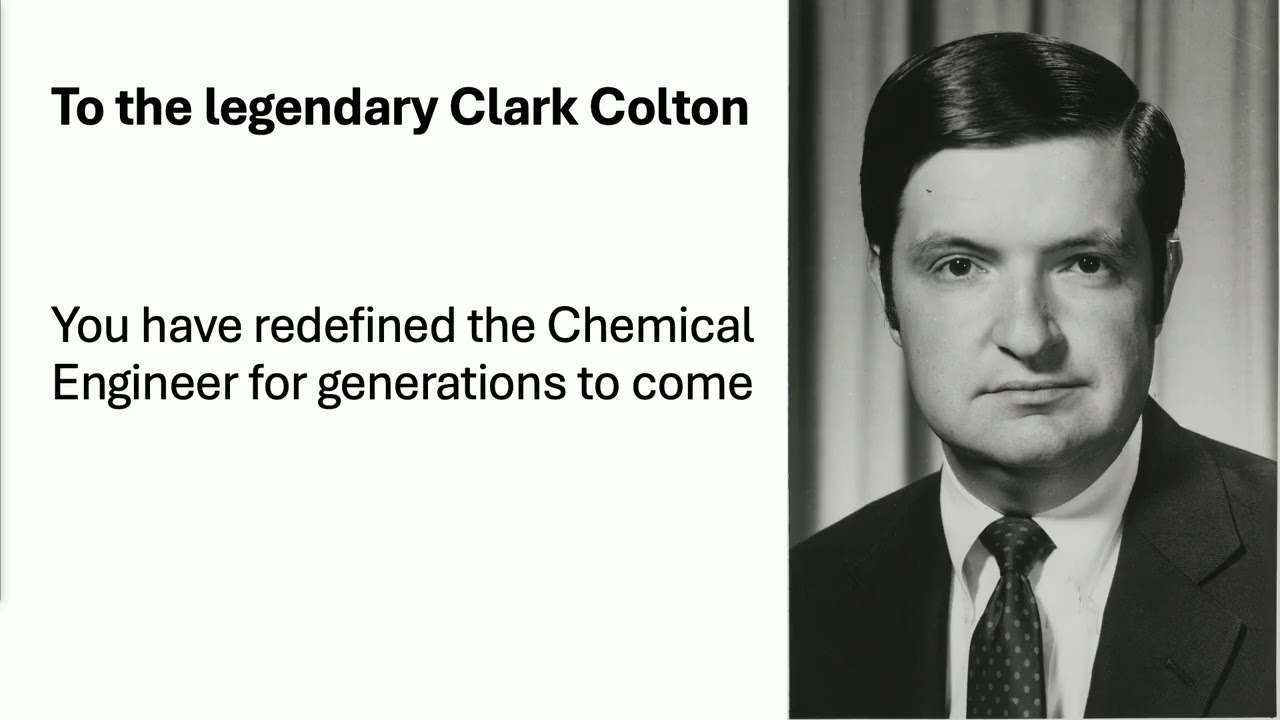
Clark Colton Symposium Enzyme Engineering continued
Keywords
Summary
177 words
Critical Evaluation
Value of the Information & Strength of the Argument
The value of the information lies in the firsthand accounts of how Clark Colton’s mentorship shaped the careers of his students and influenced the field of biochemical engineering. The speakers provide concrete examples of applying chemical engineering principles to biological systems, such as the design of an enzymatic reactor for ATP production and the development of high-gradient magnetic filtration for biotech applications. The argumentation is based on personal testimony and professional achievements, which lends credibility but is not a systematic scientific analysis. The speakers effectively illustrate the impact of Colton’s multidisciplinary approach, but the evidence is anecdotal and retrospective.
Scientific Rigor, Source Quality, Title Accuracy
The scientific rigor is moderate, as the content is a collection of personal narratives rather than a formal scientific presentation. The sources cited are the speakers’ own experiences and references to specific projects and publications, but no external sources are provided in the video description. The title accurately reflects the content, which is a continuation of the symposium on enzyme engineering. The adequacy between title and content is good, as the video indeed focuses on enzyme engineering and Colton’s legacy in that area.
197 words
Title / Content Match
The title accurately reflects the content, which continues the symposium on enzyme engineering and Clark Colton's legacy.
Quality & Reliability
8/10
The video is a symposium recording featuring first-hand accounts from former students and colleagues of Professor Clark Colton. The information is anecdotal and retrospective, but the speakers are credible professionals with verifiable careers. The content is not peer-reviewed but offers authentic historical insights into the development of biochemical engineering.
Key Moments
Markers derived by PSI from the transcript: the creator did not define chapters.
- Introduction and opening remarks by the first speaker, who discusses Clark Colton's role in pioneering interdisciplinary research in the 1970s.
- The first speaker recounts the development of an enzymatic reactor for ATP production and its commercial impact.
- The first speaker continues, describing his career in industry, including work on Kevlar at DuPont and the application of AI for production planning.
- The first speaker concludes with a tribute to Clark Colton's mentorship and the importance of a multidisciplinary approach.
- The second speaker, a former student, shares his work on high-gradient magnetic filtration and his subsequent career as a serial entrepreneur.
- The third speaker, Jose Costa, presents his journey from science to diplomacy, including his work with UNIDO and the European Commission.
- The fourth speaker, a long-time friend, shares humorous anecdotes about playing tennis with Clark and his sabbaticals at MIT.
- The fourth speaker discusses his research on RNA purification and the potential of RNA to replace proteins in therapeutic applications.
- Kris Prather, department head, provides an overview of Clark Colton's contributions to the department and his pioneering work in biomedical engineering.
- Kris Prather concludes with remarks on Colton's focus on students and the lasting impact of his mentorship.
Contribution & Novelties
The video provides a unique historical perspective on the development of biochemical engineering through the lens of Clark Colton’s mentorship. It highlights the importance of a multidisciplinary approach in solving complex problems, as demonstrated by the diverse careers of his students. The personal anecdotes offer insights into the culture of MIT’s chemical engineering department and the impact of a dedicated mentor.
Pour aller plus loin :
- Enzyme engineering — Overview of the field and its applications.
- Biochemical engineering — Introduction to the discipline and its scope.
- Artificial pancreas — Related to Colton’s research on glucose sensors and encapsulated islet cells.
- Magnetic separation — Technique used in the second speaker’s work on magnetic filtration.
- High-gradient magnetic separation — Specific method mentioned in the video.
123 words
Radar Profile
The radar profile shows high scores in quality of information and global reliability, reflecting the credibility of the speakers and the authenticity of the accounts. The quantity of information is moderate, and the technical level is moderate, as the content is accessible but includes some technical details. The overall profile suggests a valuable historical record with strong personal testimony.