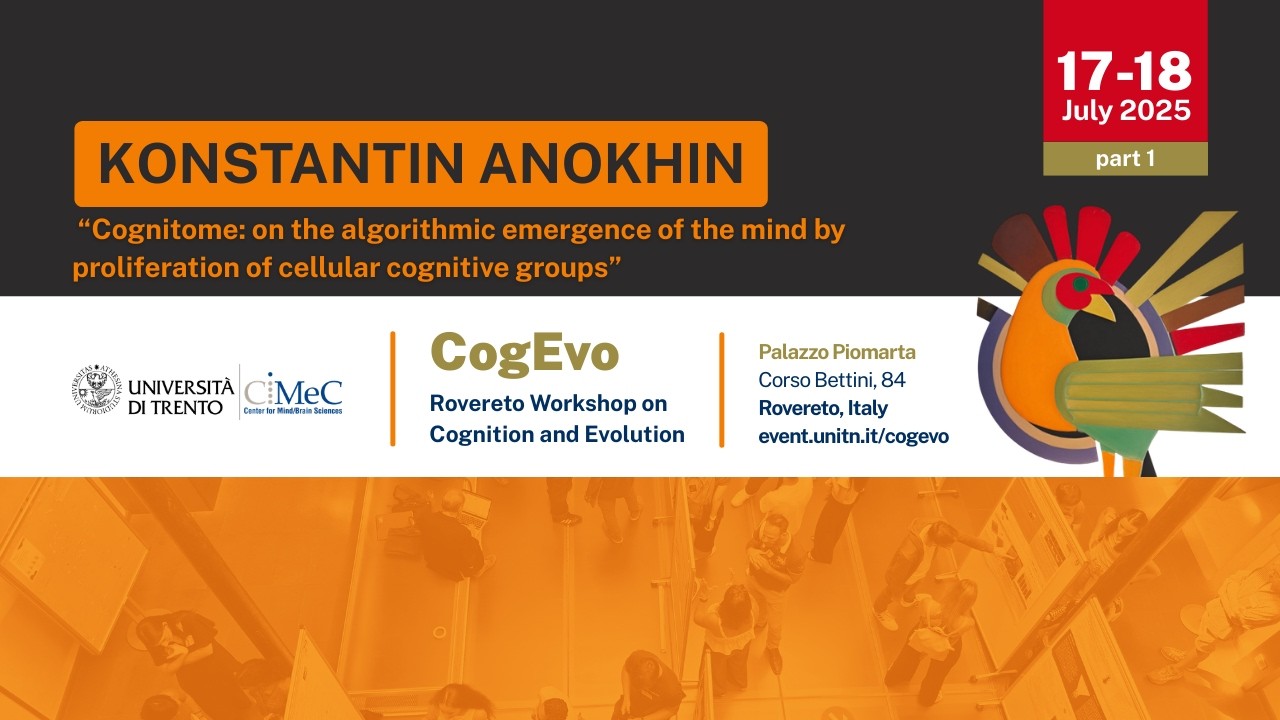
CogEvo 2025 - 2 | July 17-18, 2025 | Konstantin Anokhin
Keywords
Summary
113 words
Critical Evaluation
Value of the Information & Strength of the Argument
The talk offers a valuable synthesis of historical and contemporary ideas, proposing a novel framework (cognitome) that integrates molecular, cellular, and systems levels. Anokhin’s argumentation is logically structured, building from philosophical foundations to empirical evidence, and he effectively uses historical examples to support his claims. However, the theory is presented as a perspective rather than a fully validated model, and some leaps from data to theory are speculative. The emphasis on the distinction between mind and consciousness is thought-provoking but not universally accepted.
Scientific Rigor, Source Quality, Title Accuracy
Anokhin demonstrates scholarly rigor by referencing key figures (Sechenov, Pavlov, Anokhin, Lorenz, von Holst) and their works, grounding his argument in historical context. He cites specific experiments and concepts, such as the reafference principle and functional systems theory. However, he does not provide direct citations to recent peer-reviewed literature, and the talk is more of an overview than a detailed exposition of evidence. The title accurately reflects the content, focusing on the algorithmic emergence of mind from cellular cognitive groups.
178 words
Title / Content Match
The title accurately reflects the content: Anokhin discusses the 'cognitome' as a structural basis for mind, emphasizing algorithmic emergence from cellular cognitive groups.
Quality & Reliability
7/10
The talk presents a coherent theoretical framework based on decades of research, referencing historical and contemporary neuroscience. However, it is an expert opinion with limited empirical evidence presented in the talk itself, and some claims are speculative.
Key Moments
Markers derived by PSI from the transcript: the creator did not define chapters.
- Introduction: Anokhin outlines the talk's focus on mind vs consciousness and the Darwinian approach.
- Discussion of Cartesian vs Darwinian approaches in neuroscience.
- Historical overview: Sechenov's contributions and the origins of Russian neuroscience.
- Lorenz and von Holst: the reafference principle and the critique of reflex theory.
- Anokhin's functional systems theory and the integrative activity of neurons.
- Studies on neurons specialized for subjective experience (Shvyrkov).
- Mapping engrams with immediate early genes; the cognitome concept.
Cited Sources
- CogEvo 2025 Workshop — Official workshop page providing context for the talk.
Concurring Sources
- CogEvo 2025 Workshop — Workshop page supporting the event context.
Contribution & Novelties
Anokhin’s talk provides a novel integrative framework, the ‘cognitome’, which posits a specific neural structure underlying mind, distinct from consciousness. This perspective bridges molecular, cellular, and systems levels, and emphasizes a Darwinian evolutionary approach to cognition. The talk also highlights historical contributions from Russian neuroscience that are often overlooked in Western literature.
Pour aller plus loin :
- Neural correlates of consciousness — Relevant for contrasting with Anokhin’s structural approach.
- Functional systems theory — Directly related to Anokhin’s framework.
- Engram (neuropsychology) — Relevant to his mapping of memory traces.
88 words
Radar Profile
The radar profile shows high scores in quantity of information and technical level, reflecting the dense historical and theoretical content. Quality and reliability are slightly lower due to the speculative nature of the theory, but still solid.
💬 No comments were provided for analysis.