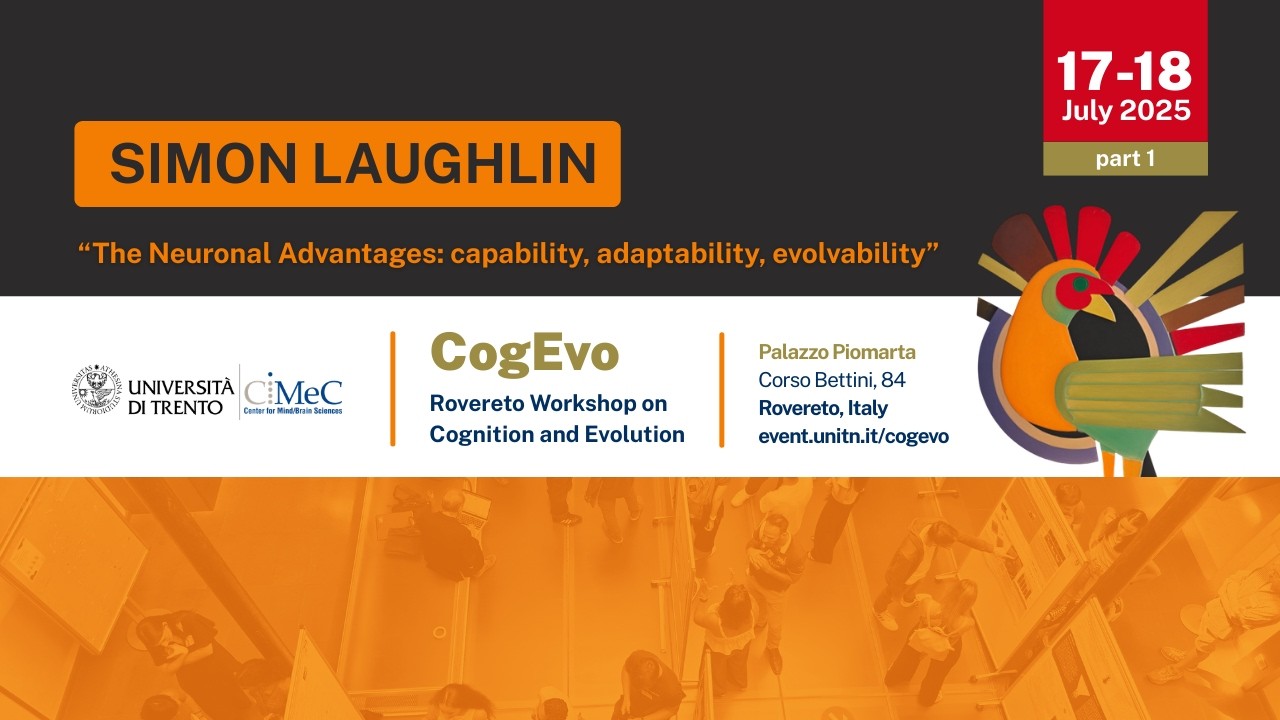
CogEvo 2025 - 1 | July 17-18, 2025 | Simon Laughlin
Keywords
Summary
188 words
Critical Evaluation
Value of the Information & Strength of the Argument
The talk provides a valuable synthesis of principles underlying neuronal information processing, adaptability, and evolvability. Laughlin argues that the same mechanisms that make neurons capable also confer adaptability and evolvability, a perspective that integrates biophysics, cell biology, and evolution. He supports his arguments with concrete examples, such as the frequency filtering in dendrites, the logarithmic transformation in simple circuits, and the molecular engineering of AMPA and NMDA receptors. The argumentation is logical and builds from basic principles to broader implications. He also introduces the concept of the ‘computer in every living cell’ to unify the molecular mechanisms that enable plasticity and evolution. The talk is persuasive and well-structured, though it is a high-level overview rather than a detailed exposition of new research.
Scientific Rigor, Source Quality, Title Accuracy
The talk is scientifically rigorous, grounded in established biophysics and cell biology. Laughlin references classic work (e.g., Adrian and Zotterman, 1926) and recent reviews (e.g., Attwell and Gibb on synapses). He is an authority in the field, and the content aligns with current understanding. The title accurately reflects the content, focusing on neuronal advantages. The talk is an expert opinion and synthesis, not a presentation of new experimental data. The description provides a link to the workshop website, but no specific sources are cited in the video itself. The talk is well-referenced implicitly, but explicit citations are limited.
235 words
Title / Content Match
The title accurately reflects the content, which focuses on how neuronal capabilities enable adaptability and evolvability.
Quality & Reliability
8/10
Talk by an emeritus professor of neurobiology at Cambridge and Fellow of the Royal Society, presenting established principles and recent insights. The content is grounded in biophysics and cell biology, with references to classic and recent work. The talk is a synthesis of known research rather than new data, but the authority and coherence are high.
Key Moments
Markers derived by PSI from the transcript: the creator did not define chapters.
- Introduction by host and start of talk
- Contrast between chemical circuits in bacteria and neural circuits
- Electrical signaling in paramecium and evolution of neurons
- Passive transmission in dendrites and frequency filtering
- Action potentials and information rate trade-offs
- Integration of multiple inputs and synaptic advantages
- Synaptic diversity and molecular engineering
- Overcoming chemical cross-talk and dense interconnectivity
- Adaptation within lifetime: locust phase change and synaptic plasticity
- Evolutionary adaptability and growth cone exploration
Cited Sources
- CogEvo Workshop Website — Mentioned in the video description as the workshop's official page.
Concurring Sources
- Principles of Neural Design — Laughlin's book with Peter Sterling, which elaborates on design principles in brains.
Contribution & Novelties
The talk offers a unifying perspective on how neuronal mechanisms confer capability, adaptability, and evolvability, emphasizing the role of the ‘computer in every living cell’ in enabling these properties. It synthesizes known principles into a coherent framework that may inspire further research.
Pour aller plus loin :
- Neuronal biophysics — Provides background on electrical signaling and cable theory.
- Synaptic plasticity — Covers mechanisms like spike-timing-dependent plasticity.
- Evolvability — Discusses the concept of evolvability in biological systems.
76 words
Radar Profile
The radar profile shows high scores in information quality and reliability, with moderate technical level. This indicates a talk that is scientifically sound and informative, but not overly technical, making it accessible to a broad audience.