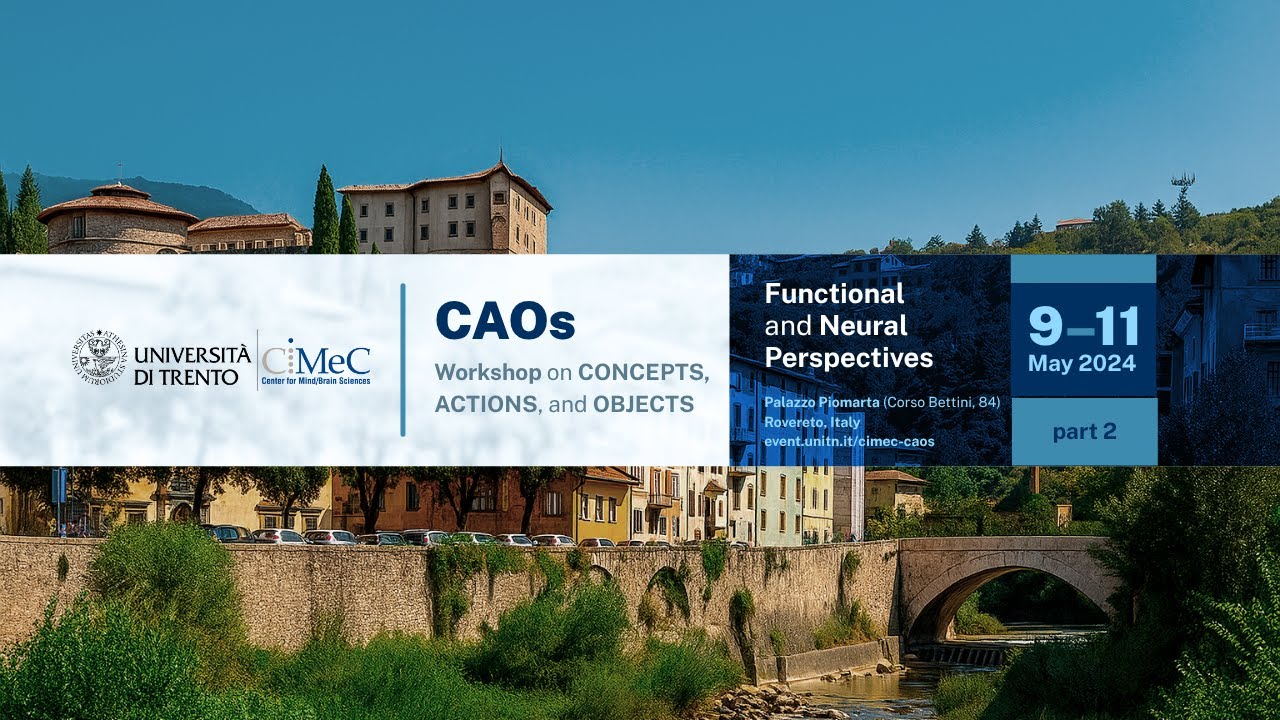
CAOS 2024 - 2 | Rovereto, May 9-11 | Patrizia Fattori
Keywords
Summary
163 words
Critical Evaluation
Value of the Information & Strength of the Argument
The talk provides valuable insights into the functional properties of area V6A, a key region in the dorsomedial visual stream. The argumentation is solid, based on a series of well-designed experiments using single-unit recordings in awake monkeys. The speaker carefully controls for visual confounds by using dark conditions and demonstrates that V6A neurons encode both motor and visual signals. The use of decoding techniques strengthens the claim that V6A activity carries information about action parameters. The proposal that V6A acts as a state estimator is speculative but well-grounded in the observed neural properties and anatomical connections. Overall, the presentation is rigorous and contributes significantly to our understanding of vision for action.
Scientific Rigor, Source Quality, Title Accuracy
The talk is scientifically rigorous, with clear methodology and cautious interpretation. The speaker references key studies in the field, including those by Mountcastle, Colby, and others, and builds on her own published work. The title accurately reflects the content, focusing on vision for action in the medial posterior parietal cortex. The talk is part of a workshop, so it is not peer-reviewed in this format, but the underlying research has been published in reputable journals. The speaker acknowledges limitations and open questions, enhancing credibility.
210 words
Title / Content Match
The title accurately reflects the content, focusing on vision for action in the medial posterior parietal cortex.
Quality & Reliability
8/10
Talk by a leading researcher in the field, presenting original data from peer-reviewed studies, with clear methodology and cautious interpretation. Some limitations: single talk, not peer-reviewed in this format, but based on solid experimental evidence.
Key Moments
Markers derived by PSI from the transcript: the creator did not define chapters.
- Introduction to the posterior parietal cortex and its role in the dorsal visual stream.
- Historical studies by Mountcastle and others on somatosensory and visual properties.
- Identification of area V6A and its visual properties, including complex receptive fields.
- Encoding of reaching direction and amplitude in V6A.
- Decoding of target location and grip type from V6A activity.
- Integration of visual and motor signals in V6A, with neurons responding differently in light and dark.
- Proposal that V6A acts as a state estimator for action control.
- Object representation in V6A, with neurons tuned to different object features.
- Anatomical connections of V6A, particularly with dorsal premotor cortex.
- Conclusions and implications for understanding vision for action.
Cited Sources
- CIMeC Workshop on Concepts, Actions, and Objects — Workshop page providing context for the talk.
Concurring Sources
- CIMeC Workshop on Concepts, Actions, and Objects — Workshop page providing context for the talk.
Contribution & Novelties
The talk presents original findings on the role of area V6A in vision for action, including evidence for encoding of both reaching and grasping parameters, integration of visual and motor signals, and object representation. It proposes a novel role for V6A as a state estimator, integrating sensory and motor signals to predict action outcomes. This extends previous work that focused primarily on reaching.
Pour aller plus loin :
- Dorsomedial visual stream — Overview of the dorsal visual stream and its subdivisions.
- Posterior parietal cortex — General information on the region.
- State estimation in motor control — Concept of state estimation relevant to the proposed function of V6A.
107 words
Radar Profile
The radar profile shows high scores in quality and reliability, with slightly lower scores in quantity and technical level, indicating a focused, in-depth presentation with strong scientific backing.