Séminaire de recherche PACRI - N°31 - 27.03.2026
Keywords
Summary
141 words
Critical Evaluation
Value of the Information & Strength of the Argument
The presentation provides valuable insights into a practical intervention to address vaccine hesitancy among healthcare workers. The argumentation is solid, based on a randomized controlled trial design with clear methodology and results. The speaker acknowledges limitations such as selection bias and small sample sizes, which strengthens the credibility. The use of established models (7C, Kirkpatrick) and theories (self-efficacy) adds theoretical grounding. The discussion of results is nuanced, distinguishing between confidence and behavioral outcomes, and suggesting future directions.
Scientific Rigor, Source Quality, Title Accuracy
The scientific rigor is high: the study uses a randomized design, validated tools, and appropriate analyses. The sources cited are not explicitly listed, but the presentation references the European project and the PRHPV project as a basis for the training. The title accurately reflects the content, which is a research seminar. The Q&A session provides additional depth, addressing potential concerns. No external sources are provided in the description, so the evaluation relies on the presented methodology and results.
170 words
Title / Content Match
The title accurately reflects the content: a research seminar presentation on vaccine promotion and epidemiological modeling.
Quality & Reliability
7/10
The video presents a rigorous research seminar with clear methodology, results, and limitations. The study design is randomized controlled trial, and the presentation includes detailed data and analysis. However, the sample sizes are small and there is potential selection bias, which limits the generalizability. The content is scientifically sound but not peer-reviewed in this format.
Key Moments
Markers derived by PSI from the transcript: the creator did not define chapters.
- Introduction to the seminar and first presentation on Vax-Action project.
- Background on influenza vaccination coverage and the need for interventions.
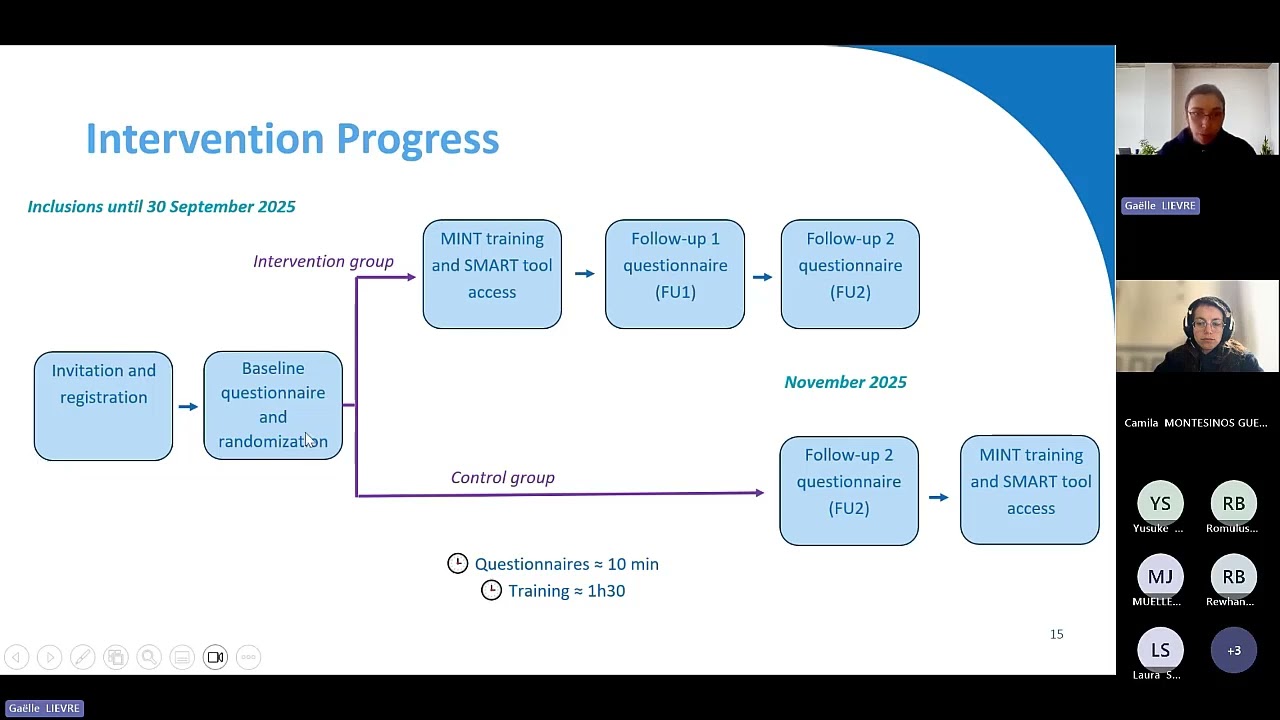
- Description of the intervention: motivational interviewing training (MINT) and SMART tool.
- Study design: randomized controlled trial across five European countries.
- Results: improvements in confidence outcomes, especially for those with lower baseline confidence.
- Discussion of limitations and future steps.
- Q&A session: addressing vaccine efficacy communication and inter-country variability.
- Second presentation on modeling MDRO prevention bundles (brief).
Contribution & Novelties
The Vax-Action project provides a novel, multi-country intervention combining motivational interviewing training with a pre-consultation tool for patients. The use of the 7C model and discrete choice experiments in the SMART tool is innovative. The study demonstrates feasibility and positive effects on healthcare workers’ confidence, which is a key precursor to behavior change. The findings suggest that such interventions can be beneficial, particularly for those with lower initial confidence.
Pour aller plus loin :
- Motivational interviewing — Core technique used in the intervention.
- Vaccine hesitancy — The problem addressed.
- Kirkpatrick model — Evaluation framework used.
95 words
Radar Profile
The radar profile shows high scores in information quantity and quality, with moderate technical level and reliability. This indicates a well-structured presentation with substantial content, but with some limitations in technical depth and external validation.