Séminaire de recherche PACRI - N°28 - 19.12.2025
Keywords
Summary
143 words
Critical Evaluation
Value of the Information & Strength of the Argument
The value of the information is high for researchers in infectious disease modeling and public health. The presentation provides a novel framework for comparing vaccine effects on antibiotic resistance, with clear methodological steps and sensitivity analyses. The argumentation is solid, based on mathematical modeling and simulation, though limited by the lack of empirical validation. The discussion adds practical insights on data challenges and potential applications.
Scientific Rigor, Source Quality, Title Accuracy
The scientific rigor is good: the model is clearly described, and the sensitivity analysis is appropriate. However, no specific sources are cited in the transcript, and the description only mentions the seminar organization. The title accurately reflects the content, which is a research seminar. The adequacy between title and content is high.
132 words
Title / Content Match
The title accurately reflects the content: a research seminar with two presentations on vaccine impact and antibiotic resistance.
Quality & Reliability
7/10
The seminar presents original research with a clear methodological framework, but the lack of peer-reviewed publication and limited data availability reduce the score.
Key Moments
Markers derived by PSI from the transcript: the creator did not define chapters.
- Introduction by Laura Temime, presentation of Chloé Aupépin's PhD topic.
- Chloé Aupépin begins her presentation on bacterial vaccines and antibiotic resistance.
- Presentation of the compartmental model structure, including sensitive and resistant strains.
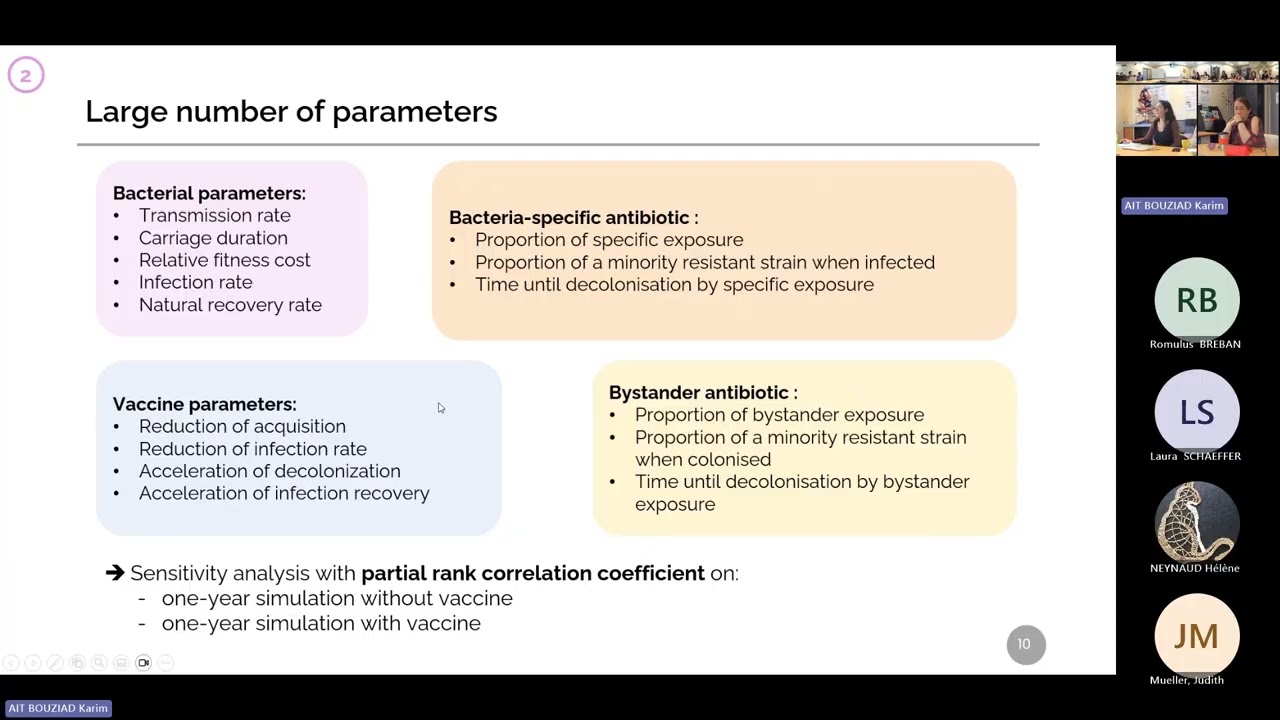
- Sensitivity analysis results: key parameters affecting infection incidence and resistance.
- Definition of six vaccine types and their impact on infection reduction.
- Application to two bacteria with different carriage rates, showing vaccine impact variability.
- Conclusion and discussion, including Q&A on model assumptions and data limitations.
- End of the seminar.
Cited Sources
- World Health Organization framework for estimating vaccine impact on AMR — Mentioned as a framework to estimate vaccine impact on antibiotic resistance.
- Primavera project — Mentioned as a dynamic modeling project on vaccine impact.
Concurring Sources
- WHO framework for estimating vaccine impact on AMR — The model aligns with WHO's framework for estimating vaccine impact on AMR.
- Primavera project — The model complements the Primavera project by providing a more generalizable approach.
Contribution & Novelties
The presentation offers a novel dynamic modeling framework that combines the simplicity of the WHO framework with the specificity of dynamic transmission models, allowing for comparison of different vaccine types across various bacteria. The sensitivity analysis provides insights into which vaccine mechanisms are most impactful. The discussion highlights the importance of considering decolonization treatment and the distinction between colonization and infection.
Pour aller plus loin :
- Antimicrobial resistance — Overview of AMR and its global impact.
- Mathematical modelling of infectious disease — Background on compartmental models.
- Vaccine efficacy — Definition and measurement of vaccine efficacy.
95 words
Radar Profile
The radar profile shows high scores in quantity of information and technical level, indicating a dense and specialized presentation. The quality and reliability scores are moderate, reflecting the preliminary nature of the research and lack of peer review.