Séminaire de recherche PACRI - N°22 - 28.03.2025
Keywords
Summary
141 words
Critical Evaluation
Value of the Information & Strength of the Argument
The value of the information is high for researchers in drug development and pharmacokinetics, as it presents a practical, iterative method to predict toxicity early, potentially reducing late-stage failures. The argumentation is solid: the presenter clearly explains the rationale, the steps, and the results, and addresses limitations and possible improvements. The method is based on established pharmacokinetic principles and is validated against known toxicity outcomes. The discussion adds depth, with questions about the threshold choice and applicability to special populations, which are answered transparently.
Scientific Rigor, Source Quality, Title Accuracy
The scientific rigor is good: the methodology is systematic, with 210 scenarios considered, and the results are compared with actual toxicity data. The sources are not explicitly cited in the video, but the work is based on industry data and standard pharmacokinetic models. The title accurately reflects the seminar content. The presentation is clear and well-structured, with appropriate technical detail. The Q&A session further clarifies the methods and limitations.
168 words
Title / Content Match
The title accurately describes the content as a research seminar, with two presentations on drug development and HPV vaccination.
Quality & Reliability
7/10
The seminar presents a structured methodological approach for early prediction of human Cmax to assess toxicity, with clear explanations of models and scenarios. The presenter is a trainee, and the work is based on industry data, but the methodology is transparent and reproducible. The discussion includes critical questions and clarifications, enhancing credibility.
Key Moments
Markers derived by PSI from the transcript: the creator did not define chapters.
- Introduction by Laura Temime, presenting Chloé Aupépin and her background.
- Chloé explains the drug development process and the high failure rate (90%).
- Introduction to Cmax and its role in toxicity, with a typical pharmacokinetic profile.
- Explanation of the two main objectives: comparing compounds and aiding drug design.
- Description of the scenarios: different data availability and estimation methods.
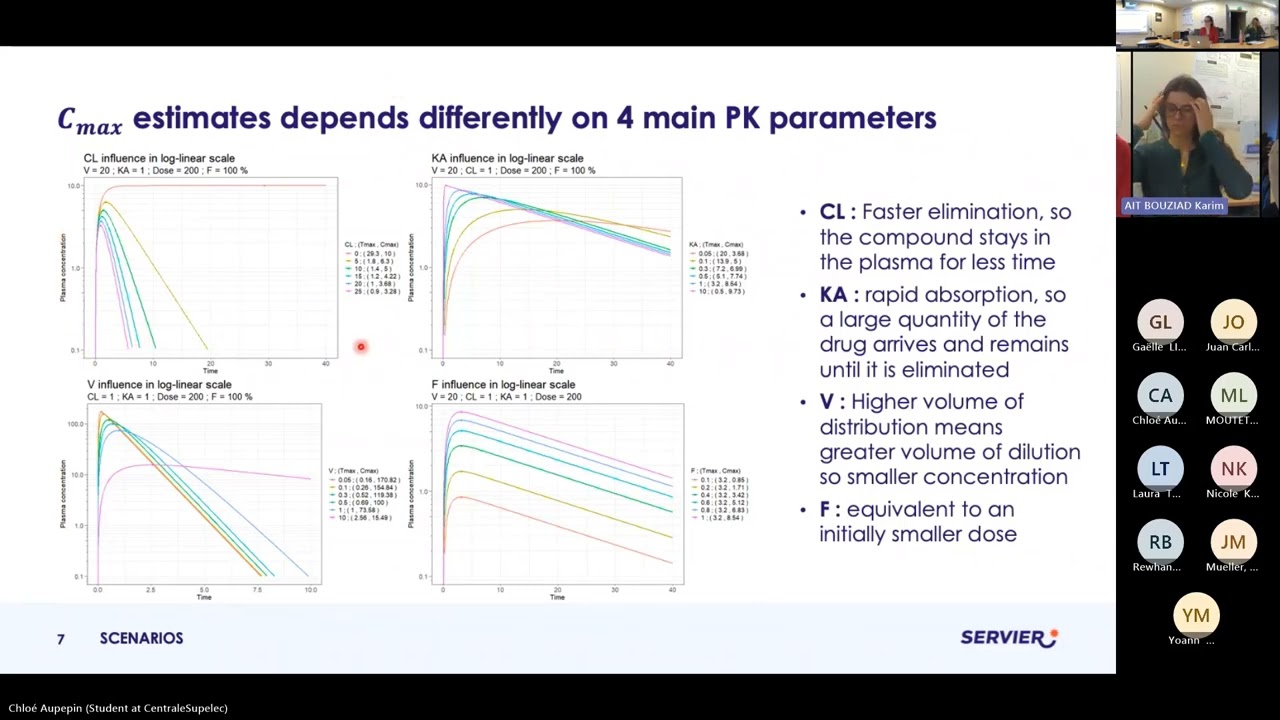
- Details on the four key parameters (clearance, volume, absorption, bioavailability) and their influence on Cmax.
- Explanation of how toxic dose is derived from Cmax and IC50 threshold.
- Presentation of the selection criteria and ranking method using proportions of scenarios.
- Results for seven compounds: identification of S2 and S4 as safest, consistent with toxicity studies.
- Discussion on the impact of missing data and the possibility of omitting in vivo data.
- Conclusion and future improvements, including liver toxicity modeling.
- Q&A session: questions about the threshold and applicability to special populations.
Cited Sources
- No external sources cited in the video — The presentation is based on internal data and standard pharmacokinetic models; no specific references are mentioned.
Concurring Sources
- No external sources cited — No external sources are mentioned in the video.
Dissenting Sources
- No external sources cited — No external sources are mentioned in the video.
Contribution & Novelties
The presentation offers a novel approach to early toxicity prediction by systematically combining multiple data sources and scenarios to estimate Cmax and rank compounds. This method is iterative and can be updated as more data become available, potentially improving compound selection and reducing late-stage failures. The work also highlights the possibility of omitting in vivo animal data in some cases, which could streamline the process.
Pour aller plus loin :
- Pharmacokinetics — Provides foundational concepts of drug absorption, distribution, metabolism, and excretion.
- Maximum concentration (Cmax) — Defines Cmax and its role in pharmacology.
- IC50 — Explains the half-maximal inhibitory concentration, used as a threshold in this study.
- Drug development — Overview of the drug development process and its challenges.
119 words
Radar Profile
The radar profile shows high scores in technical level and information quality, reflecting the specialized and well-structured content. The moderate scores in quantity and reliability suggest that while the presentation is detailed, it relies on internal data and lacks external references.