Séminaire de recherche PACRI - N°24 - 23.05.2025
Keywords
Summary
132 words
Critical Evaluation
Value of the Information & Strength of the Argument
The value of the information is high for public health researchers, as it provides insights into vaccine hesitancy profiles and their association with vaccination behavior. The argumentation is solid, based on a large dataset and appropriate statistical methods (latent class analysis, logistic regression). The presentation clearly explains the methodology and results, and the discussion acknowledges limitations and suggests next steps.
Scientific Rigor, Source Quality, Title Accuracy
The scientific rigor is good: the study uses a validated theoretical model (7C) and a large sample. The quality of sources is acceptable, as the study is based on a published protocol (OSF) and references prior work. The title accurately reflects the content, which is a research seminar. No external sources are cited in the description, but the presentation mentions the OSF protocol.
138 words
Title / Content Match
The title accurately reflects the content, which is a research seminar with two presentations.
Quality & Reliability
7/10
The seminar presents preliminary results from a peer-reviewed study protocol registered on OSF, with clear methodology and statistical analysis. However, the video is a seminar recording with limited detail and no direct citation of sources in the description.
Key Moments
Markers derived by PSI from the transcript: the creator did not define chapters.
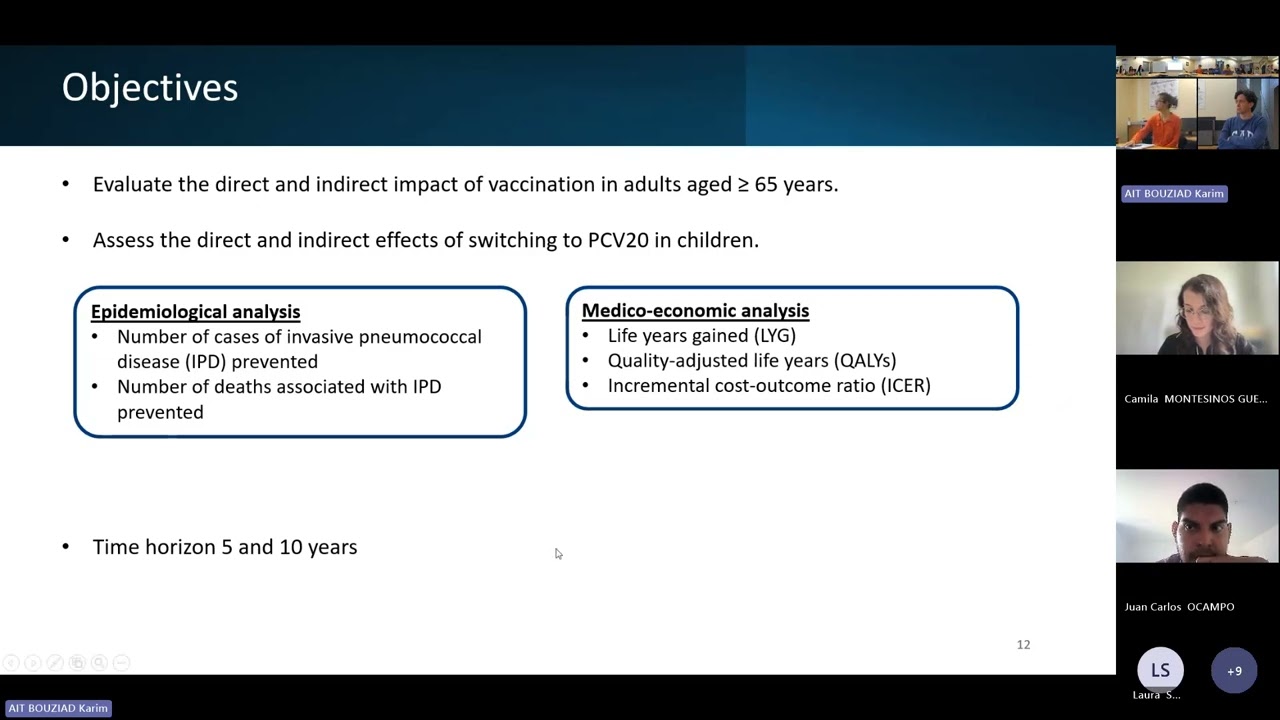
- Introduction and first presentation on pneumococcal vaccination modelling
- Start of second presentation on 7C attitudinal profiles
- Explanation of 7C model and study context
- Methodology: latent class analysis and logistic regression
- Results: identification of seven classes and their characteristics
- Discussion and limitations
- Q&A session
Cited Sources
- OSF protocol for the ComCor Cognitiv study — Mentioned as a public protocol for further methodological details.
Concurring Sources
- 7C model of vaccination — Provides theoretical background on the 7C model.
Contribution & Novelties
This study contributes to the understanding of vaccine hesitancy by identifying distinct attitudinal profiles based on the 7C model, which can inform targeted public health interventions. The novelty lies in the application of latent class analysis to a large French sample during the COVID-19 pandemic.
Pour aller plus loin :
- 7C model of vaccination — Background on psychological antecedents of vaccination.
- Latent class analysis — Statistical method used for classification.
- ComCor study — Related case-control study on COVID-19 risk factors.
80 words
Radar Profile
The radar profile shows high scores in quality of information and technical level, with moderate scores in quantity and reliability. This indicates a technically sound presentation with some limitations in depth and source citation.