Séminaire de recherche PACRI - N°23 - 25.04.2025
Keywords
Summary
132 words
Critical Evaluation
Value of the Information & Strength of the Argument
The seminar provides valuable insights into two distinct areas of infectious disease modeling. The first study on hepatitis B offers a rigorous cost-effectiveness analysis with clear methodology, including dynamic modeling, calibration, and sensitivity analyses. The argumentation is solid, with results supporting the ‘prophylaxis for all’ strategy as dominant. The second presentation, while explicitly work-in-progress, outlines a logical framework for evaluating monoclonal antibodies against S. aureus infections, with a clear model structure and consideration of colonization dynamics. However, the lack of preliminary results and the hypothetical nature of the intervention limit its current value.
102 words
Title / Content Match
The title accurately reflects the content, which is a research seminar with two presentations.
Quality & Reliability
7/10
The seminar presents two original modeling studies with clear methodology, but limited peer-reviewed validation and no external sources cited in the video.
Key Moments
Markers derived by PSI from the transcript: the creator did not define chapters.
- Introduction of the seminar and first speaker Andréa Gosset.
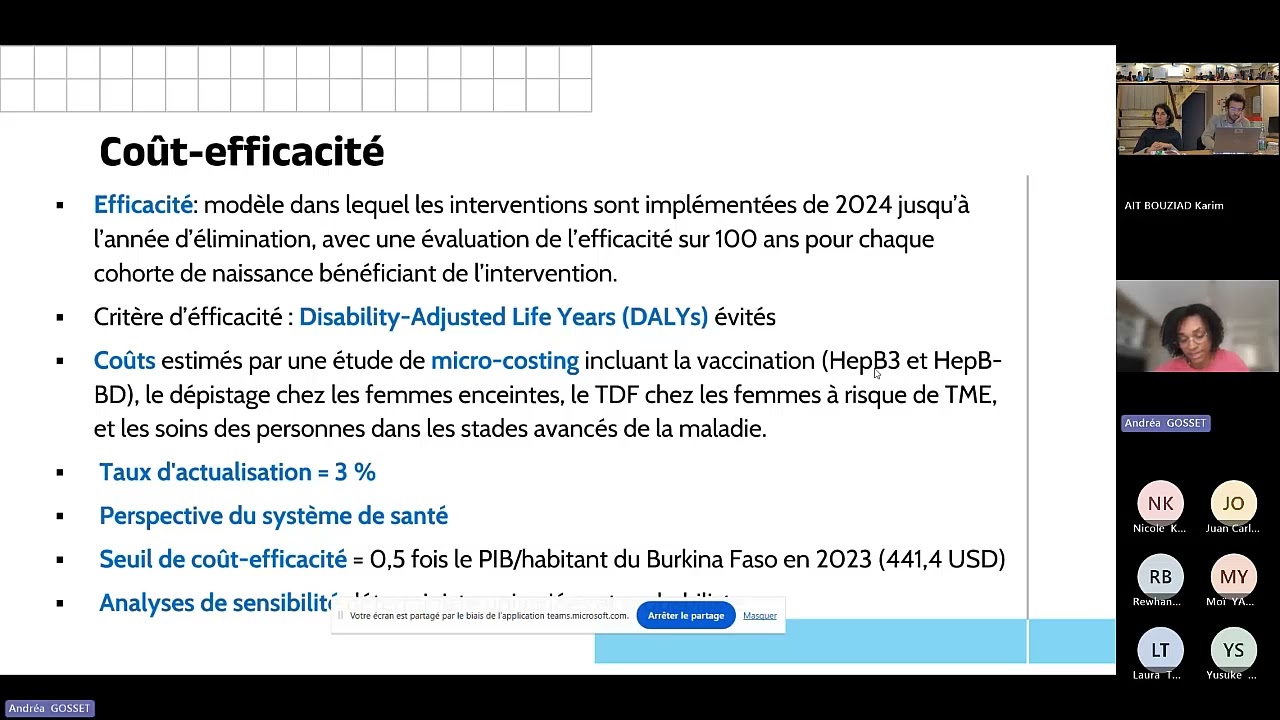
- Andréa Gosset begins her presentation on hepatitis B screening and prophylaxis in Burkina Faso.
- Discussion of the model structure and strategies for hepatitis B elimination.
- Presentation of results: elimination years and cost-effectiveness of strategies.
- Q&A session on the hepatitis B study.
- Introduction of second speaker Quentin Leclerc and his presentation on monoclonal antibodies.
- Description of the model for S. aureus infections and interventions.
- Discussion of the model's limitations and future work.
Contribution & Novelties
The seminar presents original research contributions: the hepatitis B study provides a novel cost-effectiveness analysis of decentralized screening strategies in Burkina Faso, highlighting the potential of a ‘prophylaxis for all’ approach. The S. aureus model, though preliminary, offers a framework for evaluating monoclonal antibodies in hospital settings.
Pour aller plus loin :
- WHO hepatitis B elimination targets — Official WHO information on hepatitis B and elimination goals.
- Disability-adjusted life years (DALYs) — WHO definition and methodology for DALYs.
- Monoclonal antibodies in infectious diseases — Review on monoclonal antibodies for infectious diseases.
91 words
Radar Profile
The radar profile shows high scores in quantity of information and technical level, reflecting the detailed modeling and analysis presented. Quality and reliability are slightly lower due to the lack of external references and the preliminary nature of the second study.