Séminaire de recherche PACRI - N°34 - 26.06.2026
Keywords
Summary
164 words
Critical Evaluation
Value of the Information & Strength of the Argument
The presentation provides valuable insights into the dynamics of Staphylococcus aureus in the pork production chain, particularly highlighting the amplification effect of the lairage stage. The argumentation is solid, with a clear logical flow from model development to risk estimation. The use of both MSSA and MRSA is a strength, as most studies focus on MRSA alone. The sensitivity analyses help identify key drivers of uncertainty. However, the reliance on assumed parameters and the lack of validation with current data (using 2010 prevalence for calibration) weaken the robustness of the conclusions. The presenter acknowledges these limitations, which adds to the credibility.
Scientific Rigor, Source Quality, Title Accuracy
The scientific rigor is moderate: the methodology is well-structured, but many parameters are assumed or calibrated due to data scarcity. The presenter cites literature for some parameters and conducts a meta-analysis for infection probabilities, but the sources are not explicitly listed in the video. The title accurately reflects the content, and the presentation is consistent with the seminar format. No external sources are provided in the description, limiting verifiability. The ongoing nature of the project is transparently stated.
194 words
Title / Content Match
The title accurately reflects the content: a research seminar presentation on modeling Staphylococcus aureus spread from farm to fork.
Quality & Reliability
7/10
The presentation is based on a modeling study with clear methodology, but it is an ongoing project with several parameters assumed or calibrated due to lack of data. The speaker acknowledges limitations and uncertainties.
Key Moments
Markers derived by PSI from the transcript: the creator did not define chapters.
- Introduction and context on Staphylococcus aureus, MRSA/MSSA, and the One Health approach.
- Overview of the two-stage framework: lairage transmission model and quantitative risk assessment.
- Description of the lairage model: compartments, parameters, and calibration to target prevalence.
- Results of the lairage model: amplification of MSSA and MRSA prevalence, environmental contamination.
- Sensitivity analysis of the lairage model: key drivers are transmission parameters.
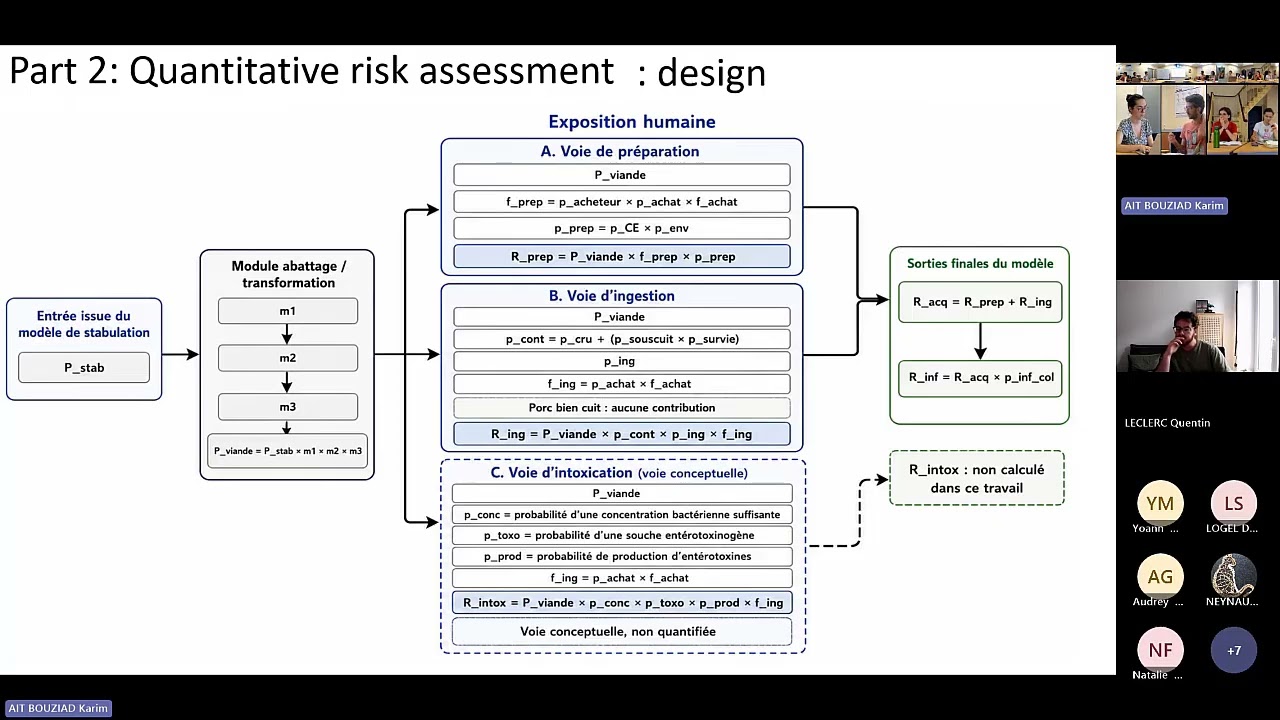
- Transition to quantitative risk assessment: pathways for acquisition, infection, and intoxication.
- Parameters for the risk assessment, including meta-analysis for infection probabilities.
- Results of the risk assessment: low annual risks, MRSA infection risk higher than MSSA.
- Sensitivity analysis of the risk assessment: M3 and acquisition probability are main drivers.
- Discussion of limitations and future work: full model, co-colonization, and data needs.
Cited Sources
- No explicit sources provided in video or description — The presenter mentions literature for parameters and a meta-analysis, but no specific references are given.
Concurring Sources
- No external sources provided — No concordant sources are available from the video or description.
Dissenting Sources
- No external sources provided — No discordant sources are available from the video or description.
Contribution & Novelties
This work provides a novel integrated modeling approach linking pre-slaughter dynamics with consumer risk assessment for both MSSA and MRSA, which is rarely done. The finding that lairage acts as an amplification step is important for food safety interventions. The risk assessment, though preliminary, suggests low consumer risk from fresh pork, which could inform public health policies.
Pour aller plus loin :
- One Health approach — Relevant for understanding the holistic perspective of the study.
- Quantitative risk assessment — Provides background on the methodology used.
- Staphylococcus aureus — Basic information on the pathogen.
93 words
Radar Profile
The radar profile shows high scores in technical level and information quality, reflecting the advanced modeling and risk assessment methods. The moderate scores in information quantity and reliability indicate the ongoing nature and data limitations. Overall, the profile suggests a technically strong but preliminary study.
💬 Sur les 0 commentaires analysés, aucune tendance n'est disponible.