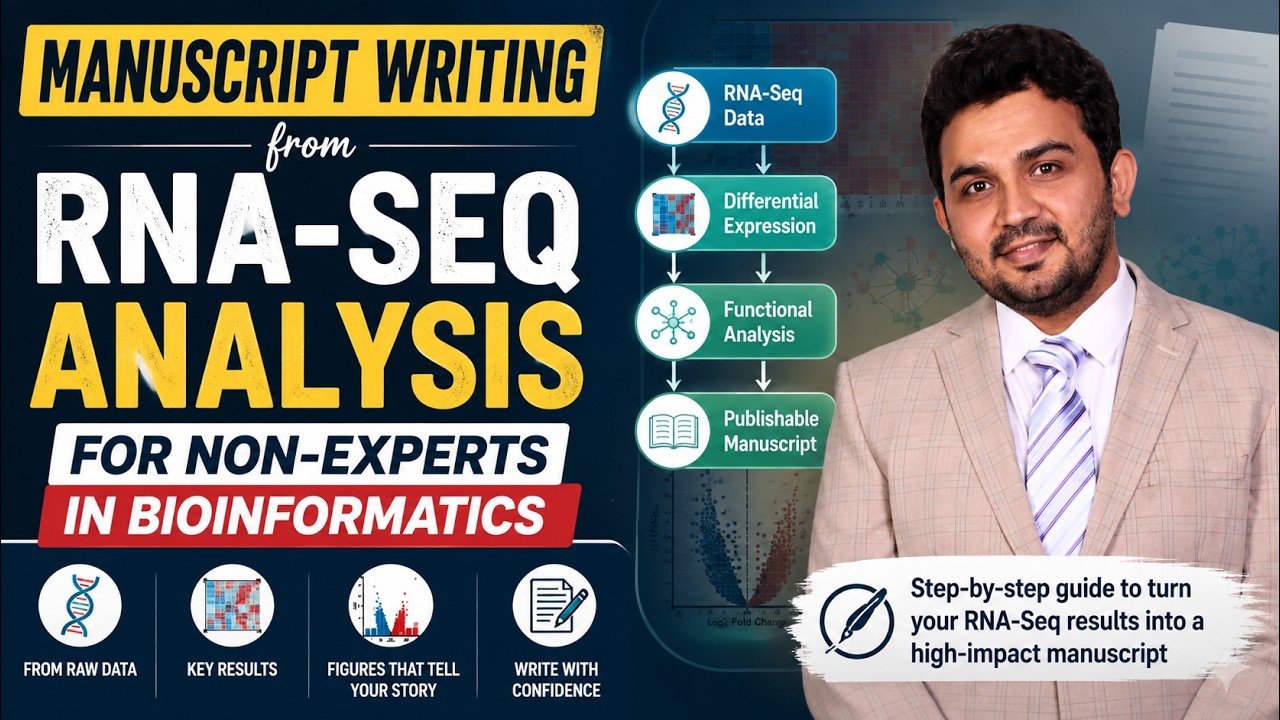
How to write RNA-Seq Results? | Complete Manuscript Writing Guide for Beginner
Keywords
Summary
166 words
Critical Evaluation
Value of the Information & Strength of the Argument
The video provides high practical value for its target audience of graduate students and researchers new to RNA-Seq. It fills a gap by focusing on the post-analysis steps, which are often neglected in other tutorials. The argumentation is solid, grounded in established bioinformatics practices and statistical principles. The presenter clearly explains concepts like normalization, FDR, and the difference between enrichment and activation, using analogies (e.g., marbles in a bag) to aid understanding. The funnel approach for candidate gene selection is a particularly valuable and well-argued strategy, as it provides a structured, defensible method. The emphasis on reproducibility and avoiding common pitfalls (e.g., whole-genome background in ORA) strengthens the tutorial’s credibility.
Scientific Rigor, Source Quality, Title Accuracy
The video demonstrates scientific rigor by consistently emphasizing statistical correctness, proper experimental design, and reproducibility. It references established tools and methods (DESeq2, edgeR, limma-voom, STRING, Cytoscape, WGCNA) and mentions key resources like Conesa et al. 2016 and the Bioconductor RNA-seq 123 workflow. However, it does not provide direct citations or URLs within the video itself, relying instead on general references. The title accurately reflects the content, which is a complete guide for beginners on writing RNA-Seq results. The video is well-structured and delivers on its promise.
211 words
Title / Content Match
The title accurately reflects the content, which is a complete guide for beginners on writing RNA-Seq results.
Quality & Reliability
8/10
The video provides a comprehensive, well-structured tutorial on writing RNA-Seq results, covering experimental design, data analysis, figure selection, and candidate gene prioritization. It emphasizes statistical rigor and reproducibility, citing established tools and methods. Minor limitations include a lack of in-depth technical detail and no explicit peer-reviewed sources beyond general references.
Key Moments
Markers derived by PSI from the transcript: the creator did not define chapters.
- Introduction: Overview of the video's purpose and structure.
- Basics of RNA-Seq: Counting RNA fragments and the concept of counts vs expression.
- Experimental design: Replicates, randomization, library type, and depth.
- Six-step analysis pipeline: QC, alignment, quantification, filtering, DE, interpretation.
- Writing the Results section: Four paragraphs structure and the golden rule.
- Common mistakes in reporting: Phrases that generate reviewer comments.
- Six essential figures: PCA, box plots, mean-variance, volcano, heatmap, enrichment.
- Interpreting volcano plots and heatmaps: Avoiding common misinterpretations.
- Funnel approach: Narrowing down candidate genes from 4000 to 5.
- Pathway analysis: ORA vs GSEA, and network analysis with STRING, Cytoscape, WGCNA.
- Validation strategies and additional analyses: Deconvolution, splicing, regulator inference.
- Final checklist and resources: Data deposition, code sharing, and recommended tools.
Cited Sources
- Conesa et al. 2016 - A survey of best practices for RNA-seq data analysis — Mentioned as a best practices survey for RNA-seq analysis.
- RNA-seq 123 workflow on Bioconductor — Mentioned as a reproducible code workflow for RNA-seq analysis.
- rnaseq.org - Griffith Lab — Mentioned as a hands-on, beginner-friendly resource for RNA-seq.
- HBC training - DESeq2 teaching material — Mentioned as openly licensed DESeq2 teaching material.
Concurring Sources
- Conesa et al. 2016 - A survey of best practices for RNA-seq data analysis — Aligns with the video's emphasis on experimental design and analysis best practices.
- RNA-seq 123 workflow on Bioconductor — Provides reproducible code for the analysis steps described in the video.
Contribution & Novelties
The video provides a practical, step-by-step guide for writing RNA-Seq results, focusing on the often-overlooked post-analysis phase. It offers a structured funnel approach to prioritize candidate genes, clear explanations of statistical concepts, and a checklist for manuscript submission. The emphasis on reproducibility and avoiding common pitfalls adds significant value for beginners.
Pour aller plus loin :
- RNA-seq data analysis best practices — Comprehensive review of RNA-seq analysis steps.
- DESeq2 documentation — Official documentation for the DESeq2 package.
- GSEA — Gene Set Enrichment Analysis tool.
- STRING database — Protein-protein interaction network tool.
- WGCNA — Weighted gene co-expression network analysis.
98 words
Radar Profile
The radar profile shows high scores in quantity of information and fiabilité globale, indicating a comprehensive and reliable tutorial. The niveau technique is moderate, reflecting its beginner-friendly approach, while the qualité information is strong, with clear explanations and practical advice.