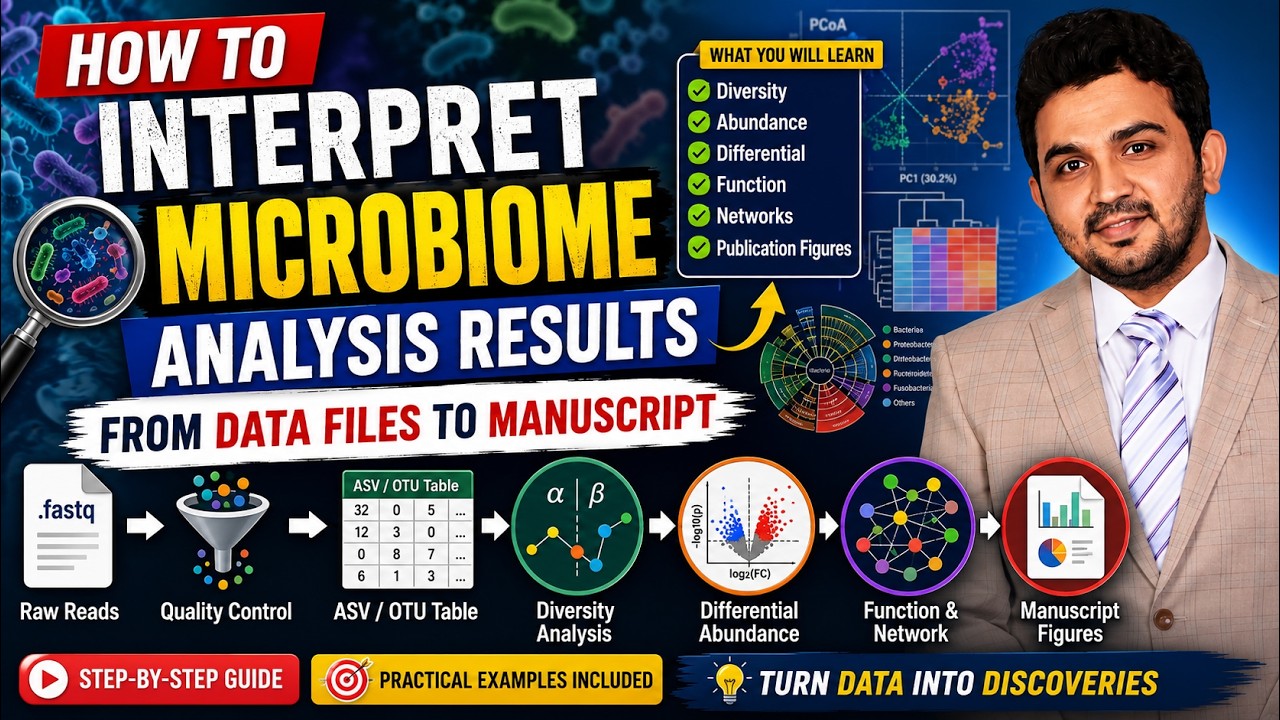
How to Read & Interpret Microbiome Results | From Data Files to Publication
Keywords
Summary
161 words
Critical Evaluation
Value of the Information & Strength of the Argument
The video provides a solid, practical overview of microbiome data interpretation, valuable for beginners and researchers preparing manuscripts. It clearly explains the purpose of each analysis step and the rationale behind choosing specific statistical tests, such as using non-parametric tests for non-normalized data and PERMANOVA for beta diversity. The argumentation is coherent and builds logically from raw data to functional insights, using examples like the Firmicutes/Bacteroidetes ratio and the link between alpha diversity and disease. However, the presentation is largely descriptive and lacks critical evaluation of methods or discussion of limitations, such as the assumptions behind PICRUSt2 predictions. The advice is practical but sometimes oversimplified, and the presenter occasionally makes broad claims without supporting citations.
Scientific Rigor, Source Quality, Title Accuracy
The video demonstrates a good understanding of standard microbiome analysis practices, but it does not cite specific scientific sources or provide references. The information is presented as the author’s expertise, which is acceptable for a tutorial but limits its scientific rigor. The title accurately reflects the content, which is a comprehensive guide to interpreting microbiome results. The video does not include any advertising or sponsored content. The description provides links to the channel but no additional resources. Overall, the scientific quality is moderate, relying on established knowledge rather than novel findings.
221 words
Title / Content Match
The title accurately reflects the content, which is a comprehensive guide to interpreting microbiome analysis results, from raw data to publication-ready figures.
Quality & Reliability
7/10
The video provides a structured, beginner-friendly overview of microbiome data interpretation, covering key concepts and common statistical tests. It is based on the author's expertise and practical experience, but lacks citations to primary literature and does not delve into advanced statistical details. The information is generally accurate and aligns with standard practices in microbiome bioinformatics.
Key Moments
Markers derived by PSI from the transcript: the creator did not define chapters.
- Introduction and overview of the tutorial's goals.
- Explanation of the seven-step microbiome analysis workflow.
- Discussion of raw FASTQ files and quality control with DADA2.
- Explanation of ASV vs OTU tables and their importance.
- Introduction to relative abundance and taxonomic composition figures.
- Explanation of alpha diversity metrics and their interpretation.
- Explanation of beta diversity and PCoA/NMDS plots.
- Discussion of differential abundance analysis (LEfSe, ANCOM, DESeq2).
- Explanation of functional prediction using PICRUSt2 and its limitations.
- Overview of co-occurrence networks and correlation heatmaps.
Contribution & Novelties
The video offers a structured, step-by-step guide to interpreting microbiome data, which is particularly useful for beginners. It consolidates common practices and provides a checklist for writing the results section. The main novelty is its pedagogical approach, breaking down complex analyses into understandable segments. However, it does not present new scientific findings or methodologies.
Pour aller plus loin :
- QIIME2 documentation — Official documentation for QIIME2, a common microbiome analysis platform.
- DADA2 paper — Original paper describing the DADA2 denoising algorithm.
- LEfSe paper — Original paper describing LEfSe for biomarker discovery.
- PICRUSt2 paper — Original paper describing PICRUSt2 for functional prediction.
- Microbiome analysis in R — R package for microbiome analysis, useful for further exploration.
115 words
Radar Profile
The radar profile shows high scores in information quantity and quality, reflecting the video's comprehensive coverage. The technical level is moderate, suitable for beginners, while reliability is good but not excellent due to lack of citations. Overall, the video is a valuable educational resource.