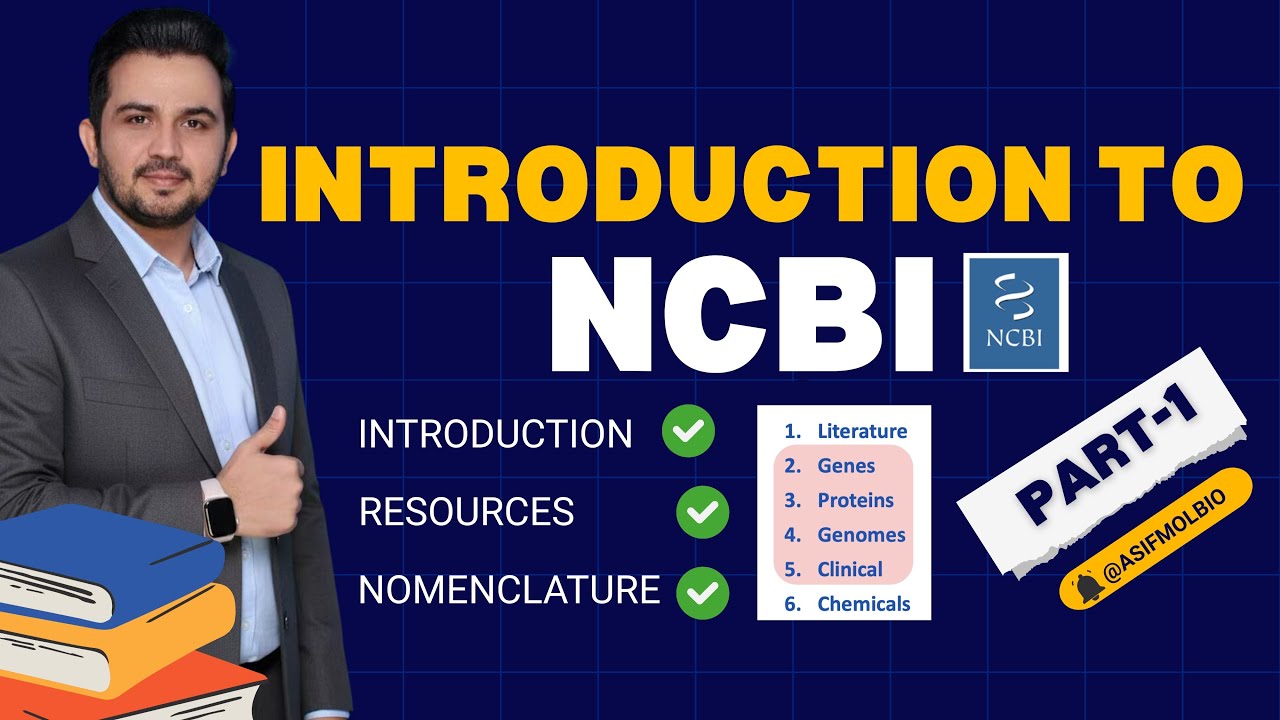
A theory and practical guide to NCBI | Genes | Proteins | Genomes | Part 1/2
Keywords
Summary
129 words
Critical Evaluation
Value of the Information & Strength of the Argument
The video provides a solid foundational overview of NCBI, making it valuable for beginners in bioinformatics. The explanation of archival versus curated databases and the accession number system is particularly useful. The argumentation is clear and logical, building from general concepts to specific examples. However, the presentation is largely descriptive and lacks critical analysis or comparison of different databases. The practical demonstrations are brief and could be more detailed, but they serve as a good starting point for hands-on exploration.
Scientific Rigor, Source Quality, Title Accuracy
The content is based on slides prepared at the University of British Columbia, which adds credibility. The presenter accurately describes NCBI’s resources and conventions. The title accurately reflects the content, as the video covers both theoretical concepts and practical usage. The video does not cite specific external sources beyond the NCBI website itself, but the information is consistent with standard bioinformatics knowledge. The lack of in-depth citations is a minor weakness, but the overall accuracy is high.
172 words
Title / Content Match
The title accurately reflects the content: a theoretical and practical guide to NCBI, focusing on genes, proteins, and genomes.
Quality & Reliability
7/10
The video provides a clear and structured introduction to NCBI, covering its databases, tools, and key concepts. The content is based on slides prepared at the University of British Columbia, lending credibility. However, the presentation is introductory and lacks depth in some areas, and the audio quality and delivery are somewhat informal.
Key Moments
Markers derived by PSI from the transcript: the creator did not define chapters.
- Introduction and acknowledgment of slides from University of British Columbia
- What is NCBI: National Center for Biotechnology Information, URL, and purpose
- Overview of NCBI homepage and main resource categories
- Introduction to INSDC collaboration (DDBJ, NCBI, ENA)
- NCBI databases: six main categories and over 40 databases
- Archival vs curated databases: redundancy and control
- GenBank: archival database, flat file format, and divisions
- RefSeq: curated database, accession number prefixes (NC, NM, NP, etc.)
- Searching genes: example with IL13 gene, gene record overview
- Proteins: searching protein sequences, viewing 3D structures
- Genomes: assemblies, download options, GFF3 and GTF formats
Cited Sources
- NCBI Homepage — The video references NCBI as the main resource and demonstrates its homepage.
- GenBank Overview — The video discusses GenBank as the archival database and its flat file format.
- RefSeq: NCBI Reference Sequence Database — The video explains RefSeq as the curated database and its accession number conventions.
Concurring Sources
- NCBI Handbook — The NCBI Handbook provides detailed information about NCBI resources, consistent with the video's content.
Contribution & Novelties
The video offers a clear and structured introduction to NCBI, particularly useful for beginners. It explains the distinction between archival and curated databases, which is often confusing. The practical examples with IL13 gene illustrate how to navigate NCBI resources. The video also introduces file formats like GFF3 and GTF, which are essential for genomic data handling.
Pour aller plus loin :
- NCBI Education — Official tutorials and training materials from NCBI.
- INSDC — The International Nucleotide Sequence Database Collaboration, which coordinates data sharing among DDBJ, ENA, and GenBank.
- FASTA format — Wikipedia article on the FASTA format, commonly used for sequence data.
- GFF3 format — Wikipedia article on the General Feature Format, used for genome annotation.
116 words
Radar Profile
The radar profile shows moderate scores across all dimensions, indicating a balanced but not exceptional video. The highest score is in 'quantite_information' and 'fiabilite_globale', reflecting the comprehensive coverage and reliable content. The 'niveau_technique' is slightly lower, as the video is introductory and does not delve into advanced topics.
💬 Sur les 0 commentaires analysés, aucune tendance n'est disponible.