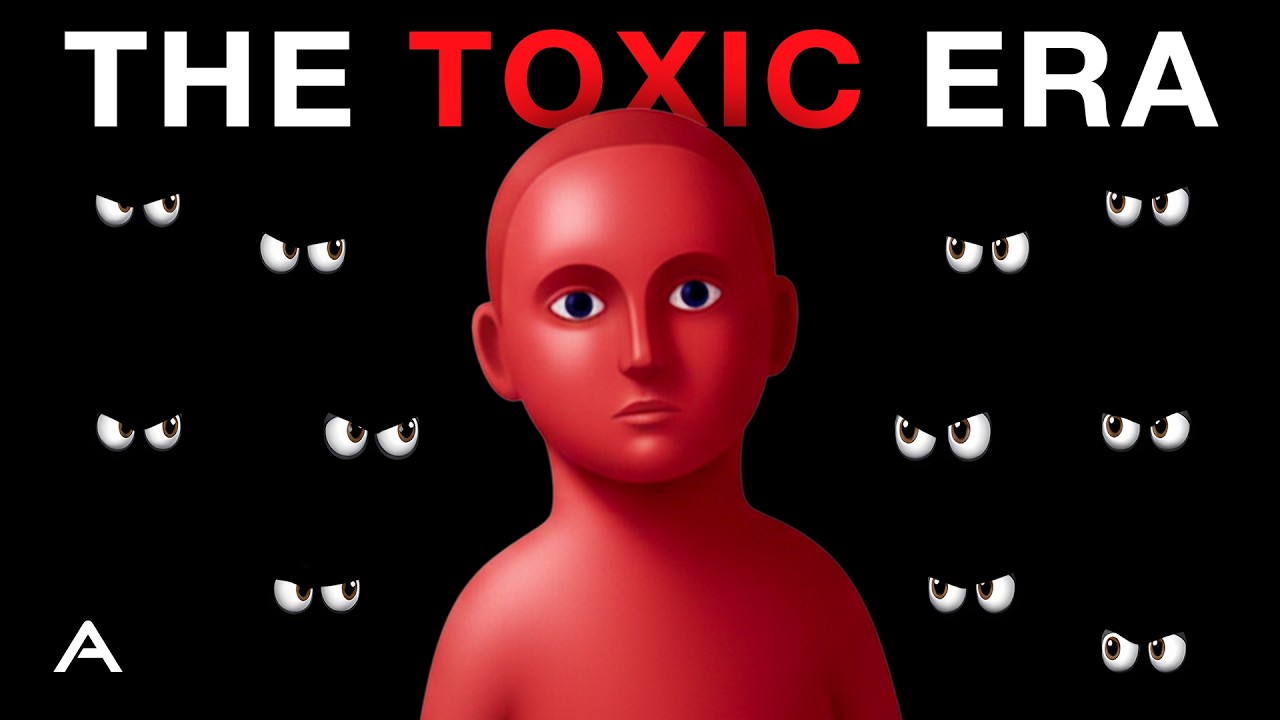
Why Society Has More Toxic People Than Ever Before
Keywords
Summary
123 words
Critical Evaluation
Value of the Information & Strength of the Argument
The video offers valuable insights into the psychological underpinnings of modern toxicity, connecting evolutionary tribalism to contemporary digital culture. It presents a compelling argument that our ancestral wiring is mismatched with the scale and speed of globalization, leading to defensive and aggressive interactions. The reasoning is generally solid, with logical progression from tribal origins to modern manifestations. However, the argumentation relies heavily on anecdotal observations and broad generalizations, lacking empirical data or academic citations. The contrast with China is thought-provoking but oversimplified, and the discussion of learned toxicity is insightful but could benefit from more concrete examples. Overall, the value lies in its accessible synthesis of psychological concepts, but the argumentation could be strengthened with more rigorous evidence.
Scientific Rigor, Source Quality, Title Accuracy
The video demonstrates moderate scientific rigor. It references psychological and sociological concepts like tribalism and status anxiety but does not cite specific studies or academic sources. The main source mentioned is Ground News, a sponsor, which is used to illustrate media bias but is not a scientific reference. The title accurately reflects the content, and the video stays on topic throughout. The lack of citations and reliance on anecdotal evidence reduce its scientific credibility, but the reasoning is coherent and well-structured. The video does not engage with counterarguments deeply, which weakens its rigor. Overall, it is more of an opinion piece than a rigorously researched analysis.
239 words
Title / Content Match
The title accurately reflects the content, which explores the psychological and societal factors behind increased toxicity in modern discourse.
Quality & Reliability
7/10
The video presents a coherent argument grounded in psychological and sociological concepts, but relies heavily on anecdotal observations and lacks rigorous empirical evidence. It references a sponsor (Ground News) for media bias, but does not cite academic sources. The reasoning is logical and thought-provoking, but the scientific rigor is moderate.
Chapters
- Why Society has more toxic people than ever before
- Humans Are Tribal By Default
- Globalization Without Psychological Adaptation
- A Societal Contrast - China
- When Beliefs Become Power
- Toxicity as a Learned Social Skill
- Why the Reasonable Disappear
- Status Anxiety In A Collapsing World
- The Death of Forgiveness
- What a Less Toxic Society Actually Requires
Cited Sources
- Ground News — Mentioned as a tool to understand media bias, with a sponsorship segment.
- Underknown Contact — Provided for questions or concerns, not a source for content.
Concurring Sources
- Social Identity Theory — Supports the idea that group membership influences behavior and perception.
- Echo Chamber (media) — Relevant to the discussion of media bias and polarization.
Dissenting Sources
- Critique of 'Toxic' Culture Claims — Some sociologists argue that perceptions of increased toxicity are subjective and not supported by longitudinal data.
Contribution & Novelties
The video synthesizes existing ideas about tribalism, social media, and identity into a coherent narrative about modern toxicity. Its original contribution lies in framing toxicity as a consequence of our tribal instincts operating at an unprecedented scale, and in contrasting Western and Chinese approaches to managing social cohesion. It also highlights the role of learned behavior in perpetuating toxicity. While not groundbreaking, it offers a fresh perspective for a general audience.
Pour aller plus loin :
- Tribalism — Provides background on the concept of tribalism in human societies.
- Social identity theory — Explains how group membership shapes self-concept and intergroup behavior.
- Echo chamber (media) — Discusses how media environments reinforce beliefs and contribute to polarization.
115 words
Radar Profile
The radar profile shows moderate scores across all dimensions, with slightly higher scores in information quantity and quality, but lower in technical level and reliability. This suggests a well-presented but not deeply technical or rigorously sourced video, suitable for a general audience.
💬 Équilibré : Sur les 30 commentaires analysés, le public exprime un mélange d'accord et de réflexion personnelle, avec des critiques légères sur la superficialité du sujet et des éloges pour la clarté de l'exposé.