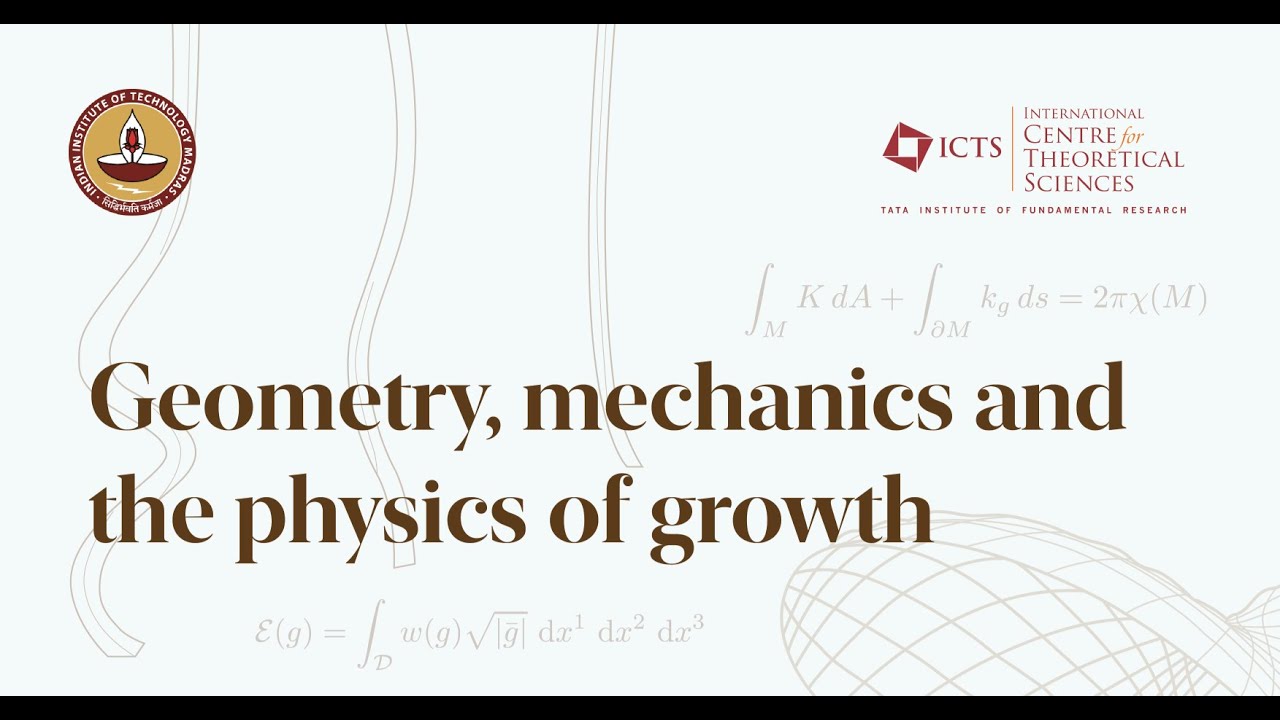
Elasticity Basics - stress, Strain, Deformation Gradient (Lecture 1)
Keywords
Summary
141 words
Critical Evaluation
Value of the Information & Strength of the Argument
The lecture provides a clear and rigorous introduction to the mathematical foundations of elasticity. The derivation of the Green-Lagrange strain tensor is well-motivated and carefully executed, highlighting the importance of considering distances to eliminate rigid-body motions. The speaker effectively explains the physical interpretation of the strain tensor, including its role in describing length and angle changes, and its diagonalization to principal strains. The argumentation is solid, building from basic definitions to more complex concepts, and the lecture is well-suited for its target audience of graduate students and researchers. The value lies in its pedagogical clarity and the emphasis on the geometric nature of deformation, which is essential for understanding more advanced topics in finite elasticity and growth.
Scientific Rigor, Source Quality, Title Accuracy
The lecture is scientifically rigorous, with a clear mathematical framework and no apparent errors. The speaker recommends several classic textbooks, including Landau and Lifshitz’s ‘Theory of Elasticity’ and ‘Elasticity and Geometry’ by Audoly and Pomeau, which are authoritative sources in the field. However, no specific research papers or external sources are cited, limiting the ability to verify claims beyond the lecture content. The title accurately reflects the content, as the lecture covers stress, strain, and deformation gradient, though the emphasis is on strain tensors. The lecture is part of a reputable program at the International Centre for Theoretical Sciences, which adds to its credibility.
236 words
Title / Content Match
The title accurately reflects the content, which covers stress, strain, and deformation gradient, though the focus is primarily on strain tensors.
Quality & Reliability
8/10
Lecture by an academic researcher, part of a scientific program at ICTS. Content is mathematically rigorous and well-structured, but no external sources are cited beyond recommended textbooks.
Key Moments
Markers derived by PSI from the transcript: the creator did not define chapters.
- Introduction and overview of the lecture goals.
- Definition of continuum solid and configurations.
- Introduction of displacement field and Lagrangian description.
- Derivation of the Green-Lagrange strain tensor.
- Discussion of strain tensor properties: symmetry, angle changes, and principal strains.
- Compatibility conditions and strain-to-displacement inversion.
- Finite elasticity and growth: use of deformation gradient.
Cited Sources
- Program: Geometry, Mechanics and the Physics of Growth — Official program page for the lecture series.
Concurring Sources
- Theory of Elasticity — Classic textbook by Landau and Lifshitz, recommended by the speaker.
- Elasticity and Geometry — Textbook by Audoly and Pomeau, recommended by the speaker.
Contribution & Novelties
The lecture provides a clear and accessible introduction to the mathematical foundations of elasticity, with a focus on the geometric nature of deformation. It bridges the gap between classical elasticity and modern applications in growth and morphogenesis. The derivation of the Green-Lagrange strain tensor is particularly well-presented, emphasizing the importance of considering distances to eliminate rigid-body motions. The lecture also highlights the role of the deformation gradient in finite elasticity, setting the stage for more advanced topics.
Pour aller plus loin :
- Green–Lagrange strain tensor — Wikipedia article on finite strain theory, including the Green-Lagrange strain tensor.
- Deformation gradient — Wikipedia article on the deformation gradient tensor.
- Continuum mechanics — Wikipedia article providing an overview of continuum mechanics.
118 words
Radar Profile
The radar profile shows high scores in quantity, quality, technical level, and reliability, indicating a well-rounded and rigorous lecture. The content is highly technical and reliable, with a strong emphasis on mathematical foundations.
💬 No comments were provided for analysis.