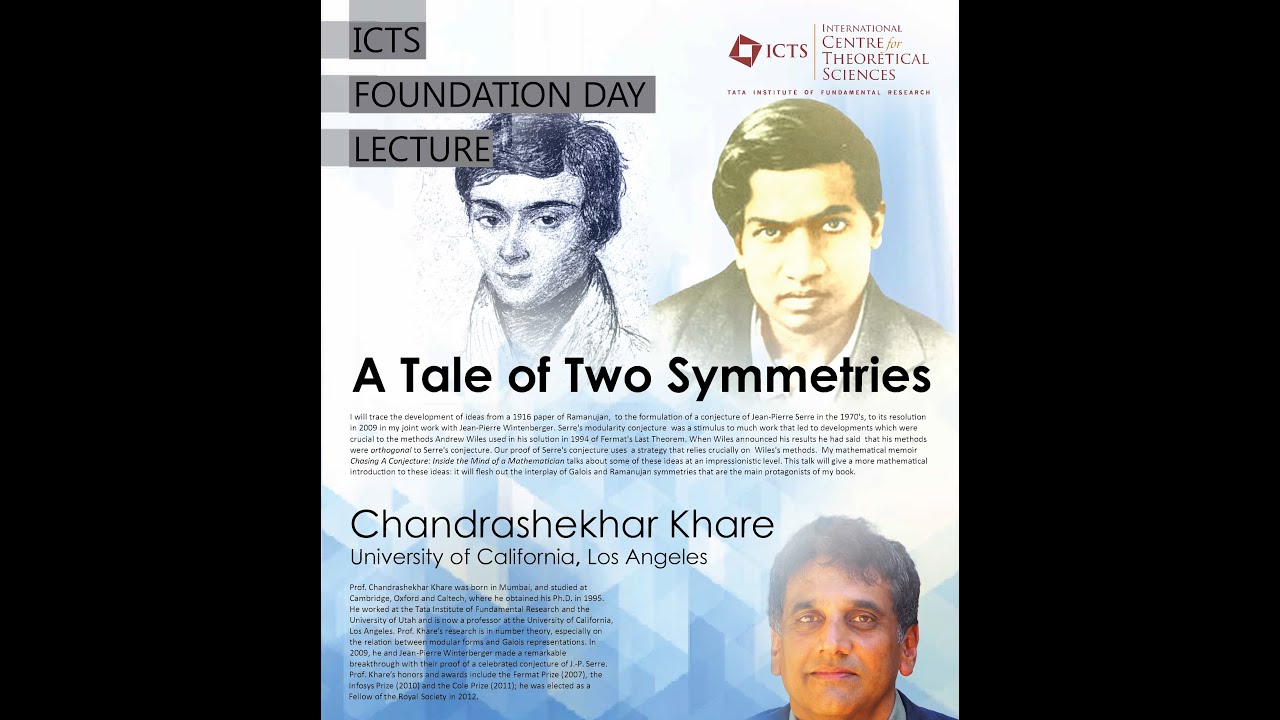
A Tale of Two Symmetries by Chandrashekhar Khare
Keywords
Summary
104 words
Critical Evaluation
Value of the Information & Strength of the Argument
The lecture provides valuable insights into the development of a major conjecture in number theory, connecting historical contributions with modern advances. Khare’s argumentation is clear and well-structured, emphasizing the conceptual interplay between different mathematical structures. He effectively conveys the significance of Serre’s conjecture and its proof, while acknowledging the broader Langlands program. The talk is persuasive in illustrating how a single conjecture can unify disparate areas of mathematics.
Scientific Rigor, Source Quality, Title Accuracy
Khare demonstrates high scientific rigor, accurately representing the mathematical content and historical context. He cites key works, including Ramanujan’s 1916 paper, Serre’s conjecture, and Wiles’ proof, and his own joint work with Wintenberger. The title accurately reflects the content, focusing on the two symmetries. The lecture is well-suited for a general scientific audience, with technical details explained intuitively.
141 words
Title / Content Match
The title accurately reflects the content: the lecture contrasts two types of symmetries (Galois and Ramanujan) and their interplay in number theory.
Quality & Reliability
9/10
Lecture by a leading number theorist (Fields Medal-level work) presenting a historical and mathematical overview of Serre's conjecture, with rigorous mathematical content and references to key works (Ramanujan 1916, Serre's conjecture, Wiles' proof). The talk is aimed at a broad audience but maintains mathematical accuracy.
Key Moments
Markers derived by PSI from the transcript: the creator did not define chapters.
- Introduction by Rajesh, welcoming Chandrashekhar Khare.
- Khare begins his lecture, introducing the two protagonists: Galois and Ramanujan.
- Introduction to Ramanujan symmetries (modular forms) and Galois symmetries (Galois representations).
- Discussion of Ramanujan's 1916 paper and the tau function.
- Explanation of modular forms and their properties.
- Introduction to Galois representations and their connection to number theory.
- Statement of Serre's conjecture and its significance.
- Discussion of the proof strategy and the role of Wiles' methods.
- Conclusion and summary of the lecture.
Cited Sources
- On some arithmetical functions (1916) — Ramanujan's paper that introduced the tau function and its properties.
- Serre's conjecture — Conjecture formulated by Jean-Pierre Serre in the 1970s, proved by Khare and Wintenberger in 2009.
- Modular forms and Galois representations — Key concepts in number theory that are central to the lecture.
Concurring Sources
- Serre's modularity conjecture — Wikipedia article confirming the conjecture and its proof.
- Modular form — Wikipedia article on modular forms, a key concept in the lecture.
- Galois representation — Wikipedia article on Galois representations, another key concept.
Contribution & Novelties
The lecture provides a unique perspective on the development of Serre’s conjecture, emphasizing the conceptual interplay between Ramanujan and Galois symmetries. It offers an accessible introduction to advanced topics in number theory, making them understandable to a broad scientific audience. The talk also highlights the historical context and the personal journey of the mathematician, adding a human dimension to the mathematical narrative.
Pour aller plus loin :
- Serre’s modularity conjecture — Overview of the conjecture and its proof.
- Modular form — Definition and properties of modular forms.
- Galois representation — Introduction to Galois representations and their role in number theory.
100 words
Radar Profile
The radar profile shows high scores in quality and reliability, with slightly lower scores in quantity and technical level, reflecting the lecture's focus on conceptual understanding rather than exhaustive technical detail.