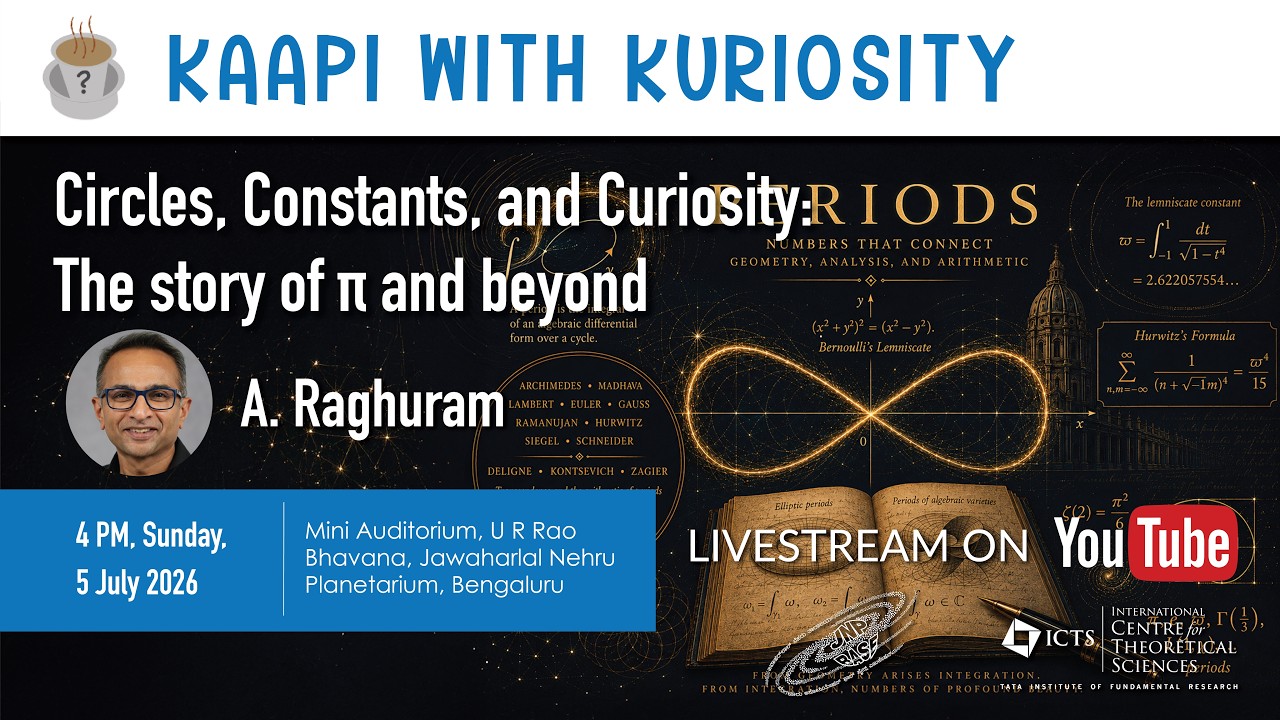
Circles, Constants, and Curiosity: The story of π and beyond
Keywords
Summary
159 words
Critical Evaluation
Value of the Information & Strength of the Argument
The talk provides valuable insights into the nature of mathematical constants, particularly π, and introduces the audience to the broader concept of periods. The argumentation is solid: the speaker builds from elementary definitions to more advanced topics, using clear examples and historical context. He explains the reasoning behind Archimedes’ approximation and the irrationality of √2, and he effectively conveys the idea that the significance of π lies in its structural properties rather than its digits. The discussion of the lemniscate constant and its connection to elliptic functions is presented in an accessible yet accurate manner, demonstrating the speaker’s expertise.
Scientific Rigor, Source Quality, Title Accuracy
The talk demonstrates scientific rigor through its accurate mathematical content and historical references. The speaker cites specific sources, including the Rhind papyrus, the works of Archimedes, and the Kerala school of mathematics. He also mentions the book ‘Pi: A Source Book’ by Berggren, Borwein, and Borwein. The title accurately reflects the content, as the talk indeed covers the story of π and extends to related constants. The presentation is well-structured, and the speaker is careful to define terms and provide context. However, as a public lecture, some historical details are presented as legends (e.g., the death of Archimedes) without explicit sourcing, but this does not undermine the overall reliability.
223 words
Title / Content Match
The title accurately reflects the content: the talk traces the story of π, its historical approximations, and extends to the concept of periods and the lemniscate constant.
Quality & Reliability
8/10
The talk is delivered by a professional mathematician (professor at Fordham University, fellow of Indian academies) and covers historical and mathematical content with accuracy. The presentation is well-structured, but as a public lecture it does not provide formal proofs for all claims, and some historical anecdotes are presented as legends.
Key Moments
Markers derived by PSI from the transcript: the creator did not define chapters.
- Introduction and pizza puzzle to motivate π
- Definition of a circle and circumference/area formulas
- Archimedes' method for approximating π using polygons
- History of π: Babylonians, Egyptians, Chinese, Indians
- Irrationality of π and √2, and the concept of countability
- Introduction to periods and the lemniscate constant
- Connection to elliptic functions and L-functions
- Conclusion and Q&A
Cited Sources
- Pi: A Source Book — Mentioned as a comprehensive resource on the number π.
Concurring Sources
- Pi: A Source Book — The book is a comprehensive reference on π, aligning with the historical and mathematical content of the talk.
Contribution & Novelties
The talk offers a fresh perspective on π by connecting it to the broader concept of periods, which are numbers arising from integrals of algebraic functions. It highlights the lemniscate constant as a striking example, showing how a simple curve leads to a deep and mysterious number. The speaker’s expertise in L-functions adds a unique angle, linking these constants to modern number theory.
Pour aller plus loin :
- Period (algebraic geometry) — Wikipedia article explaining the concept of periods.
- Lemniscate constant — Wikipedia article on the lemniscate constant and its properties.
- Elliptic integral — Wikipedia article on elliptic integrals, which are central to the lemniscate constant.
- Special values of L-functions — Wikipedia article on the topic of the speaker’s research.
120 words
Radar Profile
The radar profile shows high scores in quantity of information, quality of information, and global reliability, reflecting the speaker's expertise and the depth of content. The technical level is moderate, suitable for a general audience, which is appropriate for the outreach context.
💬 Sur les 0 commentaires analysés, aucune tendance n'est disponible.