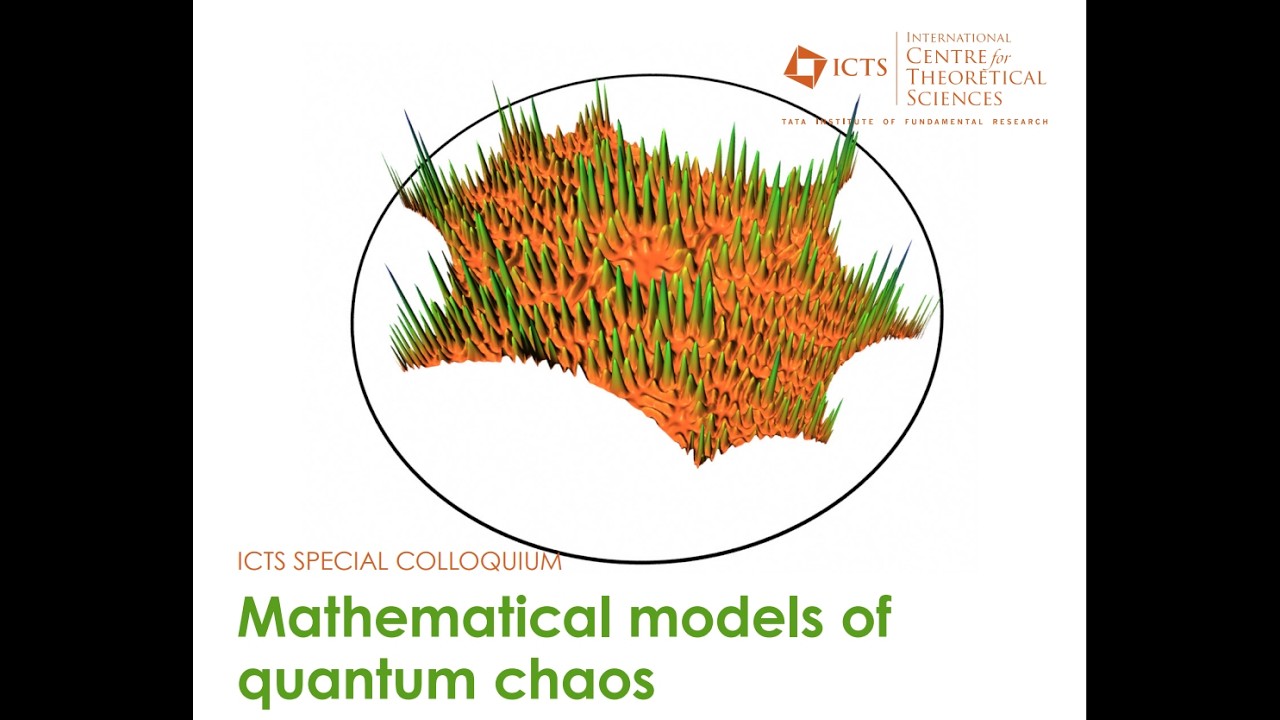
Mathematical Models of Quantum Chaos by Jens Marklof
Keywords
Summary
162 words
Critical Evaluation
Value of the Information & Strength of the Argument
The talk provides a high-value overview of the state of the art in quantum chaos, presenting both conjectures and rigorous results. The argumentation is solid, clearly distinguishing between proven theorems and open conjectures. Marklof explains the mathematical framework and the significance of each result, making the content accessible to a broad scientific audience. He effectively uses examples like the Riemann zeta zeros and the Sinai billiard to illustrate the concepts. The presentation is well-structured, moving from general statistical tests to specific models and results, and he acknowledges the limitations of current knowledge.
Scientific Rigor, Source Quality, Title Accuracy
The talk demonstrates high scientific rigor, with careful attention to hypotheses and conditions in theorems. Marklof cites key references such as Berry-Tabor (1977), Bohigas-Giannoni-Schmit (1984), Montgomery, Rudnick-Sarnak, and Oppenheim, among others. He clearly attributes results to their authors and distinguishes between numerical evidence and proofs. The title accurately reflects the content, as the talk focuses on mathematical models and rigorous results. The presentation is suitable for a scientific audience, but the speaker makes an effort to explain concepts for non-specialists.
187 words
Title / Content Match
The title accurately reflects the content: the talk focuses on mathematical models (tori, hyperbolic surfaces) for quantum chaos, discussing energy level statistics and conjectures.
Quality & Reliability
9/10
Talk by a leading mathematician (President of LMS, Fellow of Royal Society) presenting rigorous mathematical results and conjectures in quantum chaos, with clear distinction between proven theorems and open problems.
Key Moments
Markers derived by PSI from the transcript: the creator did not define chapters.
- Introduction: Heisenberg uncertainty principle and the challenge of defining chaos in quantum mechanics.
- Introduction to energy level statistics and statistical tests for pseudo-random sequences.
- Example of Riemann zeta zeros: Montgomery's conjecture and numerical evidence for GUE statistics.
- Discussion of random matrix theory in nuclear physics and quantum billiards.
- Berry-Tabor conjecture for integrable systems and Bohigas-Giannoni-Schmit conjecture for chaotic systems.
- Introduction to the Laplacian on flat tori and the problem of level statistics.
- Results on Poisson statistics for two-point correlations on tori, including recent work with Kim and Welch.
- Connection to the quantitative Oppenheim conjecture and Diophantine conditions.
- Discussion of hyperbolic surfaces and recent evidence for random matrix statistics in high genus.
- Open problems and future directions.
Cited Sources
- Berry, M. V., & Tabor, M. (1977). Level clustering in the regular spectrum. Proceedings of the Royal Society of London A, 356(1685), 375-394. — Conjecture that integrable systems have Poisson level statistics.
- Bohigas, O., Giannoni, M. J., & Schmit, C. (1984). Characterization of chaotic quantum spectra and universality of level fluctuation laws. Physical Review Letters, 52(1), 1-4. — Conjecture that chaotic systems have random matrix statistics.
- Montgomery, H. L. (1973). The pair correlation of zeros of the zeta function. Analytic number theory, 24, 181-193. — Conjecture on pair correlation of Riemann zeros.
- Rudnick, Z., & Sarnak, P. (1996). The pair correlation function of fractional parts of polynomials. Communications in Mathematical Physics, 178(1), 145-166. — Rigorous results on pair correlation for restricted test functions.
- Oppenheim, A. (1929). On an arithmetic function. Journal of the London Mathematical Society, 1(3), 205-211. — Original conjecture on values of indefinite quadratic forms.
- Margulis, G. A. (1987). Formes quadratiques indéfinies et flots unipotents sur les espaces homogènes. Comptes Rendus de l'Académie des Sciences, 304, 249-253. — Proof of Oppenheim conjecture using ergodic theory.
- Marklof, J. (2003). Pair correlation densities of inhomogeneous quadratic forms. Annals of Mathematics, 158(2), 419-471. — Result on Poisson statistics for tori with flux.
- Sarnak, P. (1997). Values of indefinite quadratic forms. International Mathematics Research Notices, 1997(4), 165-193. — Result on Poisson statistics for generic lattices.
- Eskin, A., Margulis, G., & Mozes, S. (2005). Quadratic forms of signature (2,2) and eigenvalue spacings on rectangular 2-tori. Annals of Mathematics, 161(2), 679-725. — Proof of Poisson statistics for rectangular tori under Diophantine conditions.
Concurring Sources
- Berry, M. V., & Tabor, M. (1977). Level clustering in the regular spectrum. Proceedings of the Royal Society of London A, 356(1685), 375-394. — Conjecture that integrable systems have Poisson level statistics.
- Bohigas, O., Giannoni, M. J., & Schmit, C. (1984). Characterization of chaotic quantum spectra and universality of level fluctuation laws. Physical Review Letters, 52(1), 1-4. — Conjecture that chaotic systems have random matrix statistics.
Contribution & Novelties
The talk presents recent rigorous results on the Berry-Tabor conjecture for flat tori, including a new three-dimensional example with explicit Diophantine conditions, and discusses recent evidence for random matrix statistics on hyperbolic surfaces in the high genus limit. It highlights the connection to the quantitative Oppenheim conjecture and the role of ergodic theory.
Pour aller plus loin :
- Quantum chaos — Overview of the field.
- Random matrix — Mathematical background.
- Oppenheim conjecture — Historical context and proof.
- Riemann zeta function — For the zeros and Montgomery’s conjecture.
- Berry–Tabor conjecture — Specific conjecture discussed.
93 words
Radar Profile
The radar profile shows high scores in information quality, technical level, and reliability, with slightly lower scores in information quantity and technical level. This indicates a dense, rigorous talk with substantial content, but requiring some mathematical background to fully appreciate.