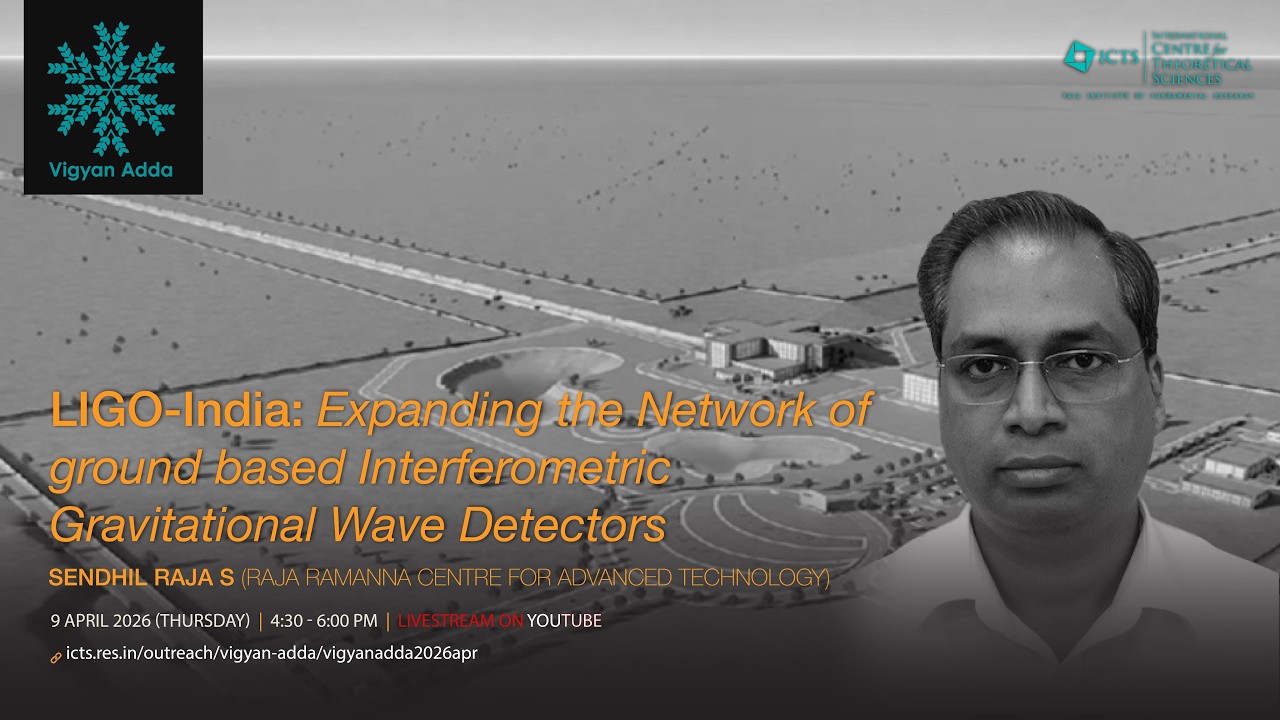
LIGO-India: Expanding the Network of ground based Interferometric Gravitational Wave Detectors
Keywords
Summary
155 words
Critical Evaluation
Value of the Information & Strength of the Argument
The talk provides valuable insights into the engineering and physics behind gravitational wave detectors, explaining complex concepts in an accessible manner. The argumentation is solid, building from fundamental principles to the specific design choices of LIGO. The speaker effectively justifies the need for long arm lengths, high laser power, and advanced optical techniques to achieve the required sensitivity. The discussion of the LIGO-India project adds practical context and demonstrates the ongoing expansion of the global detector network. The presentation is well-structured and logically coherent, making it a valuable resource for understanding the state of the art in gravitational wave astronomy.
Scientific Rigor, Source Quality, Title Accuracy
The scientific rigor is high, as the speaker is an expert directly involved in the project. The content aligns with established knowledge in gravitational wave physics. The talk does not cite specific sources, but it references well-known concepts and the Hulse-Taylor pulsar. The title accurately reflects the content, which covers both the general principles and the specific project. The talk is a science communication lecture, not a peer-reviewed presentation, but it is reliable and up-to-date. No comments were provided for analysis.
196 words
Title / Content Match
The title accurately reflects the content, which covers both the general principles of gravitational wave detection and the specific LIGO-India project.
Quality & Reliability
8/10
The talk is given by an expert directly involved in the LIGO-India project, with a strong background in optical instrumentation. The content is technically accurate, well-structured, and includes specific details about detector design and sensitivity. The presentation is a science communication talk, not a peer-reviewed study, but the information is reliable and up-to-date.
Key Moments
Markers derived by PSI from the transcript: the creator did not define chapters.
- Introduction and overview of the talk's structure.
- Explanation of gravitational waves and their sources.
- Discussion of the gravitational wave spectrum and detector sensitivity.
- Indirect detection via the Hulse-Taylor pulsar.
- Introduction to interferometric detection and the Michelson interferometer.
- Explanation of power recycling and Fabry-Pérot cavities.
- Signal recycling and achieving required sensitivity.
- Overview of LIGO detectors and their locations.
- Introduction to LIGO-India project and its status.
- Technological challenges and benefits of LIGO-India.
Cited Sources
- LIGO-India Project — Official website of the LIGO-India project, mentioned as the main topic of the talk.
- LIGO Scientific Collaboration — The collaboration that the speaker is part of, mentioned in the context of the Breakthrough Prize.
Concurring Sources
- LIGO Scientific Collaboration — The collaboration's official site provides information consistent with the talk's content.
Contribution & Novelties
The talk provides a comprehensive overview of gravitational wave detection, with a focus on the LIGO-India project. It explains the technical innovations that enable the detection of tiny strains, such as power recycling and Fabry-Pérot cavities, and discusses the engineering challenges. The talk is valuable for its clear explanation of the principles and its update on the LIGO-India project.
Pour aller plus loin :
- LIGO-India official website — Official project information and updates.
- LIGO Scientific Collaboration — Collaboration details and publications.
- Gravitational wave on Wikipedia — General overview of gravitational waves.
- Hulse-Taylor pulsar on Wikipedia — Details on the indirect detection.
101 words
Radar Profile
The radar profile shows high scores in all dimensions, indicating a well-rounded and reliable presentation. The talk is technically strong, provides substantial information, and is highly reliable due to the speaker's expertise. The only slight weakness is the level of technical depth, which is moderate, but this is appropriate for the target audience.