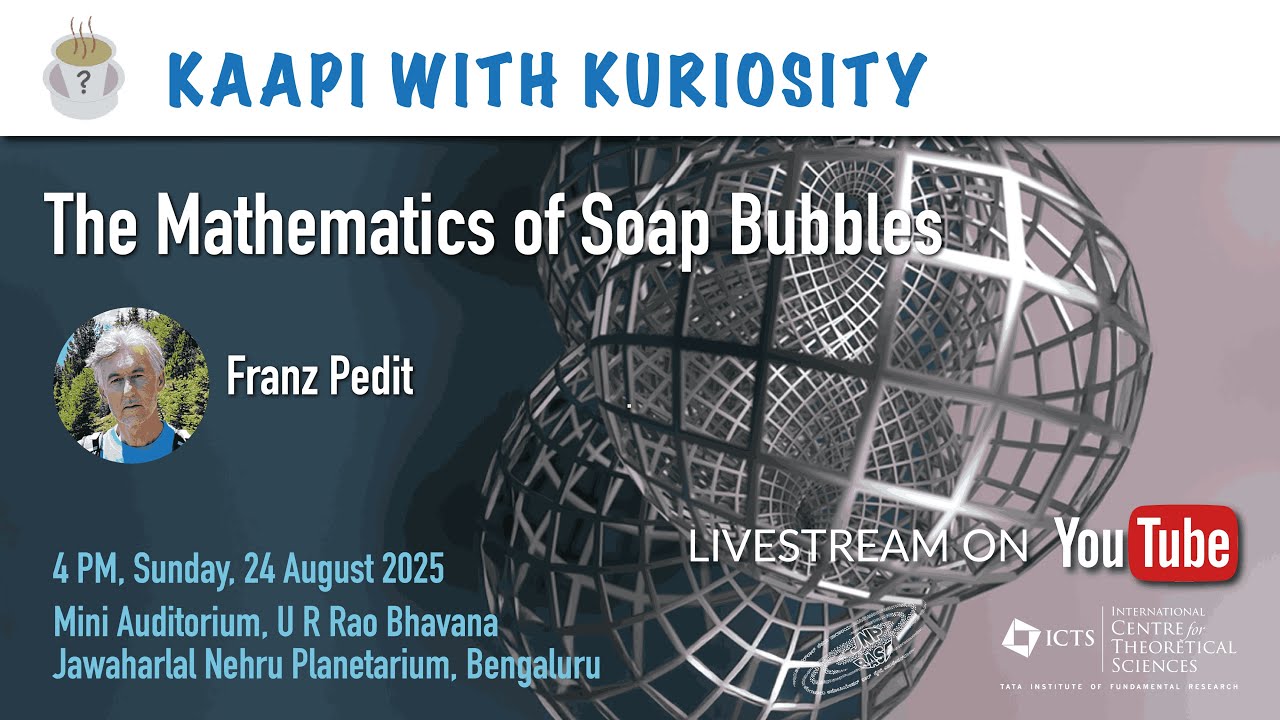
The Mathematics of Soap Bubbles
Keywords
Summary
146 words
Critical Evaluation
Value of the Information & Strength of the Argument
The talk provides substantial value by presenting the mathematical theory of minimal surfaces in an accessible yet rigorous manner. Pedit’s argumentation is solid: he starts with empirical observations of soap films, introduces the variational principle of area minimization, and then connects it to historical developments and modern research. He uses live demonstrations and visual aids to support his claims, making the abstract concepts tangible. The logical progression from simple examples (disk, catenoid) to more complex ones (helicoid, deformation) builds a coherent narrative. Pedit also addresses potential questions, such as why the catenoid pops when pulled too far, explaining it through the competition between the catenoid and two disks. The inclusion of Atiyah’s poem and references to art and architecture enriches the argumentation, showing the cultural and aesthetic dimensions of mathematics.
Scientific Rigor, Source Quality, Title Accuracy
The scientific rigor is high: Pedit, a professor of mathematics, accurately presents the historical facts and mathematical results. He correctly attributes the Plateau problem and its solution by Douglas, and mentions the Fields Medal. The sources cited are primarily historical and mathematical, though no specific papers are referenced in the talk. The title ‘The Mathematics of Soap Bubbles’ is apt, as the lecture focuses on the mathematical principles underlying soap bubbles and minimal surfaces. The content is well-structured and the demonstrations, though sometimes imperfect, are used effectively to illustrate concepts. The talk is aimed at a general audience, but it does not compromise on mathematical correctness. The only minor issue is the lack of explicit citations for further reading, but this is typical for a public lecture.
272 words
Title / Content Match
The title accurately reflects the content, focusing on the mathematical principles behind soap bubbles and minimal surfaces.
Quality & Reliability
9/10
Talk by a renowned mathematician, rigorous mathematical content, historical references accurate, and clear explanations.
Key Moments
Markers derived by PSI from the transcript: the creator did not define chapters.
- Introduction and Atiyah's poem on mathematics.
- Historical context: soap bubbles in art and architecture.
- Lagrange's problem and the concept of surface tension.
- Plateau's problem and Douglas's solution.
- Live demonstration of soap film on a square frame.
- Discussion of the disk as the minimal surface for a circle.
- Catenoid between two circles and its popping behavior.
- Helicoid and its deformation into the catenoid.
- Connection to harmonic maps and ongoing research.
Cited Sources
- Michael Atiyah's poem — Quoted at the beginning to illustrate the nature of mathematics.
- Lagrange's problem — Historical problem about minimal surfaces.
- Plateau's problem — Formulated by Joseph Plateau, solved by Jesse Douglas.
- Jesse Douglas and Fields Medal — Douglas received the first Fields Medal for solving Plateau's problem.
Concurring Sources
- Minimal surface — Confirms the definition and examples of minimal surfaces.
- Plateau's problem — Historical and mathematical details on the problem.
- Catenoid — Describes the catenoid and its properties.
- Helicoid — Describes the helicoid and its relation to the catenoid.
Contribution & Novelties
The talk provides an accessible introduction to minimal surfaces, connecting classical problems to modern research. It highlights the historical development and the aesthetic appeal of mathematics. The live demonstrations and visualizations make abstract concepts tangible.
Pour aller plus loin :
- Minimal surface — Overview of minimal surfaces and their properties.
- Plateau’s problem — Detailed history and mathematical formulation.
- Catenoid — The minimal surface between two circles.
- Helicoid — The minimal surface generated by a helix.
- Harmonic maps — Related concept in geometric analysis, relevant to Pedit’s research.
87 words
Radar Profile
The radar profile shows high scores across all dimensions, indicating a well-rounded and reliable presentation. The talk excels in information quantity and quality, with a strong technical level and high reliability, making it an excellent resource for understanding minimal surfaces.